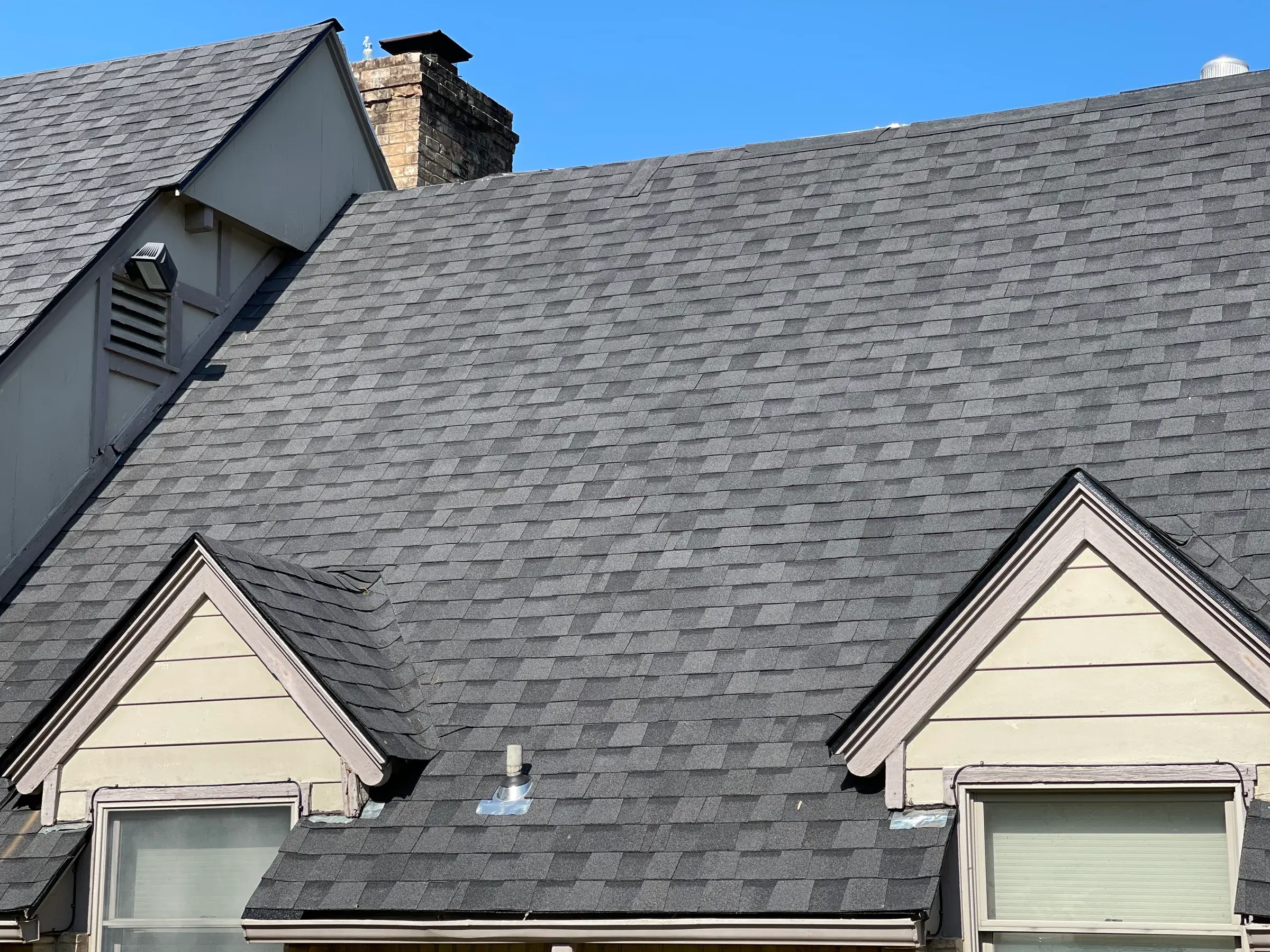
Most skylight leaks come from failed flashing, an inadequate curb, or a sealant-dependent installation — not the glass itself. Insulated glass units can also fail internally, and condensation on the interior frame is frequently mistaken for a leak. Skylights are cheapest to replace during a full tear-off, when the flashing kit can be integrated with new underlayment.
The three families: deck-mounted, curb-mounted, and tubular daylighting devices
Almost every residential skylight belongs to one of three families. Knowing which one is in your ceiling changes the entire repair conversation, because each family fails in a different place.
A deck-mounted skylight sits low, right on the roof deck. The frame and the flashing kit are engineered together as a system, and the flashing tucks under and over the shingles in a set order. A curb-mounted skylight sits on top of a wood box — the curb — that is framed up off the deck like a short chimney. The unit drops onto the curb and the flashing wraps the curb, not the unit. A tubular daylighting device (a TDD, sometimes called a sun tunnel) is a different animal entirely: a small dome on the roof, a reflective tube running down through the attic, and a flat diffuser lens in the ceiling. No view, no framing changes, just light.
In Ottawa County housing stock, all three show up. Detached single-family homes make up 76.7% of local housing units according to the U.S. Census Bureau's American Community Survey, and a lot of those homes have had additions, bathroom remodels, and hallway daylighting projects layered on over decades. The curb-mounted units tend to be the older or site-built ones. The tubular units tend to be the newest.
| Type | How it mounts | Where it's typical | Flashing approach | Relative cost |
|---|---|---|---|---|
| Deck-mounted | Frame fastened directly to the roof deck around the opening; low profile | Newer installs, main living spaces, anywhere a slim exterior look matters | Manufacturer flashing kit specific to the unit and the roof covering; integrates with underlayment | Moderate unit cost, moderate labor |
| Curb-mounted | Unit sets on a wood curb framed up off the deck | Older homes, site-built openings, low-slope sections, retrofits over an existing curb | Apron, step, and head flashing wrap the curb; unit is separate from the flashing | Unit can be cheaper; curb carpentry and flashing add labor |
| Tubular (TDD) | Roof dome plus a reflective tube through the attic to a ceiling diffuser | Hallways, closets, interior bathrooms, rooms with no exterior wall | Small one-piece flashing base, self-contained; far less roof surface interrupted | Lowest of the three in both unit and labor |
Fixed vs. venting vs. manual vs. motorized: what each adds and what each can break
A fixed skylight is sealed shut. It has no hinge, no gasket to compress, no motor, no wiring. It is the least likely of any unit to give you trouble, and if you only want light, it is the honest choice.
A venting skylight opens. That is genuinely useful in a market that the Oklahoma Climatological Survey's 1991–2020 normals put at 57 days a year above 90°F, with an August daily-high normal of 91.5°F. Hot air leaves at the highest point in the room, and a bathroom clears faster. But every opening unit adds parts that wear: a hinge, a perimeter gasket, a latch or crank, and a drainage channel in the sash that can silt up with grit and pollen.
Manual and motorized units
A manual venting unit opens with a crank or a pole hook. Fewer parts, nothing to lose power. A motorized unit — line-voltage or solar — opens on a switch or remote and usually carries a rain sensor that closes it automatically when the sensor gets wet. Rain sensors are a real convenience, but treat them as a convenience and not a guarantee. They react to water hitting the sensor, and a sudden hard blow of wind-driven rain arrives before the unit finishes closing.
The practical point: when a venting unit "leaks," check first whether it was actually closed and latched, and whether the gasket has taken a compression set. A gasket that has gone flat and shiny where it should be soft is a gasket that is no longer sealing.
Glazing: laminated vs. tempered, insulated glass units, and impact considerations
The glass in a modern skylight is not one pane. It is an insulated glass unit — an IGU — which is two lites of glass separated by a spacer, with a sealed cavity of dry air or argon between them. The spacer holds a desiccant that keeps that cavity dry. Everything about how an IGU fails traces back to that edge seal.
The two lites are usually not the same. The outboard lite facing the sky is typically tempered, which means it is heat-treated to be stronger and to break into blunt pebbles rather than shards. The inboard lite facing your living room is typically laminated: two thin sheets of glass bonded to a plastic interlayer, so that if it breaks, the interlayer holds the pieces in place instead of dropping them on the floor. Sloped glazing over occupied space is governed by the skylight and sloped-glazing section of the residential code — R308.6 in recent IRC editions — and the requirements for the inboard lite are the reason that section exists. Section numbering does shift between editions, so confirm the specific requirement against the current Oklahoma residential code rather than against whatever a manufacturer brochure printed years ago.
On performance, the unit-level standard is AAMA/WDMA/CSA 101/I.S.2/A440, which is what manufacturers certify skylights against for structural load, air leakage, and water penetration. The water-penetration side of that testing leans on ASTM methods — E547 for cyclic static pressure and E2140 for continuous water on the glazing. If you want to know how a unit was proven watertight, those are the test names to look for on the spec sheet. For energy numbers, U-factor and SHGC, the U.S. Department of Energy's ENERGY STAR skylight criteria are the reference point, and skylights have their own criteria separate from windows because a skylight faces the sky.
| Glazing | What it is | Typical role | Failure mode | What you'd see |
|---|---|---|---|---|
| Tempered glass | Heat-treated for strength; breaks into small blunt pebbles | Usually the outboard (sky-facing) lite | Impact fracture; rare spontaneous breakage from inclusions | The whole lite crazes into pebbles at once, all over |
| Laminated glass | Two glass sheets bonded to a plastic interlayer | Usually the inboard (room-facing) lite over occupied space | Cracks but stays in the opening; interlayer can haze at edges over time | A crack line you can see but nothing falls; edge cloudiness |
| Insulated glass unit (IGU) | Two lites with a sealed, desiccant-dried cavity between | The assembly in nearly every modern glass skylight | Edge seal fails, moisture enters the cavity, desiccant saturates | Permanent fog or streaks BETWEEN the panes that you cannot wipe off either side |
| Acrylic or polycarbonate dome | Molded plastic, single or double wall | Older curb-mounted units and most tubular domes | UV degradation, yellowing, crazing, embrittlement, then impact cracking | Amber tint, a network of fine surface cracks, brittle edges, chips at fasteners |
Condensation vs. leak: how to tell them apart before you call anyone
This is the single most useful thing on this page. A skylight that drips is not automatically leaking. Water gets into a room around a skylight in three completely different ways, and they call for three completely different responses.
Condensation forms when warm, humid indoor air touches a cold surface. A skylight is the coldest surface in most ceilings, and the Oklahoma Climatological Survey's normals put Miami at 89 nights a year below freezing. On those nights, the glass and the metal frame get cold enough to pull moisture straight out of the air in your house. A shower running, a pot boiling, a bathroom fan that dumps into the attic instead of outside — any of those loads the air. The water then runs down the glass, collects in the frame track, and eventually spills over onto the shaft. It looks exactly like a leak. It is not one, and no amount of caulk on the roof will fix it.
A true leak follows the rain. It starts during or shortly after a storm and stops when things dry out. And an IGU seal failure is neither — the water is sealed inside the glass unit itself and never touches your ceiling at all.
| What you're seeing | Condensation or leak? | Likely source | Next step |
|---|---|---|---|
| Beads or a film on the interior frame and glass on a cold morning, no rain in 24 hours | Condensation | Indoor humidity meeting cold glazing; often a bath fan venting into the attic | Run the bath fan longer, confirm it exhausts outside, check attic ventilation before touching the roof |
| Drips only during rain, stops within hours of the rain stopping | Leak | Flashing laps, head flashing, or the curb | Interior and attic observation, then a roof inspection |
| Drips only in hard wind-driven rain, never in steady vertical rain | Leak | Water driven up under a flashing lap or a sealant-dependent joint | Roof inspection focused on the head and side flashing |
| Fog, streaks, or mineral haze BETWEEN the panes that won't wipe off from either side | Neither — IGU seal failure | Failed edge seal; desiccant saturated | Glass or unit replacement. Do not let anyone open the flashing for this |
| Stain on the shaft drywall a foot or more below the skylight, dry to the touch, grows slowly over a season | Usually condensation, sometimes an old slow leak | Uninsulated or poorly air-sealed shaft, or a long-running head-flashing leak | Attic inspection of the shaft exterior and the flashing above it |
| Water at the bottom corners of the shaft after a snow or ice melt, not during rain | Usually ice-related or condensation | Meltwater backing up at the head of the unit, or warm air leaking into a cold shaft | Attic inspection during or right after the thaw; do not go on the roof |
| Water visibly inside the sash channel of a venting unit | Neither, if the drain is blocked | Sash weep channel silted with grit, pollen, or tree debris | Clear the channel from inside; verify the unit latches fully closed |
Why old skylights leak: flashing kits, curb height, sealant-dependent installs, and IGU seal failure
Four causes account for most of what we find, and only one of them involves the glass.
The flashing kit was wrong, missing, or improvised
A deck-mounted skylight is a system. The manufacturer's published installation instructions pair a specific unit with a specific flashing kit and a specific order of assembly. When a skylight is reused on a new roof, or when a unit from one maker gets a kit from another, or when someone builds the flashing out of coil stock on the tailgate, the layering logic breaks. Water only has to find one lap running the wrong way.
The curb is too short or was never counterflashed
On curb-mounted units, the curb has to be tall enough that the flashing rides well above the water running down the roof, and the unit's own flange has to counterflash the top of that curb so water is shed outward. The NRCA Roofing Manual's skylight and curb details show that relationship clearly. Site-built curbs are the usual offender — framed a couple of inches proud of the deck, flashed as an afterthought, and asked to survive 30 years of runoff.
The install depends on sealant to stay dry
This is the big one. Flashing is supposed to work because of geometry — because each piece overlaps the one below it and gravity does the rest. Sealant is a supplement, not a system. But a lot of skylights, especially ones that were retrofitted into an existing roof without lifting shingles, are dry only because someone ran a bead of caulk. Caulk has a service life, and under Miami's UV load it is a short one. When you see a skylight ringed in black roof cement, you are not looking at a repair. You are looking at a countdown.
The glass unit failed internally
IGU seal failure has nothing to do with your roof. Every day the sun heats that sealed cavity, the air expands and pushes on the edge seal; every night it contracts and pulls. Do that a few thousand times and the seal eventually breathes. Once it does, humid air enters, the desiccant saturates, and you get permanent fog. The unit still keeps rain out. It just no longer performs, and it looks bad from the couch.
The plastic-dome problem: UV degradation, crazing, and why domes yellow
Acrylic and polycarbonate domes were everywhere on 1970s and 1980s roofs, and a lot of them are still up there. They do not age gracefully. Ultraviolet light slowly breaks the polymer chains at the surface. The dome goes amber, then develops crazing — a spiderweb of fine surface cracks that scatters light and turns a bright room dim and yellow. Underneath the cosmetics, the plastic is getting brittle.
That brittleness is what matters here. The Oklahoma Climatological Survey's normals give Miami 4 to 5 days a year with hail larger than three-quarters of an inch. A new, flexible dome absorbs a hit like that. A 25-year-old crazed dome does not — it shatters or punches through, and now you have an open hole. Add 89 freezing nights a year, because cold plastic is stiffer plastic, and a January hit is harder on a dome than a June one.
There is no repair for a crazed dome. Replacement is the whole menu. The good news is that a tubular unit or a small modern glass unit will usually drop into the same footprint, and you get back the light you have been losing a little at a time for two decades.
Flashing kits and step flashing: matching the kit to the roof covering
Step flashing is the L-shaped metal that ties a roof plane into a vertical surface. One piece per shingle course, each one bent over the corner, each one lapped by the shingle above it. Around a skylight, step flashing runs up both sides. At the bottom there's an apron or base flashing that lays over the shingles. At the top there's a head flashing or saddle that goes under the shingles. That sequence is not stylistic. It is the whole reason the assembly works.
Flashing kits are also covering-specific. A low-profile kit for asphalt shingles will not work on a standing-seam metal roof or a profiled covering, and vice versa. The kit has to match both the unit and what the roof is made of.
| Order | Component | What it does | Common failure |
|---|---|---|---|
| 1 | Underlayment turned up the curb | First water barrier; wraps the opening before any metal goes on | Cut short, not turned up, or omitted entirely on a retrofit |
| 2 | Apron (base) flashing at the downslope side | Lays OVER the shingles below so water sheds onto the roof | Set under the shingles by mistake, which funnels water into the opening |
| 3 | Step flashing up both sides, woven course by course | Each piece lapped by the shingle above; carries water past the curb | One long piece of bent metal substituted for individual steps, then caulked |
| 4 | Head flashing / saddle at the upslope side | Goes UNDER the shingles above so water from up the roof passes over it | Too short, no end dams, or relying on sealant instead of a lap |
| 5 | Counterflashing from the unit's own flange | Covers the top edge of the step and head flashing, sheds water outward | Missing on site-built curbs; unit flange sits flat and lets water behind |
| 6 | Sealant at terminations only | A supplement at end laps and fastener heads | Used as the primary barrier — the single most common cause of a skylight leak |
Shafts and light wells: the hidden place moisture shows up
Unless the skylight is in a vaulted ceiling, there's a shaft — a boxed tunnel from the roof deck down through the attic to the ceiling opening. Nobody thinks about the shaft until it stains.
The shaft passes through unconditioned attic space, which means its walls need insulation and air sealing on the attic side, exactly like an exterior wall. When they don't have it, warm house air rises into the shaft, hits cold surfaces, and condenses inside the drywall cavity. You get a stain that appears in dry weather, gets worse in January, and drives homeowners to caulk a skylight that was never leaking.
Shafts also disguise real leaks. Water entering at the head flashing can run down the outside of the shaft framing and show up on drywall two feet from the skylight, or drop onto a ceiling in the next room over. That is why the attic view matters more than the roof view — from the attic you can see the shaft exterior, the framing around the opening, and where the water actually tracks. It's a standard part of what we look at during a [roof inspection](/services/roof-inspections).
Replace with the roof or wait? The economics of doing it during a tear-off
Here is the arithmetic that decides most of these jobs. A skylight's flashing lives inside the roof covering. To replace a skylight properly, you have to open the roof around it, remove and rebuild the flashing, and re-lay the shingles. That work happens anyway during a full tear-off. Doing it separately means paying to open the same square of roof twice.
There's an Oklahoma-specific piece here too. Oklahoma amended the residential code's roof-covering section — IRC R908.3.1.1 — to require tear-off rather than shingling over the old covering in defined conditions. Where that applies, the deck around your skylight is going to be stripped bare regardless. That's the moment when a new flashing kit can be integrated with fresh underlayment the way the manufacturer's instructions intend, instead of being threaded into a roof that's already built.
So the rule of thumb is simple. If the roof is within a few years of replacement and the skylight is aging, wait and do them together. If the roof has a decade left and the skylight is actively leaking, fix the skylight now and expect to pay for the roof work around it. And if the skylight is fogged but not leaking and the roof is new, that's a glass replacement, not a roof job — the two are unrelated. Whether the work belongs on a [roof repair](/services/roof-repair) ticket or gets folded into a [roof replacement](/services/roof-replacement) is usually obvious once someone has looked at the attic.
When removal is the honest answer
Not every skylight deserves to be replaced. Some of them are just holes somebody put in a roof in 1984.
Decking over an opening and shingling it in is cheaper than any new unit, and it's the right call more often than the industry admits. Consider it when the skylight lights a hallway or closet nobody notices, when it sits on a low-slope section where it will always be the wettest detail on the roof, when the shaft has a chronic condensation history that no reasonable amount of insulation has fixed, or when there are four aging units on one roof and you're really being asked whether to buy four new ones.
Tubular units are the middle path worth knowing about. If what you actually want is daylight in a dark interior room, a TDD delivers it with a fraction of the roof penetration and none of the shaft. Removing two failing glass units and adding one tubular unit is a perfectly sensible outcome, and it's the kind of trade we'd rather talk through than sell around. Trees matter here too: on the east side of Ottawa County, where the Ozark Plains bring rolling, wooded ground, a shaded skylight already collects leaf litter and moss and delivers less light than the brochure promised. On the flatter Neosho Lowlands to the west, open wind fetch means more wind-driven rain hitting the head flashing. Same county, two different arguments.
What a skylight line item on a quote should specify
"Replace skylight — $X" is not a scope. Here's what a real line item covers. Bring this list to whoever is quoting your [skylight work](/services/skylight-services), including us.
What your skylight quote should specify
- Unit type and mounting: deck-mounted, curb-mounted, or tubular — and the exact model and rough opening size, not just "skylight"
- Glazing spec: laminated inboard lite, tempered outboard lite, IGU or not, and any coating; the unit's AAMA/WDMA/CSA 101/I.S.2/A440 certification if it's a glass unit
- Flashing kit: the specific kit part number, and confirmation that it matches BOTH the unit and your roof covering (asphalt shingle, metal, or profiled)
- Curb work: whether an existing curb is being reused, rebuilt, or raised — and if reused, who inspected it for rot
- Underlayment at the opening: what goes under and up the curb before any metal is installed
- Fixed or venting, and if venting: manual or motorized, rain sensor or not, and how any wiring reaches the unit
- Shaft finish: insulation, air sealing on the attic side, drywall repair, texture, and paint — and explicitly whether paint is included or excluded
- Interior ceiling repair around the opening if the drywall is stained or cut
- Sealant used as a supplement at terminations only — not as the primary water barrier
- Tear-out and disposal of the old unit and any rotted framing
- City of Miami roof permit, where the work triggers one — we pull it
- The written manufacturer warranty document for the unit and glass, handed to you rather than described verbally
- The contractor's Oklahoma CIB registration, verifiable by you before work starts
On warranties: units and glass carry manufacturer coverage that varies widely by brand, by product line, and by whether the unit was installed per the published instructions. Read the actual document. A verbal number from anyone — installer or salesperson — is not the warranty. The paper is.
If a skylight in your house is dripping, fogged, or ambered over, the first useful step is figuring out which of the three problems you actually have, because they don't share a fix. We'll look at it from the inside and from the attic, tell you what we see, and put it in writing. Free inspections, and no charge for the quote — call (209) 758-8550, or start with our [Miami, Oklahoma](/locations/miami-ok) service page.
Questions people ask about this
Why is my skylight dripping when it isn't raining?
That's almost always condensation, not a leak. Warm, humid indoor air hits the cold glass and frame and turns to water, which runs down and collects in the frame track before spilling over. The Oklahoma Climatological Survey's 1991-2020 normals give Miami 89 nights a year below freezing, so there are plenty of nights cold enough for this. Check that your bathroom exhaust fan actually vents outside rather than into the attic, and look at attic ventilation before anyone touches the roof.
There's fog between the panes of my skylight. Is my roof leaking?
No. If the haze is between the two panes of glass and you can't wipe it off from either side, the sealed insulated glass unit has failed — the edge seal breathed, moist air got into the cavity, and the desiccant saturated. The unit still keeps rain out. The fix is glass or unit replacement, and opening your roof flashing will not help. If someone proposes flashing work for fogged glass, get a second look.
Should I replace my skylight when I replace my roof?
Usually yes, if the skylight is aging. A skylight's flashing lives inside the roof covering, so replacing the unit means opening the roof around it either way — work that's already happening during a tear-off. Oklahoma amended IRC R908.3.1.1 to require tear-off rather than shingling over in defined conditions, which means the deck around your skylight often gets stripped bare regardless. Doing both at once means a new flashing kit gets integrated with fresh underlayment instead of threaded into a finished roof.
Can I just caulk around my skylight to stop the leak?
It might buy you a season, and that's the problem — it hides the real cause. Flashing works because of geometry: each piece overlaps the one below it and gravity does the rest. Sealant is a supplement at terminations, not the water barrier. If a skylight is only dry because of a bead of caulk, it will leak again, and under Miami's UV load it won't take long. A skylight ringed in black roof cement is a countdown, not a repair.
Are old plastic dome skylights worth replacing or should I remove them?
Both are legitimate answers, and it depends on what the skylight actually does for the room. Acrylic domes yellow and craze from UV exposure and get brittle, and a brittle dome doesn't survive hail — the Oklahoma Climatological Survey puts Miami at 4 to 5 days a year with hail larger than three-quarters of an inch. There's no repair for a crazed dome. If it lights a hallway or closet nobody notices, decking it over and shingling it in is cheaper than a new unit. If you want the daylight, a tubular unit often drops into a similar footprint with far less roof penetration.