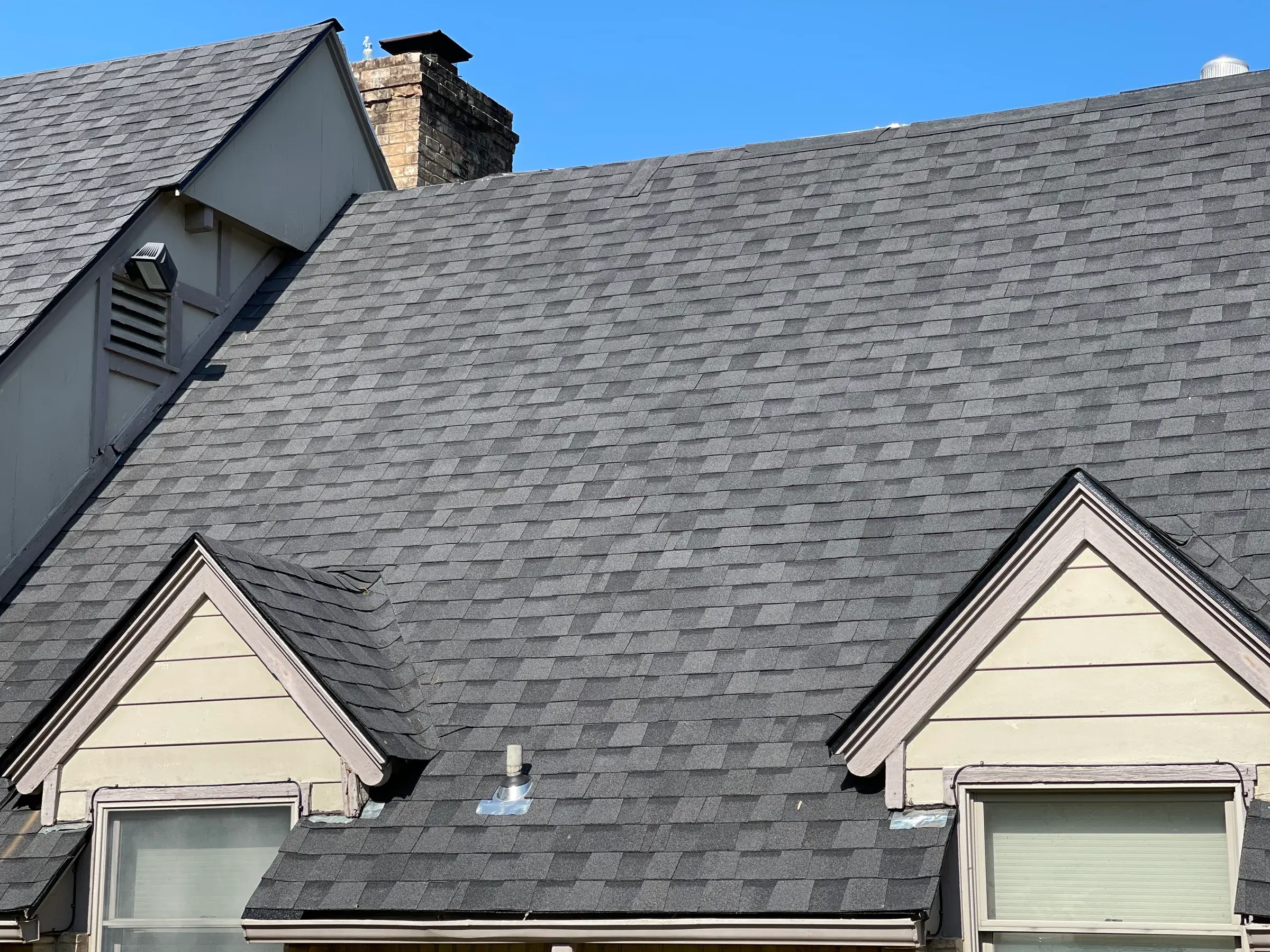
Roof Leak Repair in Miami, Oklahoma
The stain on your ceiling is almost never under the hole. Water runs along decking and rafters and drops wherever it feels like, sometimes rooms away. Finding a leak is detective work, and about a third of the time in Miami the answer isn't a hole at all — it's condensation from an attic that can't breathe.
A ceiling stain tells you water got in. It almost never tells you where. Water enters at one point, runs along decking and rafters, and drops somewhere else entirely — sometimes a room away. So we treat a leak as a diagnosis first: attic from underneath, roof from above, controlled water testing when it's hiding. Sometimes the answer isn't a hole at all.
The Stain Is Not the Leak: How Water Actually Travels
Water gets through the roof at one point. It almost never falls straight down from there. It hits the underside of the decking and follows two things: gravity, and whatever surface it can cling to. The sheathing is a flat plane, so water spreads across it. A rafter is a channel, so water runs down it. It can travel ten or fifteen feet sideways from where it came in before anything stops it.
Then it drops. Usually at a nail point, a truss plate, a seam between sheets of decking, or a wiring staple — something that interrupts the run. That drop lands on the insulation, soaks in, and eventually reaches the drywall. That is your stain. The stain marks where the water quit travelling, not where it started.
This is also why the stain often shows up days after the storm. Insulation holds water like a sponge. By the time the ceiling browns, the weather that caused it has moved on, and you're left with no obvious link between the rain and the mark. Chasing that stain straight up through the roof is the single most common way a leak gets "fixed" three times and still leaks.
The Six Places Miami Roofs Leak Most
Roofs rarely leak through the middle of a shingle field. They leak where the roof stops being a roof — anywhere it's been cut, turned, or tied into something else. Six spots account for most of what we find on homes around Miami and Ottawa County.
- Pipe boots. The rubber or neoprene collar that seals around a plumbing vent pipe. It's the shortest-lived part of the whole roof. Miami gets roughly 62% annual sunshine, 57 days a year above 90°F, and 5 above 100°F — and a shingle deck runs far hotter than the air. That UV and heat load hardens the collar until it splits, usually on the south and west faces first. This is the most common single leak we find, and it's a repair, not a re-roof.
- Step flashing at walls. The L-shaped pieces of metal woven in one per shingle course where a roof plane runs into a wall — a dormer side, a chimney side, a two-story wall. If someone ran a continuous strip of metal instead of stepped pieces, or caulked it instead of lapping it, it will leak.
- Valleys. Where two roof planes meet and every drop from both sides funnels through. In the eastern half of Ottawa County — the Ozark Plains side, rocky and wooded — valleys pack with leaves and needles, the debris holds water against the shingles, and water that sits long enough finds the seam.
- Chimneys without a cricket. A cricket is the small ridge built behind a wide chimney to split water around it. Without one, the up-slope side of the chimney is a dam. Water pools there, sits, and works its way under.
- Backed-out nails. Miami runs about 57 days above 90°F and 89 nights below 32°F. Decking expands and contracts through every one of those cycles, and fasteners creep upward a fraction at a time until a nail head tents the shingle above it. Now there's a hole with a shingle roof over it.
- Roof-to-wall terminations over a gutter. Where a roof edge dies into a wall above a gutter, there should be a kickout flashing — a small bent tab that throws water out into the gutter instead of letting it run down behind the siding. It's the most-skipped piece of metal on a house, and when it's missing the damage shows up in the wall, not the ceiling.
Skylights belong on that list too, and they're worth their own conversation — most skylight leaks are the flashing kit around the unit, not the glass.
Leaks That Aren't Leaks: Condensation, HVAC, and Plumbing
Here's the part most homeowners have never been told. A real share of the "roof leaks" we get called to in Miami are not holes in the roof. They're condensation in the attic, and no amount of work on the shingles will touch them.
Miami sits on the Neosho. It's a river town, and the air here carries moisture. Add what a household makes on its own — showers, cooking, laundry, a bath fan that was run up into the attic instead of out through the roof — and that warm wet air rises into the attic. On a cold night, and Miami gets around 89 of them below freezing every year, that air hits decking that's the same temperature as the outdoors. The moisture condenses on the underside of the plywood. Sometimes it frosts. Then it warms up, melts, and rains down onto your insulation.
How to tell condensation from a real leak
- It appears on cold, clear nights rather than during rain. If your "leak" shows up in January when it hasn't rained in a week, stop looking for a hole.
- The staining is widespread and vague rather than a single track. A leak makes a path. Condensation makes a haze across a whole area.
- Rusted nail shanks. Look up in the attic at the hundreds of nail tips poking through the decking. If they're rusty and dark all across the field, that's years of moisture condensing on cold metal. It's one of the most reliable tells there is.
- The decking looks dark or streaked on the underside, and the insulation below it is matted down.
The cause is nearly always the intake side of the ventilation, not the exhaust. Soffit vents get insulated over during an energy-efficiency job, or painted shut over the years, or were never adequate to begin with. A ridge vent with no intake feeding it can't pull outside air through the attic — so it pulls conditioned air out of your house instead, and drags the humidity with it. Ottawa County housing is about 12.2% mobile and manufactured homes, and those have a shallow roof cavity with very little room for air to move, so condensation shows up there faster and harder.
Then there's the mechanical stuff. An air handler in the attic with a clogged condensate line will drip all summer — that's a stain that only appears during the hot stretch when the unit runs hardest, and never in winter. Uninsulated ducts sweat. A second-floor supply line or shower pan leaks when the fixture gets used, not when it rains. We check for these before we tell you the roof did it. And if we find water damage that's gone beyond the roof's business, we say so plainly and point you to the right trade — remediation isn't work we do.
How We Trace a Leak (Including Water Testing)
Leak tracing is detective work. There's an order to it, and skipping steps is how people end up paying for three repairs.
- We ask when. Not just "it leaks" — does it leak in every rain, or only some? Only when the wind blows from one direction? Only during a thaw? Only when the AC runs? The answer narrows the search more than anything we can see from the driveway.
- Attic first, from underneath. With a light, looking for staining, water tracks down rafters, rusted nail shanks, wet or matted insulation, and daylight where there shouldn't be any. Then we trace up-slope from the wet spot, because water came down to get there.
- Roof second, from above. Every penetration, valley, and flashing detail up-slope of the suspect area gets looked at. Not just the one nearest the stain.
- Water testing when it's still hiding. This is running water on the roof in isolated sections, starting low and working up, one zone at a time, with someone inside watching. Ten to fifteen minutes per zone. It's slow on purpose — flood the whole roof at once and you've learned nothing about which detail failed.
- You get a photo report of what we actually found, and a written estimate for the work we would perform. If it turns out to be condensation or a condensate line, that's what the report says.
Why Roof Cement and Flex Sealant Make Leaks Worse
Black roof cement out of a tub, and rubber sealant out of a spray can. Both are everywhere, and both usually make the job bigger.
The problem is that they bridge a symptom instead of fixing a system. Flashing works mechanically — overlapping pieces of metal arranged so gravity carries water out and over the next piece. A smear of mastic isn't part of that system. It's a plug. And it's a plug in a climate that runs 57 days above 90°F and 89 nights below 32°F, which means it's expanding and contracting hundreds of times a year against material that moves at a different rate. It cures, shrinks, and cracks. Then water gets in through the crack and can't get back out, because the patch is now a dam.
The bigger cost is diagnostic. A patch hides the detail underneath from whoever looks next. We can't read a flashing lap through a quarter inch of mastic, so it has to come off — and scraping cured roof cement off asphalt shingles tears granules and often takes the shingle with it. A repair that would have been one pipe boot becomes a boot plus three shingles plus a patch of underlayment. If it's leaking right now and you need it stopped tonight, a tarp is the honest short-term answer. Sealant isn't.
Leaks That Only Appear in Certain Weather
A leak with conditions attached isn't a mystery. It's the best clue you'll get. Pay attention to the pattern and tell us about it.
- Only in wind-driven rain. The detail sheds vertical water fine and fails against horizontal water. Think flashing laps, vent louvers, ridge vent baffles, a siding-to-roof junction. West Ottawa County is Neosho Lowlands — flat prairie and farmland with very little to break the wind, so this pattern is common out that way.
- Only in long, soaking rain. That's saturation getting past the underlayment rather than a hole. Look at low-slope areas: shallow porch roofs, additions, anywhere the pitch flattens out.
- Only after a hail event. Miami averages 4 to 5 days a year with hail larger than 0.75 inch. Hail can bruise the fiberglass mat inside a shingle — fracture it — without punching a visible hole. It doesn't leak that afternoon. It leaks months later when the mat gives up. This is why a post-hail inspection matters even when the roof looks fine from the ground.
- Only during a thaw, or a day or two after cold weather. That's ice, not a hole. See below.
- Only in summer with the AC running hard. That's a condensate line or a sweating duct, not the roof.
- Only when someone uses a fixture. That's plumbing.
Leaks in Winter: Ice, Refreeze, and Backed-Up Water
Miami isn't a snow-belt town, but 89 freezing nights a year is plenty to run this cycle. Heat escapes from the house into the attic and warms the decking. Snow or ice on the upper roof melts. The water runs down toward the eave — and the eave overhang hangs out over open air, so it's cold. The water refreezes there and builds a ridge of ice. Every melt after that adds to it.
Now water is standing behind a dam. Shingles are designed to shed water moving downhill; they are not designed to hold standing water. It wicks back up under the courses, past the fasteners, and through the deck. Inside, it usually shows at the top of an exterior wall — behind crown molding, or as a stain that runs along the wall line rather than out in the middle of the ceiling.
The fix isn't on the roof surface. It's making the attic cold and dry: sealing the air leaks feeding heat up there, getting insulation right, and opening the intake so the deck stays close to outdoor temperature. Sealant on the eave does nothing. Worth knowing: Oklahoma's residential code leaves the ice barrier requirement blank — a membrane at the eaves isn't mandated here. That doesn't mean it's a bad idea. It means it's a conversation to have before a tear-off, not after the ceiling stains.
When the Leak Is Really Telling You the Roof Is Finished
One leak does not mean one new roof. A split pipe boot on a ten-year-old roof is a repair, full stop, and anyone who tells you otherwise is selling. But sometimes the leak is a messenger.
- Leaks in multiple unrelated places at once. Not one failed detail — a system giving out.
- Granules collecting in the gutters and at the downspout outlets. That's the shingle's UV armor washing off. With around 62% annual sunshine and an August daily high normal of 91.5°F, that armor works hard here.
- Shingles that crack or crumble when you lift them instead of flexing. Brittle means the asphalt has lost its oils.
- Decking that feels soft or spongy underfoot. That's rot, and rot means the water has been getting in for a long time.
- A roof that's already been layered over once.
If it does come to replacement, two Oklahoma specifics matter. Oklahoma amended the residential code's re-roof section (IRC R908.3.1.1) to require a tear-off rather than shingling over the old roof under defined conditions — so "just add a layer" isn't always on the table here the way it is in some states. And the City of Miami requires a permit for new roofs and re-shingles. We pull it.
The money math is simple enough to do on your driveway. Median home value in Ottawa County sits around $123,300. A repair that keeps a sound roof going another eight years is good money spent. Three repairs chasing leaks around a worn-out roof is not. We'll tell you which one you have, and we'll tell you if it's the answer you didn't want. Inspections and quotes are free, and if it's actively coming in we can get a tarp on it. Call (209) 758-8550.
Roof Leak Repair questions
The stain is in my living room. Is the leak right above it?
Usually not. Water enters at a penetration or a seam, travels along the underside of the decking or down a rafter until it hits something that stops it, and drops there. Chasing the stain straight up is the most common way a leak gets 'repaired' three times and still leaks.
My roof only leaks in certain storms. Why?
That's a strong clue, not a mystery. Leaking only in wind-driven rain points to a detail that sheds vertical water fine — a flashing lap, a vent louver, a siding-to-roof junction. Leaking only in long soaking rain points to saturation getting past underlayment. Leaking only during a winter thaw points to ice, not a hole.
Could my 'leak' be condensation?
Very possibly. In an attic with poor ventilation, warm moist household air hits cold decking, condenses, and rains back down on the insulation. It looks exactly like a roof leak from below — except it appears on cold clear nights rather than during rain, and it shows up as widespread staining rather than a single track.
I put roof cement on it and it still leaks. Now what?
That's typical. Roof cement and spray sealants bridge a symptom, trap water behind them, and hide the actual entry point from whoever looks next — and they have to be scraped off before a real repair can be made. They usually make the eventual repair bigger, not smaller.
How do you find a leak you can't see?
Attic first, from underneath, looking for staining, rusted nail shanks, and daylight. Then the roof, checking every penetration, valley and flashing above the suspect area. If it's still hiding, controlled water testing — running water on isolated sections in sequence with someone watching inside — usually forces it to show itself.
Does one leak mean I need a new roof?
No. A single failed pipe boot on a ten-year-old roof is a repair, full stop. A leak on a twenty-five-year-old roof with granule loss across the field is the roof telling you something. Same symptom, completely different answer.

Protect Your Property with a Free Roof Inspection
Tell us what you're seeing. We'll arrange an inspection, explain the findings, and provide clear next steps without pressure.
- • A real look at the roof, not a sales visit
- • Photos of whatever we find, and what it means
- • A written quote if you want one — and an honest “you don’t need us yet” if that’s the answer