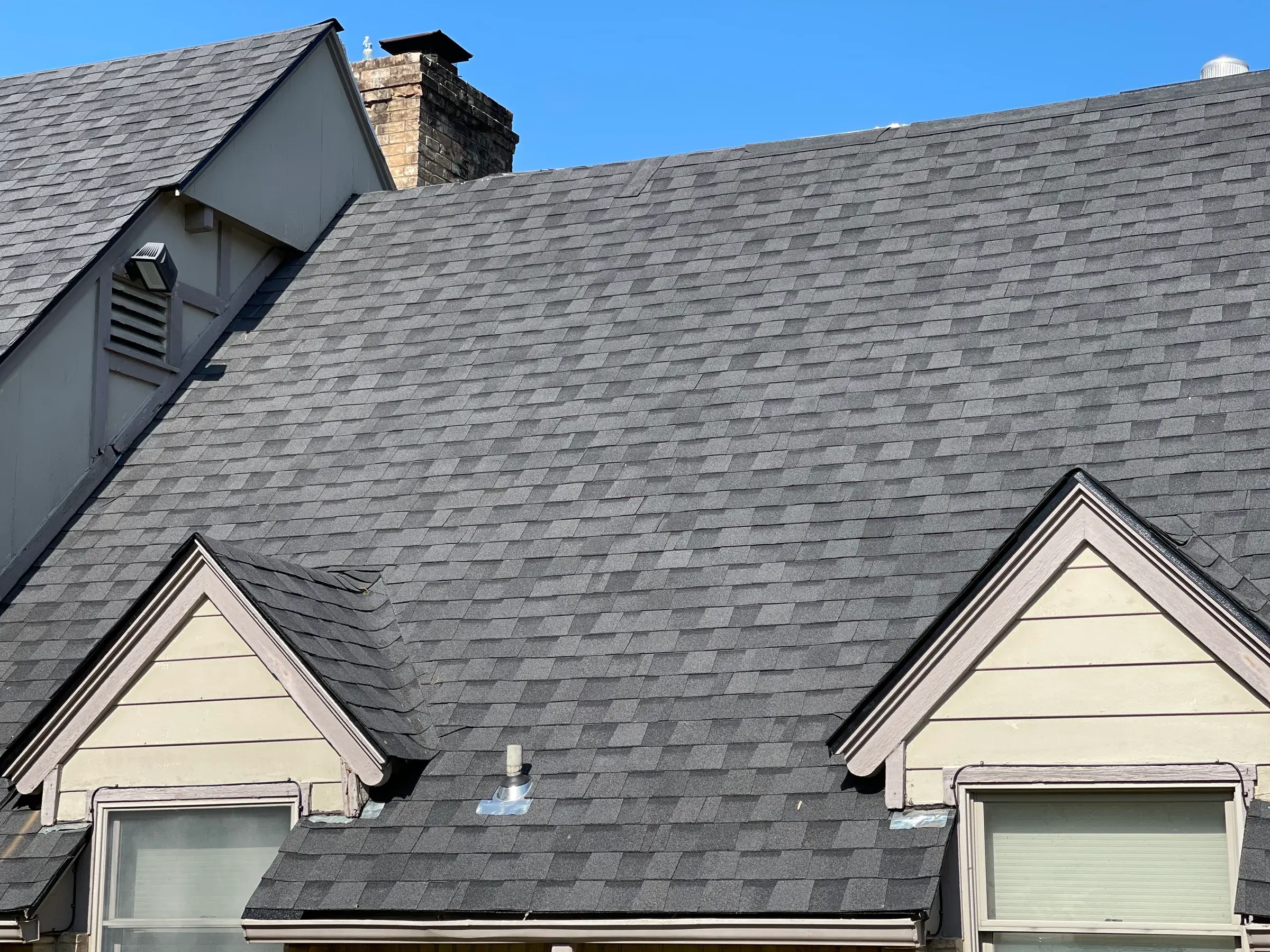
Emergency Roof Tarping in Miami, Oklahoma
Tarping is triage. It doesn't fix a roof — it stops the next twelve hours of rain from ruining the ceiling, the insulation and the drywall while the actual repair gets scoped. We tarp roofs in Miami and around Ottawa County after storm damage, and we're straight with you about what a tarp can and can't do.
Water is coming through your ceiling and you need it stopped tonight, not perfected. That's what tarping is for. This page explains what a tarp can actually hold back in Northeast Oklahoma weather, how it has to be fastened to survive prairie wind, the conditions under which we won't climb, and how a temporary cover hands off to the real repair.
A tarp is a lid, not a roof. It sheds water off the top of a damaged area and buys you time. It does not restore anything, it does not seal, and it does not care how tidy it looks from the street. The only question worth asking about a tarp is whether the next round of rain lands on your decking or on the tarp.
Being clear about that matters, because the gap between what a tarp does and what people assume it does is where houses get wrecked. Here is the honest split.
- What it does: keeps bulk water out of an opening — missing shingles, a limb strike, a section peeled back by wind.
- What it does: stops the leak from spreading sideways through insulation and into rooms that aren't wet yet.
- What it doesn't: stop water driven uphill by wind. A tarp sheds; it does not seal.
- What it doesn't: protect the rest of the roof. If a storm took shingles off one slope, the other slopes are usually loosened too.
- What it doesn't: fix bruised or fractured shingles, split decking, or flashing that's pulled loose.
A tarp is triage. Triage is valuable precisely because it's honest about being temporary.
When Tarping Is the Right Call — and When It Isn't
Tarping is the right call when there's an actual opening: shingles gone down to the felt or the deck, a limb through the roof, a ridge line stripped, a section of roof lifted and folded back. Wind and falling timber make those. Around Miami that's a real split by geography — east of town on the Ozark Plains you're in rolling, wooded country where a limb comes through the roof, and out west on the Neosho Lowlands you're on open prairie where wind gets a straight run at a roof edge with nothing to slow it down.
Here's the part that surprises people. Hail usually does not need a tarp. Ottawa County gets 4 to 5 days a year with hail larger than three-quarters of an inch, and the phone rings hard after every one of them — but hail typically bruises the shingle mat and knocks granules loose without opening a hole. The leak from a hail hit often shows up weeks or months later, once the exposed mat has cooked and cracked. Putting a tarp over hail bruising accomplishes nothing except adding fastener holes. What that roof needs is an inspection and a photo record, not a blue sheet.
And sometimes the right answer is inside the house, not on the roof. If the opening is small, if the weather is still active, or if the roof isn't safe to stand on, containing water at the ceiling with buckets and plastic does more good than a rushed tarp that blows off at 2 a.m.
How a Tarp Is Actually Secured (and Why the DIY Version Fails)
Bricks, sandbags, and cinder blocks do not hold a tarp down in Oklahoma. A loose tarp edge in wind is a sail — it inflates, flogs, and either tears itself off the roof or peels shingles up as it goes. We've pulled tarps off roofs that did more damage than the storm did. Weight is not attachment.
The method that actually survives is a batten sandwich. The tarp edge gets wrapped around a wood strip — a 1x3 or 2x4 furring strip — and the whole assembly is screwed down through the shingles into the decking, so the fastener pulls on wood rather than tearing through plastic. Grommets are for tie-downs on a trailer, not for a roof in a straight-line wind.
- Photograph the damage before anything goes over it. Once the tarp is on, the evidence is under it.
- Clear the debris. Broken limbs, loose shingle pieces, and lifted nails will chew a tarp from underneath within a day.
- Run the tarp from above the damage, over the ridge where the roof allows it, so no seam faces uphill.
- Roll the top and bottom edges around wood strips, then fasten through the strips into the deck at close spacing.
- Pull the field tight. Slack is where water ponds and where wind gets a grip.
- Wrap and fasten the side edges the same way — sides are where most tarps let go first.
Yes, that puts screw holes in your roof. It should. Those holes land in an area that's already being replaced, and a tarp that stays on through a squall is worth far more than a few fasteners in shingles that are coming off anyway. That is the trade, and anyone who tells you a proper tarp is hole-free hasn't installed one that held.
The Damage That Happens While You Wait: Insulation, Drywall, Mold
The roof is rarely the expensive part of a leak. What's underneath is.
- Blown fiberglass and cellulose insulation mat down when they get wet and don't loft back up. Compressed insulation has lost most of its R-value permanently — you feel that in July and again in January.
- Drywall wicks. The paper facing pulls water sideways well beyond the visible stain, and a saturated ceiling sags before it fails.
- Wood decking and framing hold moisture long after the ceiling looks dry, and organic material that stays damp can start growing mold within a day or two.
- Water tracks along the top of ceiling joists and comes out somewhere unrelated to the hole. The stain in the hallway may be from a leak over the bedroom.
- Anywhere water meets wiring or a light fixture, that circuit is a hazard until it's dry and checked.
That's the whole argument for tarping fast. Not to save the roof — the roof is already damaged and priced. To save the ceiling, the insulation, and the framing that are still fine right now.
Tarping and Your Insurance Documentation
Reasonable steps to prevent further damage are normally something a policyholder is expected to take, not penalized for. Practically, that means: photograph everything before the tarp, keep receipts for materials, and don't throw away the limb or the shingle pieces until they've been photographed where they landed.
What we do here is document, not advocate. We take a photo report of the damage, we write an estimate for the work we would perform, and we can meet your adjuster on the roof if you ask us to. Your insurer decides what's covered — we don't promise that a tarp will be reimbursed, and we don't offer free tarping, because Oklahoma law is strict about contractors offering things of value tied to an insured job.
Steep Pitches, Old Decking, and Roofs We Won't Walk in a Storm
We will not put someone on a roof during lightning or high wind. That's not negotiable, and it isn't caution for its own sake — a tarp installed in a wind that can lift it is a tarp that takes shingles with it when it goes. If we can't work safely, we'll tell you so, help you contain water from inside, and get up there when the weather allows.
The three conditions that stop us
Steep pitch, roughly 6:12 and up, becomes genuinely unsafe when wet — and after hail, loose granules on wet shingles behave like ball bearings underfoot. Compromised decking is the second: soft spots at the eaves from long-term leaking, or older plank decking with a split board, mean a foot can go through. Active weather is the third. Wind that's still gusting turns any unfastened tarp edge into a lever.
If a roof fails on any of those, the honest answer is interior containment now and a proper tarp when it's survivable. Nobody's ceiling is worth a fall.
How Long a Tarp Can Stay On
Weeks, not seasons. Northeast Oklahoma is unusually hard on a poly tarp. We run about 57 days a year above 90°F under roughly 62% annual sunshine, and UV is what kills woven polyethylene — it goes chalky, then brittle, then it shreds along the fold lines. Then the other direction: 89 nights a year below freezing, so water ponded in any slack pocket freezes, expands, and works the weave apart. A tarp that looked fine in October can be confetti by March.
There's a second clock running too. Every week a tarp sits there, wind is working the fasteners, and the shingles at the tarp edges are being lifted and dropped. The tarp is not neutral — it's slowly costing you roof. Treat the date it went on as the start of a countdown, not the end of the problem.
From Tarp to Permanent Repair: The Handoff
The tarp is the first ten percent. The handoff is where the actual outcome gets decided, and it goes like this: full inspection of every slope once the weather clears, a photo report of what we found, a written estimate for the repair or replacement we'd perform, and then scheduling. If your claim is in play, that documentation is what you and your adjuster work from — the decision on coverage is theirs.
When we pull the tarp, we're looking at the decking underneath, not just the shingles. Wet OSB swells at the panel edges and doesn't return to flat; you'll see that telegraph through new shingles as ridging if it isn't cut out. That's a decking repair, and it gets priced honestly rather than covered over.
Two things worth knowing before the permanent work starts. Oklahoma has amended the residential code (IRC R908.3.1.1) to require a tear-off rather than shingling over the existing roof in defined conditions — so a second layer isn't always an option, whatever anyone quotes you. And the City of Miami requires a permit for new roofs and re-shingles. We pull it.
If there's water coming in right now, call us at (209) 758-8550 and tell us what you're seeing — where it's dripping, whether the ceiling is bulging, and what the weather is doing at your address. That determines whether the right first move is a ladder or a bucket.
We are roofing contractors, not public adjusters or insurance attorneys. Coverage decisions are made by your insurer under your policy.
Emergency Roof Tarping questions
Is a tarp a repair?
No. A tarp is a temporary cover that buys time — usually days to a few weeks — while the damage is documented and the real repair is scoped and scheduled. Anyone who tells you a tarp is a solution is telling you something else too.
Can I just tarp it myself?
You can, and plenty of people do it safely from a ladder on a low slope. The failures happen because a tarp has to be secured above the damage and run over the ridge or anchored so wind can't get under it — a tarp that catches wind becomes a sail and takes shingles with it. And a wet roof after a storm is genuinely dangerous.
Will you tarp during a storm?
Not during lightning or high wind, and not on decking that's already compromised — no roof is worth someone falling through it. If we can't get up safely, we'll help you contain water from inside and get on the roof as soon as it's survivable.
Does tarping affect my insurance claim?
Reasonable emergency measures to prevent further damage are normally expected of a policyholder, not penalized. Photograph the damage before the tarp goes on and keep any receipts. Oklahoma's roofing statute also has a specific rule here: emergency services performed under an insurance-related contract require the insured's written acknowledgment that the work is necessary to prevent damage to the premises.
How long can a tarp stay on my roof?
Longer than it should, in practice — but tarps degrade in UV and flog themselves apart in wind, and every week one is up is a week water can find a new edge. Treat it as weeks, not seasons, and get the permanent repair scheduled.
What should I do inside while I wait?
Move what you can out from under the leak, put containers down, and if a ceiling is bulging with trapped water, puncture it deliberately at the low point into a bucket rather than letting it collapse on its own. Turn off electricity to any area where water is near fixtures or wiring.
Protect Your Property with a Free Roof Inspection
Tell us what you're seeing. We'll arrange an inspection, explain the findings, and provide clear next steps without pressure.
- • A real look at the roof, not a sales visit
- • Photos of whatever we find, and what it means
- • A written quote if you want one — and an honest “you don’t need us yet” if that’s the answer