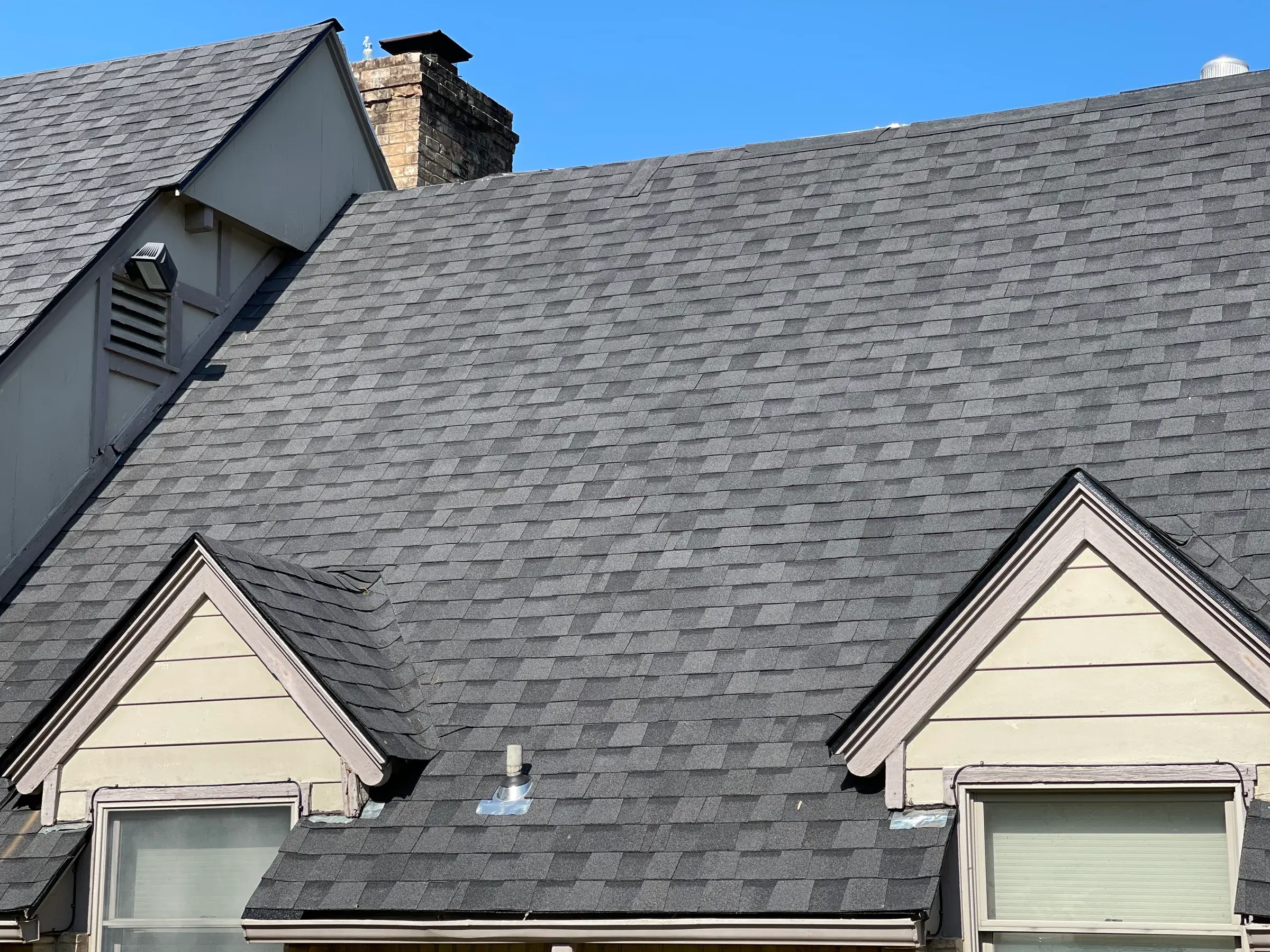
Roof Decking & Structural Repair in Miami, OK
Decking is the part of your roof nobody sees and everybody pays for. It shows up as a surprise line item after tear-off, as a soft spot underfoot, or as a slope that's gone wavy. On Miami's older homes it's also a plank-decking question, and that changes what can go on top of it.
Decking is the wood layer under your shingles — the part nobody sees until the roof comes off. It's also the single most abused line item in roofing, and the place a fair bid and a padded one part ways. Here's how decking fails on Northeast Oklahoma homes, how it should be priced, and when a sag stops being a roofing question.
What Roof Decking Is and Why It Rots
Decking — also called sheathing — is the wood skin nailed across your rafters. On most homes built from the mid-century onward it's 4x8 sheets of plywood or OSB (oriented strand board, wood chips pressed and glued into a panel). On older homes it's individual boards. Everything above it depends on it. Underlayment lies on it. Shingles nail through it. A shingle is only as strong as the wood holding its nails.
Decking rots two ways: from above, when water gets past a flashing or a pipe boot and sits in the wood, and from below, when attic moisture condenses on the cold underside. The second one surprises people, because it happens with no leak at all.
Northeast Oklahoma is hard on the wood in a specific way. We get 89 nights a year below freezing and 57 days above 90°F. An attic in August runs far hotter than the 91.5°F daily max outside. Wood expands, contracts, expands again. Over decades that cycling backs nails out, opens panel joints, and loosens the grip that keeps everything up there.
What failure actually looks like in the wood
- OSB edge swell — the chips at a panel edge absorb water and puff up permanently. They never go back down. You see it from the ground as a faint ridge line telegraphing through the shingles every four feet.
- Plywood delamination — the glued plies separate and the sheet goes soft and layered, like wet cardboard.
- Rot from a slow leak — usually a dark, defined patch that feels spongy when you step on it. The stain is bigger than the hole.
- Nail pops — fasteners working back out as the deck moves, pushing little bumps up under the shingles.
- Splits and blown-out nail holes where a fastener was driven too close to an edge or into a gap.
Where Decking Fails on Ottawa County Homes
Decking almost never fails uniformly. It fails where water is concentrated, where it sits, and where something penetrates the roof.
- The first few feet above the eave, where meltwater, debris and gutter backup all collect.
- Valleys — every gallon that lands on two planes funnels through one line.
- Around chimneys, skylights and pipe boots, where the flashing detail is doing all the work.
- Low-slope additions: porch roofs, carports, sunroom tie-ins. Shallow slope plus a wall junction is the most common rot address on any house.
- Directly under a bath fan that terminates in the attic instead of outside.
- Under anything mounted through the roof — old antenna feet, an abandoned swamp cooler curb, a satellite bracket somebody never sealed.
Ottawa County splits down the middle, and it shows up on roofs. East of Miami you're into the Ozark Plains — rockier, wooded, rolling. Tree cover means shade, leaf litter packed into valleys, and decking that stays damp longer after a rain. West is the Neosho Lowlands, flat prairie and farmland, full sun and wind-driven rain hitting one exposure hard. Same county, two different failure patterns.
Plank Decking on Older Miami Homes: Gaps, Cupping and Re-Sheeting
Miami was platted in 1891 and peaked in population in 1980. A lot of the housing stock predates plywood entirely. Those roofs were sheathed in individual boards — 1x6 or 1x8 lumber laid across the rafters, usually with a deliberate gap between them so the wood could move.
Give those boards eighty years and three things happen. They cup, so the face isn't flat anymore. They shrink, so a 3/8-inch gap becomes an inch. And they split along the old nail lines. Modern architectural shingles want continuous, flat support and consistent nail holding. If a nail lands in a gap, it holds nothing — and you won't know until wind finds that shingle.
There are two honest paths. If the planks are sound, the gaps are tight, and only a few boards are bad, we replace those boards and roof directly on the planks. If the gaps are wide or the boards are cupped, the deck gets re-sheeted — new panels laid over the existing planks to create a continuous nailing surface. Re-sheeting is a real added cost. It also raises the deck slightly, which means flashing, drip edge and trim details all have to be re-cut to suit. This is worth knowing before you collect bids, not after, because a bidder who ignores it will look cheaper than one who didn't.
A five-minute check you can do yourself
Go into the attic in daylight with the light off and look up. Thin daylight through plank gaps is normal and always has been. Dark staining along the nail lines, fuzzy white growth, or wood that looks wet when the roof hasn't leaked is not normal — that's condensation, not rain, and it means the next section applies to you.
Why Bad Ventilation Rots Decking From Underneath
Your house makes moisture all day. Showers, cooking, laundry, breathing. That warm wet air rises and ends up in the attic. If there's no path out, it hits the underside of the decking, which on a January night here is well below freezing. It condenses. Some nights it frosts. Next afternoon it melts and runs into the wood.
With 89 freezing nights a year, that's not an occasional event. It's a cycle that runs most of the winter, every winter, for as long as the airflow is wrong. Twenty years of that will rot a deck from below with the shingles above it still looking respectable.
The usual culprits are simple: insulation stuffed over the soffit vents so no air can get in, a bath fan blowing straight into the attic, or a ridge vent with no intake to feed it. None of those are exotic. All of them are fixable during a re-roof.
How Decking Gets Priced — and Why Honest Roofers Price It Per Sheet
Nobody — not us, not anyone — can see the condition of your decking with shingles on it. That's just physics. So decking cannot be a fixed number in a bid. It has to be a unit price: a stated rate per sheet or per board, written on your estimate before work starts, charged only for what actually comes off.
That single line is where a fair bid and a bait-and-switch bid separate. Two bids should worry you. One is the bid with no decking line at all — that contractor either forgot or is planning to surprise you. The other is the bid that assumes a big pile of sheets up front. That padding either pays for itself when the deck turns out fine, or it becomes the excuse to add more once the roof is open and you have no leverage.
We photograph rotted sheets where they lie, before anything is cut. If you're home, we count them with you. If this is a storm claim, that photo report and our written estimate for the work we would perform go to you — your insurer decides what's covered.
Decking vs. Structure: Sheathing, Rafters, Trusses, Ridge
These get talked about as one thing and they are not. Decking is the skin. Rafters and trusses are the bones. The ridge board is the spine. Roofers replace skin. Bones are a different scope entirely, and we'd rather tell you that than pretend otherwise.
Trusses deserve a specific warning. A truss is an engineered assembly — every web and chord in that triangle is carrying a calculated share of the load. Cutting one member changes how the whole thing works. If somebody ran a duct through a truss web, or sawed one out to make attic storage, that is not a roofing repair. That's a question for someone qualified to evaluate framing, and it should be answered before a new roof goes on top of it.
We replace decking and sheathing as part of roofing work. Where a roof problem is really a framing problem, we say so and point you to the right trade.
The Sag Question: Cosmetic, Chronic, or Structural
A wavy roof scares people, and sometimes it should. There are three different things people call a sag.
- Cosmetic dip between rafters. The decking relaxes slightly in each bay, so the surface reads as gentle scalloping. Very common on older and plank-decked homes. Usually just visual.
- A localized soft spot. Defined edges, feels spongy underfoot, often near a valley or a penetration. That's rot in a sheet or two, and it's a decking repair.
- A whole plane or ridge line that's moved. That's framing, not decking.
Here's the diagnostic that separates them, and you can do it from your driveway. Stand at a corner of the house and sight down the ridge line the way you'd sight down a rifle. A dead-straight ridge with a wavy field below it means the decking has moved and the bones are fine. A ridge that dips in the middle, or a whole plane that's tipped, means something is happening in the framing.
Decking Discovered Mid-Tear-Off: What Happens Next
This is the moment most homeowners meet the word "decking" for the first time — standing in the yard while somebody on the roof yells down a number. It shouldn't be a moment of panic, and it shouldn't be a negotiation. It should be a procedure you already agreed to.
Oklahoma amended the residential code at IRC R908.3.1.1 to require tear-off rather than shingle-over in defined conditions. That's an advantage for you. Tear-off means the deck gets exposed, swept and actually looked at, instead of being buried under another layer and forgotten for twenty years. The City of Miami also requires a permit for new roofs and re-shingles. We pull it.
- Shingles and underlayment come off and the deck is swept clean. Now everything is visible.
- We walk the deck and sound it. Bad sheathing announces itself underfoot — it flexes, it thuds instead of knocks.
- Every bad sheet gets marked and photographed in place, before it's touched.
- You get told before anything is cut. If you're home, we walk the count with you. If you're not, you get the photos.
- Replacement panels go in at matching thickness — you don't mix deck depths, or the surface telegraphs through the shingles — fastened to framing, with panel clips at unsupported edges where they're needed.
- The final count goes on the invoice at the same rate that was on your estimate. Not a different rate. The same one.
- The photo report stays in your file. If you're filing a storm claim, it's yours to give your insurer.
Free inspections and free quotes, across Oklahoma, Kansas, Missouri and Arkansas from our one office on Main Street in Miami. If you've got a soft spot, a wavy plane, or a bid with a decking line you don't understand, call us at (209) 758-8550 and we'll go look before you commit to anything.
Roof Decking & Structural Repair questions
Why does decking cost extra? Shouldn't it be in the bid?
Nobody can see under your shingles until they're off, so decking is priced as a unit — a per-sheet rate stated on the estimate up front, charged only for what's actually replaced. That's the fair way. Be wary of both extremes: a bid with no decking line at all, and a bid that assumes a huge quantity to pad the number.
How do I know the decking really needed replacing?
You should be shown. We photograph rotted sheets in place before they come off and count them with you if you're home. If a contractor tells you about decking only when the invoice arrives, that's a problem with the contractor, not with your roof.
My roof has a wavy or sagging spot. Is that serious?
It depends what's sagging. Decking dipping between rafters is common on older homes and usually cosmetic or a localized rot issue. A whole plane sagging, or a ridge line that dips, is a framing question — that's a structural conversation, and if it looks structural we'll tell you to bring in someone qualified to evaluate it rather than roofing over it.
What is plank decking and why does it matter?
Older homes here were sheathed in individual boards rather than sheets. Planks cup, shrink and open gaps over decades, and modern shingles need continuous support and consistent nail holding. Sometimes planks are sound and can be roofed directly; sometimes they need sheeting over first, which is a real added cost and worth knowing about before you get a bid.
Why is my decking rotten if my roof never leaked?
Ventilation. Moist air from the house rises into the attic, and if there's no path for it to leave, it condenses on the cold underside of the decking every winter night for twenty years. That rot grows from underneath with no leak involved — and re-roofing without fixing the airflow starts the clock over.
Do you do structural work, or just decking?
We replace decking and sheathing as part of roofing work. Rafter, truss and load-bearing repairs are a different scope, and where a roof problem is really a framing problem we'll say so plainly rather than stretch.
Protect Your Property with a Free Roof Inspection
Tell us what you're seeing. We'll arrange an inspection, explain the findings, and provide clear next steps without pressure.
- • A real look at the roof, not a sales visit
- • Photos of whatever we find, and what it means
- • A written quote if you want one — and an honest “you don’t need us yet” if that’s the answer