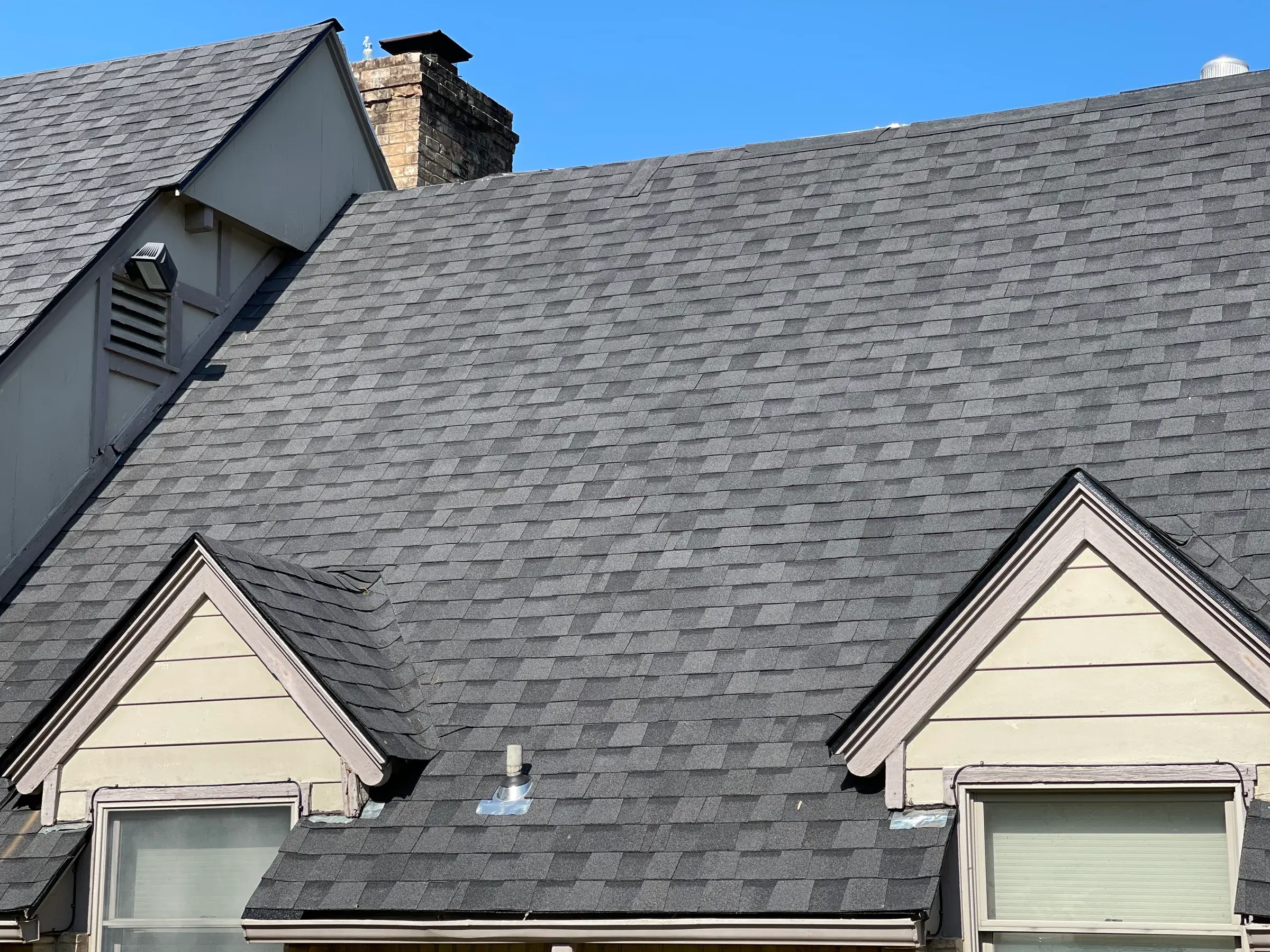
Chimney Flashing Repair in Miami, OK
The chimney is the hardest thing on your roof to keep dry — a masonry box interrupting a water plane, with four different flashing problems and a hundred years of settling. On Miami's older homes it's also the leak everyone treats with caulk, over and over, until the decking around it turns to sponge.
Water shows up on the ceiling near the chimney. Someone smears caulk on it. Eighteen months later it's back. That's the cycle on a lot of homes around Miami and Ottawa County. Chimney leaks are the most misdiagnosed leak on a roof, and the real fix is almost never sealant. Here's what's actually going wrong up there — and what we do and don't touch.
Why Chimneys Leak More Than Anything Else on a Roof
A roof is a water plane. Every shingle on it exists to hand water to the shingle below it and get it off the edge. A chimney is a masonry box punched straight through that plane — and unlike a pipe boot or a vent, it's big, it's square, and it doesn't move the way the rest of the roof moves.
That last part matters more than most people realize. Northeast Oklahoma gives a roof 57 days a year above 90°F and 89 nights a year below freezing. Brick, steel flashing, wood decking and asphalt shingles all expand and contract at different rates through that swing. Every joint where those four materials meet gets worked back and forth, twice a day, for decades. Add roughly 62% annual sunshine baking any exposed sealant, and 4 to 5 days a year with hail bigger than three-quarters of an inch landing on the thinnest metal on your roof.
Then there's settling. A masonry chimney usually carries its weight down to its own footing. The house frame rides on the soil around it. Over fifty or eighty years those two things do not move in lockstep, and the gap opens up exactly where the metal meets the brick. Nothing failed, exactly. The house just moved.
The Four Parts: Base, Step, Counter Flashing and the Cricket
Chimney flashing isn't one thing. It's four separate details doing four separate jobs, and any one of them can be the leak while the other three are fine.
- Base or apron flashing — the piece across the downhill face of the chimney, where water coming off the slope above piles up first.
- Step flashing — individual L-shaped pieces of bent metal, roughly four inches on a side, one per shingle course, woven up both sides of the chimney so each piece laps the one below it. It is not a single long strip of metal. If it is a single long strip on your chimney, that's a problem worth knowing about.
- Counter flashing — the metal that covers the top edge of the base and step flashing and tucks into the brick, so water running down the chimney face gets intercepted by metal instead of finding the seam behind it.
- The cricket — the peaked structure on the uphill side that splits water and sends it around the chimney rather than into it.
Base, step and counter flashing work as a set: the first two catch water off the roof, the third keeps water off the face of the brick from getting behind them. The cricket keeps the whole uphill side from ever becoming a problem in the first place. Which brings us to the part almost nobody has.
The Missing Cricket: Why Water Pools on the Uphill Side
Picture the back of your chimney — the side facing up the slope. Everything the roof above collects runs down and hits that wall of brick. Without something to split it, water divides itself around the chimney by accident, slowly, and a lot of it doesn't leave at all.
A cricket is a small framed peak built tight against the uphill face — a miniature ridge that sheds water left and right the way the roof's own ridge does. It's framed in lumber, decked, and then either shingled or covered in seamed metal, depending on how shallow the pitch behind the chimney ends up being. Done right, water never sits against the brick at all.
The current Oklahoma residential code requires a cricket or saddle behind any chimney more than 30 inches wide, measured across the slope. That's not a suggestion or a best practice — it's in the code. And it is skipped constantly, because a cricket is real carpentry and real sheet metal work on a job someone wanted to price as a shingle tear-off.
What the missing cricket actually does to your roof
Water that has nowhere to go brings company. Leaves and pine litter wash down and stack against the back of the brick, and that mat holds moisture against the decking permanently. In winter, that same trapped mass is where snowmelt refreezes — with 89 freezing nights a year, that spot goes through the freeze-thaw cycle over and over while the rest of the roof stays dry. This is why the decking behind a chimney is so often soft and delaminated while the decking six feet away is perfect. If you've had the same chimney leak fixed three times, go look for the cricket. There probably isn't one.
Counter Flashing Cut Into Mortar vs. Caulked to the Face
This is the second thing that gets skipped, and it's the one that turns a leak into an annual expense.
Counter flashing is supposed to be let into the chimney, not stuck onto it. A groove — a reglet — gets cut into a mortar joint, typically an inch to an inch and a half deep. The top edge of the metal is bent, driven into that groove, locked or wedged in place, and sealed. Water running down the brick hits metal that is physically inside the wall. Gravity does the rest, and the sealant is a secondary defense rather than the only one.
The shortcut is to hold a strip of flat metal against the brick face, fasten it, and run a heavy bead of caulk along the top. It looks finished. It works for a season or two. Then it spends its life in full sun through 57 days above 90°F and gets pulled apart every freezing night, and it shrinks and cracks — and now the caulk is a funnel pointed straight down the back of the flashing. Each round of re-caulking buries the actual defect a little deeper.
One material detail worth knowing: aluminum flashing in direct contact with masonry doesn't age well, because mortar is alkaline and it corrodes the aluminum from the joint outward. That's why counter flashing set into brick should be a metal chosen for that contact, not whatever was on the truck.
Old Masonry on Older Miami Homes: Settling, Spalling, Failing Mortar
Miami was platted in 1891 and built out through the mining decades — the college up the road started life in 1919 as the Miami School of Mines. Plenty of the housing here dates to those years, and it's overwhelmingly detached single-family: 76.7% of Ottawa County's 13,701 housing units. Which means a lot of real brick chimneys with real lime-and-sand mortar joints that are now closing in on a century of Oklahoma weather.
Freeze-thaw is what wears them out. Brick absorbs a little water, that water freezes on one of our 89 sub-32°F nights, and it expands. Do that a few thousand times and the face of the brick starts flaking off in sheets — that's spalling. The mortar joints go soft and sandy and recede. And in the meantime the chimney has been drifting relative to the house frame for decades.
Here's why we're telling you this on a flashing page: a reglet cut into crumbling mortar has nothing to grip. If the joints are shot, cutting into them makes it worse, and any flashing we set there is temporary by definition. When we find that, we say so before we start — the masonry gets addressed first, then the flashing goes in against sound joints. Doing it in the other order wastes your money and our day.
Not All Chimney Water Is Flashing: Crown, Cap and Brick Absorption
Worth knowing before you pay any roofer: a chimney can put water in your house with flashing that's in perfect shape. The chimney is a vertical column open at the top, and there are several ways in that have nothing to do with the roof.
- A cracked crown — the sloped concrete or mortar slab across the top of the chimney. Hairline cracks feed water straight down inside the brickwork, and it surfaces well below where it went in.
- A missing or damaged rain cap — the flue is simply an open pipe pointed at the sky.
- Deteriorated mortar joints anywhere on the stack, above or below the roofline.
- Brick that has weathered porous enough to soak up water and hold it. This is the one that fools people, because it usually shows up only after a long soaking rain, not a fast one.
So we work bottom-up before we blame anything, in this order:
- Look from inside first. Where the stain sits relative to the chimney — uphill side, downhill side, or all the way around it — narrows the field before anyone gets on a ladder.
- Get in the attic and read the decking around the chimney from underneath. Dark staining and soft, delaminating plywood behind the chimney is the missing-cricket signature. Water tracks on the framing tell us where it entered.
- On the roof, check the four details individually: is there a cricket, is the step flashing actually stepped, does the counter flashing terminate in a mortar joint or on the face of the brick, is the base flashing lapped correctly.
- Inspect the crown, the cap and the brick faces — from the roof, with a camera, not with a diagnosis by assumption.
- If it's still ambiguous, isolate it with water. Hose the apron first and give it time. Then the step flashing. Then the counter flashing. Then the crown last. One zone at a time, with someone watching inside. Wetting the whole chimney at once tells you nothing you didn't already know.
You get a photo report of what we find, and a written estimate for the work we'd actually perform. If hail is what tore up the flashing — and we get 4 to 5 hail days a year here — we document it the same way. Your insurer decides coverage; we just make sure what we saw is on the record clearly.
Unused and Abandoned Chimneys: Flash It or Remove It?
A lot of chimneys on older Miami homes aren't chimneys anymore. They were built to vent a coal or wood stove, or a floor furnace, or a water heater that got replaced sometime around 1985. The appliance is long gone. The masonry penetration through your roof is still there, still needing a cricket, still needing counter flashing, still spalling.
That's worth thinking about honestly. Keeping an unused chimney watertight is a cost you'll pay again every couple of decades for a structure doing nothing. The alternatives are simple to state: flash it properly and maintain it, or have it taken down below the roofline and roof over the opening cleanly.
We'll tell you which one we'd do if it were our house. Removal itself involves a mason and, depending on how the chimney is tied into the framing, structural questions that need answering before anyone swings a hammer — so treat that as a conversation to have, not a service to order off a page. What we can tell you for certain is which of those two roads your particular chimney is on.
Where Our Work Stops and a Mason's Begins
We'd rather be clear about this in public than let you find out on the day.
We are roofers. We flash chimneys and we make the roof watertight against them. We do not do masonry.
- Not ours: tuckpointing, repointing, crown repair or rebuild, spalling or replacement brick, chimney rebuilds, anything inside the flue, liners, caps as a masonry job, and chimney sweeping.
- Ours: crickets — framing, decking and flashing them. Base and apron flashing. Step flashing woven course by course. Counter flashing cut into sound mortar joints. Decking replacement where water has already destroyed it. Shingle work to tie it all back into the roof.
If the masonry is what's wrong, we'll say so and get out of the way rather than sell you roofing you don't need. That costs us a job now and then. It also means when we tell you the flashing is the problem, you can believe us.
Free inspection, free quote, and a straight answer about which trade you actually need. We're at 111 S Main St in Miami and we work across Ottawa County and up into Kansas, Missouri and Arkansas. Call (209) 758-8550 and we'll come look at it.
Chimney Flashing Repair questions
What is a chimney cricket and do I need one?
A cricket is a small peaked structure built on the uphill side of a chimney to split water and route it around instead of letting it pile against the brick. Wide chimneys on a slope need one — without it, water, leaves and ice sit against the back of the chimney permanently, which is exactly how the decking behind a chimney rots out. If your chimney is wide and there's no cricket behind it, that's your leak.
Why does my chimney leak get fixed and come back?
Because it's usually being caulked, not flashed. Sealant smeared where the flashing meets brick will hold for a season or two, then shrink and crack — and each round of caulk hides the fact that the counter flashing was never cut into the mortar joint the way it should be. The third caulk job costs more than doing it right the first time would have.
Is the water definitely coming from the flashing?
Not always, and this is worth knowing before you pay a roofer. A cracked chimney crown, a missing rain cap, deteriorated mortar joints, or brick that has gotten porous enough to absorb water will all put water in your house with perfectly good flashing. We look at all of it and tell you which one it is.
Do you repair the chimney itself?
No. Tuckpointing, crown repair, spalling brick, rebuilds and anything inside the flue belong to a mason or a chimney professional. We flash chimneys and we make the roof watertight against them. If the masonry is the problem, we'll say so and get out of the way rather than sell you roofing you don't need.
My chimney isn't used anymore. What should I do with it?
You have two honest options: flash and maintain it properly, or have it removed below the roofline and roof over the opening. Plenty of old Miami homes have chimneys serving appliances that were replaced decades ago, and paying to keep an unused masonry penetration watertight forever is a choice. Removal is often the cheaper long game — though that's a call that involves a mason and, potentially, structural questions.
What does correct chimney flashing look like?
Base and apron flashing at the low side, step flashing woven up both slopes course by course, a cricket behind a wide chimney, and counter flashing whose top edge is cut into a mortar joint and sealed — so water running down the brick face is intercepted by metal rather than trusting a bead of caulk to hold for a decade.
Protect Your Property with a Free Roof Inspection
Tell us what you're seeing. We'll arrange an inspection, explain the findings, and provide clear next steps without pressure.
- • A real look at the roof, not a sales visit
- • Photos of whatever we find, and what it means
- • A written quote if you want one — and an honest “you don’t need us yet” if that’s the answer