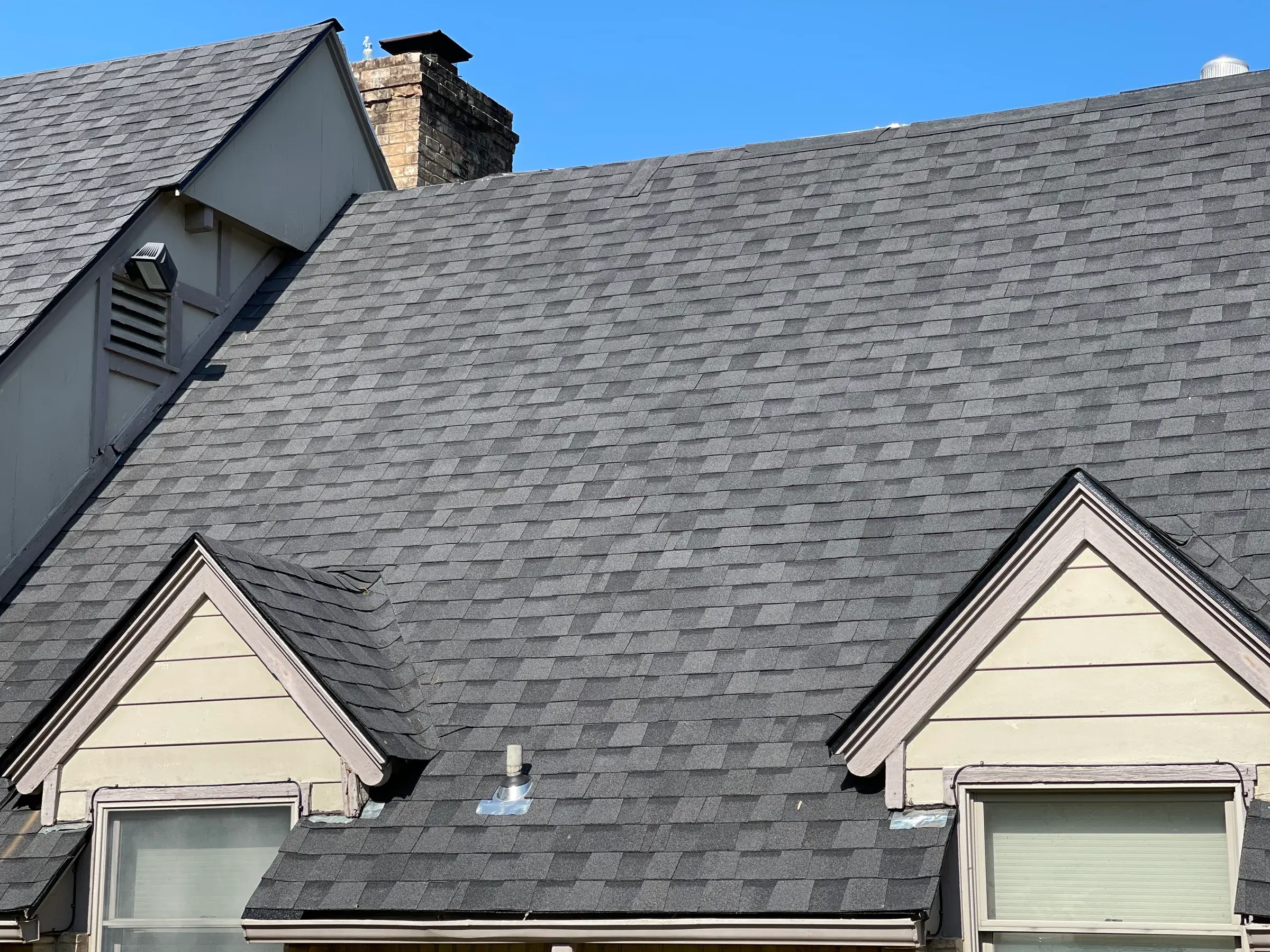
Ridge Vent Installation in Miami, Oklahoma
A ridge vent is the quietest, most even way to exhaust an attic — when the slot is cut right, the intake exists, and the vent is rated for the wind this part of Oklahoma delivers. When any of those are missing it's a decorative strip that leaks. This page is about which one you have.
Most homes we look at with a ridge vent are not actually ventilated. The vent is up there, low and shingled over so you barely notice it. Whether it moves any air at all depends on three things nobody can see from the driveway: the slot underneath it, the intake at your eaves, and the baffle on its edge. Here's how to tell which one you have.
How a Ridge Vent Actually Works
A ridge vent is half of a system. It's the exhaust half. Warm air in an attic rises to the highest point and leaves through the vent, and the only reason it can leave is that cooler air is coming in low, at the eaves. Cut off the intake and the exhaust stops. That's the whole physics of it, and almost every ridge vent problem we find in Miami traces back to that one sentence.
What makes a ridge vent different from every other exhaust option is that it pulls along the entire top of the attic instead of from two or three spots. Air moves evenly across the underside of the decking rather than racing to the nearest hole and leaving the far corners still. On a roof with a decent continuous ridge, that's a real advantage, not a marketing one.
Northeast Oklahoma gives an attic two separate jobs. Summer here runs 57 days a year above 90 degrees, with an August daily high normal of 91.5 and about 62 percent annual sunshine sitting on the shingles. Winter runs 89 nights a year below freezing, and that's when the second job shows up: moisture from inside the house drifts into the attic and condenses on cold decking. A poorly ventilated attic in January can be wetter than one in July. We don't sell ventilation as an energy product. We sell it as the thing that keeps your decking dry and your shingles from cooking from underneath.
Ridge Vent vs. Box Vents vs. Powered Fans vs. Turbines
Four options, four honest sets of tradeoffs.
- Ridge vent — even exhaust across the whole attic, no moving parts, nearly invisible from the street. Needs a continuous ridge to work along and real intake below it. On a hip-heavy roof with 10 feet of ridge, there's simply not enough of it to matter.
- Box vents (turtle vents, louvers) — spot exhaust. Genuinely the right call on broken rooflines, hips, and multi-plane roofs where continuous ridge doesn't exist. The tradeoff is arithmetic: every box vent is another penetration through the deck and another flashing detail that has to hold for 20 years.
- Powered attic fans — usually a mistake, and we'll say so before we sell you one. If intake is inadequate, a powered fan doesn't magically find outside air. It pulls the easiest air available, which is conditioned air from your house through ceiling penetrations, can lights, and the attic hatch. It also has a motor, a thermostat, and a humidistat, all of which fail silently. You keep paying for it and it stops working and nobody knows.
- Turbines (whirlybirds) — on outbuildings and shops across rural Ottawa County they're everywhere, and on a barn they're fine. On a house, the bearings eventually dry out, the unit gets noisy, wobbles, and seizes. A seized turbine is a static box vent that costs more. And it only spins when the wind blows.
The Slot: Why the Cut Determines Whether It Works
Here is the claim this page exists to make: the ridge vent is not the product. The slot is. The vent is a weather cover over a hole. If the hole is wrong, the cover on top of it is decoration.
A correct slot is a strip of decking removed on each side of the ridge board — commonly around an inch per side, though the vent's own instructions govern the width — running continuously along the ridge and stopping short of the ends, so the vent's end plugs land on solid roof. That's it. It is not complicated. It is also skipped, rushed, or done wrong constantly, because once the vent is nailed down and capped nobody can see what's underneath.
The four ways we find it wrong
- Never cut at all. The vent was nailed straight over solid decking. It looks perfect from the driveway. It ventilates nothing. This is more common than anyone wants to admit.
- Cut too narrow, or cut in only one section. A 12-foot slot in the middle of a 40-foot ridge is not a ridge vent, it's a small box vent with a long lid.
- Cut with the blade set too deep, chewing into the ridge board or nicking the rafter tops. That's a framing issue hidden under a vent.
- Cut all the way to the gable ends. The vent's end plugs are meant to seal onto decking. Run the slot past them and you've opened a direct tunnel from the weather into your attic, at the highest, most wind-exposed line on the house.
How to check yours in five minutes
- Go into the attic in the middle of a bright day. Take a flashlight but leave it off at first.
- Let your eyes adjust and look straight up at the peak, down its full length.
- A continuous thin ribbon of daylight running the ridge means the slot is cut and open.
- A ribbon that starts and stops means it was cut in sections.
- No daylight at all means the slot was never cut, or was cut and then blocked, and your ridge vent has never worked a day.
No Intake, No Exhaust: Why Ridge Vents Fail on Miami Homes
When a homeowner tells us the attic is still hot with a ridge vent up there, intake is the answer roughly nine times out of ten. A ridge vent can only move the air that gets in at the eaves.
Ottawa County has 13,701 housing units and 76.7 percent of them are detached single-family. A lot of that stock is older — Miami peaked at 14,237 people in 1980 and has declined since, so much of what's standing was framed before continuous soffit venting was standard. We find soffits that were never vented, vents painted shut through three repaints, and, most often, blown-in insulation shoved out over the top plate until it seals the eave solid. Baffles — the cardboard or foam chutes that hold a channel open from the soffit up past the insulation — are missing on most of the attics we crawl.
General practice is to have at least as much intake as exhaust, and when the two are close, err toward more intake. If intake falls short, the ridge vent doesn't quit. It finds air somewhere else — the gable vents, the bath fan duct, the recessed light housings, the attic hatch — and starts pulling from inside your house. Now you've got a system that moves conditioned indoor air into a cold attic in winter. That's how ventilation work creates a moisture problem instead of solving one.
Diagnosing the whole system — intake, exhaust, insulation, and the ceiling plane below it — is what our roof ventilation repair work covers. This page is about the component. If your ridge vent is the symptom and not the disease, that's the page to read next.
Wind-Driven Rain and Snow Infiltration at the Ridge
This is where Oklahoma matters more than the vent's box copy admits. A ridge vent is an intentional opening at the most wind-exposed line on your house, and wind here doesn't always arrive politely with rain falling straight down.
The defense is the external baffle — the small raised lip along the outside edge of a quality rigid vent. It makes wind jump the opening rather than drive into it, and the low pressure it creates over the top actually helps pull air out. Cheap rolled mesh vents typically have no baffle at all. They rely on the mesh, which stops leaves and wasps and does very little against horizontal water. That's the single biggest quality difference between ridge vent products, and it isn't visible once the cap shingles are on.
Exposure varies across the county in a way that's worth naming. West of Miami is Neosho Lowland — flat prairie and farmland with nothing between your ridge and the horizon. East is Ozark Plains, rockier, rolling, and wooded. A ridge running broadside to open ground west of town is taking wind an identical roof tucked in the trees toward the Missouri line will never see. Same vent, different job.
Blowing snow behaves the same way as blowing rain and is sneakier. Fine snow gets driven through an unbaffled vent, sits on the insulation, and melts weeks later. The homeowner sees a ceiling stain in spring and starts looking for a shingle problem 30 feet away.
One more ridge-specific item: Miami gets 4 to 5 days a year with hail larger than three-quarters of an inch. Ridge vents are plastic and they sit at the highest point on the roof. Hail cracks and splits the housings, and because the vent is capped with shingles, a cracked ridge vent is one of the most commonly missed items on a hail inspection. If we find it, we photograph it and include it in the written damage report. Your insurer decides what's covered.
Retrofitting a Ridge Vent on an Existing Roof
It's a real job, not a bolt-on. It's also meaningfully cheaper done during a replacement, when the ridge cap is coming off anyway.
- Check intake first. Always first. If the soffits are packed solid, cutting a ridge slot accomplishes nothing and we'd rather tell you that before we're on the roof.
- Remove the existing ridge cap shingles along the full run.
- Snap a line each side of the ridge and set the saw depth to the decking thickness only — deep enough to cut sheathing, not deep enough to reach the ridge board or rafter tops.
- Cut the slot continuously, stopping short of each end so the end plugs will land on solid deck. Framing at the peak — a hip juncture, a strongback, blocking — gets worked around, not cut through.
- Clear the cut and look into the attic while it's open. This is the one moment you get a free look at the underside of the decking along the whole ridge.
- Set the vent and fasten it with nails long enough to pass through the vent, the cap shingle, and into the decking below. Short fasteners are why vents lift.
- Cap with matching ridge cap over the vent, and install the manufactured end plugs at both ends.
- Close the old exhaust. Turbines and box vents come off, the holes get decked and flashed over. Capping a turbine base and leaving it is not closing it.
On code: Oklahoma amended IRC R908.3.1.1 to require tear-off rather than shingling over in defined conditions, so a re-roof here is often not a layover regardless of what's on the roof now. The City of Miami requires a permit for new roofs and re-shingles, and we pull it. That's ours to handle, not yours.
Ridge Vents on Metal Roofs and Complex Rooflines
Ridge vents work on metal, but the closure has to be specified for the panel, not adapted from a shingle roof. Exposed-fastener panels need profile-matched closure strips — foam or molded pieces cut to the exact rib shape — under the ridge cap, with a vent mesh that lets air through while the closure blocks water. Standing seam is a different detail again. An improvised ridge closure on a metal roof, or a strip of generic foam mashed over ribs it doesn't fit, is an open channel for wind-driven rain along the entire peak. On our metal roofing work, the ridge detail gets specified with the panel, up front.
Complex rooflines are the other honest limit. A hip roof with 12 feet of ridge over a 2,000 square foot attic doesn't have the ridge length to exhaust it, and forcing one in is how you end up with a vent that satisfies nobody. Hip vent products exist and can help. Sometimes box vents are just the better engineering.
Watch for partitioned attics, too. A bonus room over the garage, a knee wall, a framed-off section — a ridge vent only serves the air volume it can actually reach. We've seen homes where the main attic ventilates beautifully and a sealed-off compartment ten feet away is baking.
When a Ridge Vent Is the Wrong Answer
We'd rather tell you no than sell you a strip of plastic. Ridge vents are the wrong call when:
- The home has a structural ridge beam rather than a ridge board. There's no cavity to cut into, and you don't put a saw through a structural member to make air move.
- The roof is hip-dominant with little continuous ridge. Not enough length to do the job.
- The attic is unvented by design — spray foam at the roof deck, conditioned attic. Cutting a ridge vent into that breaks the assembly it was built as.
- There's a cathedral ceiling with no vent channel above the insulation. Nothing to exhaust.
- It's a manufactured or mobile home. Those are 12.2 percent of housing in Ottawa County, and the roof structure usually has no conventional attic or ridge cavity. The fix there is almost never a ridge vent.
- There's no intake and no way to add it — no overhang, no soffit. Exhaust without intake is just a hole.
Free inspection, free quote, and a straight answer. If we get in your attic and find that your ridge vent is fine and your soffits are packed with insulation, we'll tell you that, and the ridge vent portion of the bill is zero. Call (209) 758-8550. We're at 111 S Main St in Miami and we work across northeast Oklahoma and into Kansas, Missouri, and Arkansas.
Ridge Vent Installation questions
Is a ridge vent better than box vents?
Usually, for a roof with a decent continuous ridge. A ridge vent exhausts along the entire top of the attic, so it ventilates evenly instead of pulling from a few spots. Box vents work fine on rooflines with short or broken ridges, hips, or multiple planes where there isn't enough continuous ridge to make a ridge vent worth it.
I have a ridge vent and my attic is still hot. What's wrong?
Nine times out of ten, intake. A ridge vent can only exhaust the air that comes in at the soffits, and if those are blocked by insulation, painted shut, or never existed, the ridge vent has nothing to move. The second most common cause is a slot that was never actually cut, or cut too narrow — the vent is on the roof, but the roof under it is solid.
Can a ridge vent leak?
Yes, in two ways. Cheap rolled or unbaffled vents let wind-driven rain in from the side, which matters in Oklahoma more than in most places. And a slot cut too wide, or run all the way to the ends of the ridge, opens paths that no vent covers. A properly baffled, correctly cut, correctly fastened ridge vent is very reliable.
Can I add a ridge vent to my existing roof?
Yes. It means removing the ridge cap, cutting the slot through the decking on each side of the ridge board, setting the vent and re-capping. It's a real job, not a bolt-on, and it's meaningfully cheaper if it's done while the roof is being replaced anyway.
Should I keep my turbines or powered fan if I add a ridge vent?
No — that's the classic mistake. Two types of exhaust on the same attic space short-circuit each other: the fan or turbine takes the easy air from the ridge vent instead of pulling it from the soffits, and the attic underneath barely moves. Pick one system and close the other.
Do ridge vents work on metal roofs?
They do, with vent products made for the panel profile and closures that match the ribs. It's a detail that has to be specified for the panel, not adapted from a shingle roof — an improvised ridge closure on a metal roof is an open invitation for wind-driven rain.
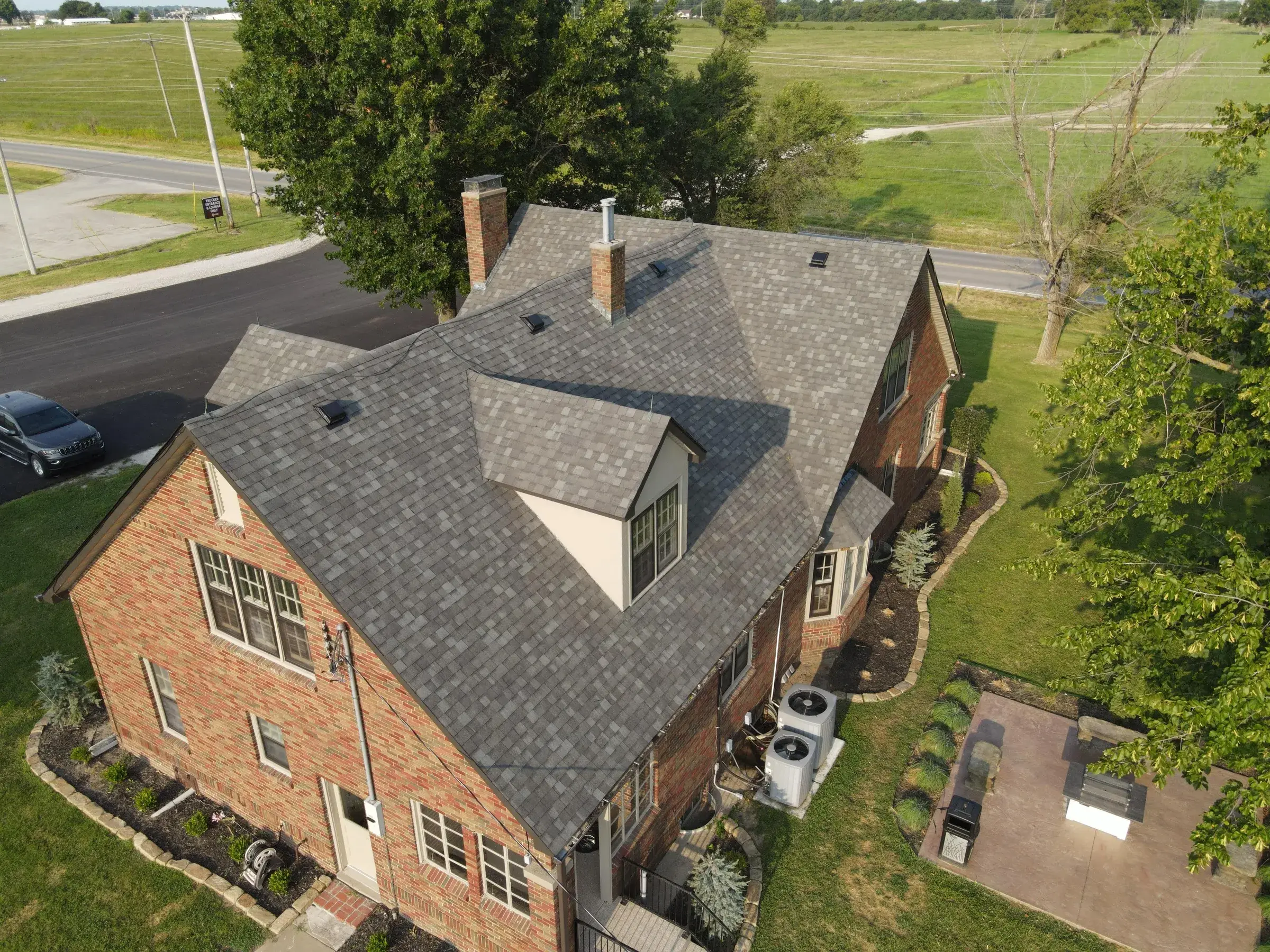
Protect Your Property with a Free Roof Inspection
Tell us what you're seeing. We'll arrange an inspection, explain the findings, and provide clear next steps without pressure.
- • A real look at the roof, not a sales visit
- • Photos of whatever we find, and what it means
- • A written quote if you want one — and an honest “you don’t need us yet” if that’s the answer