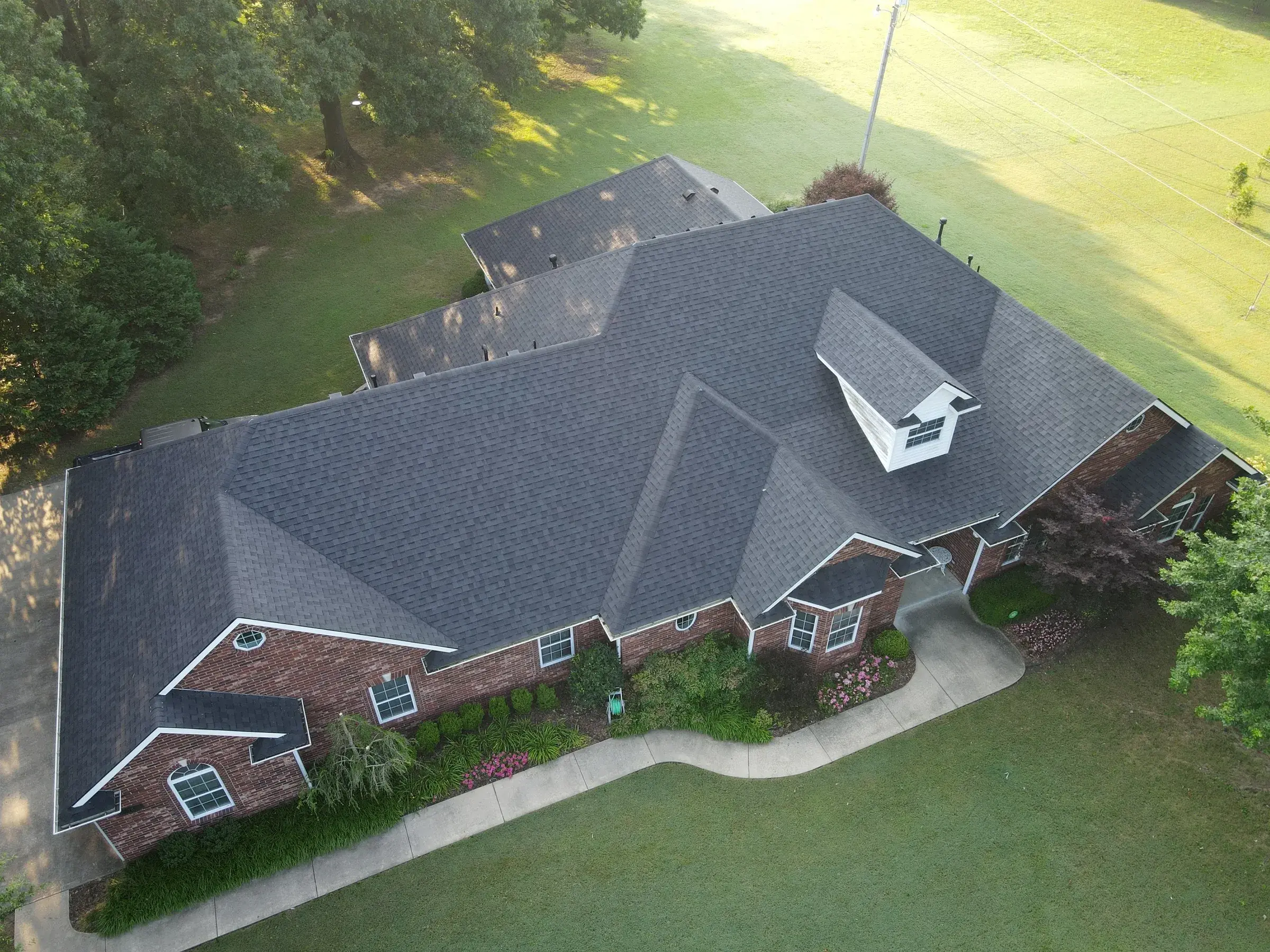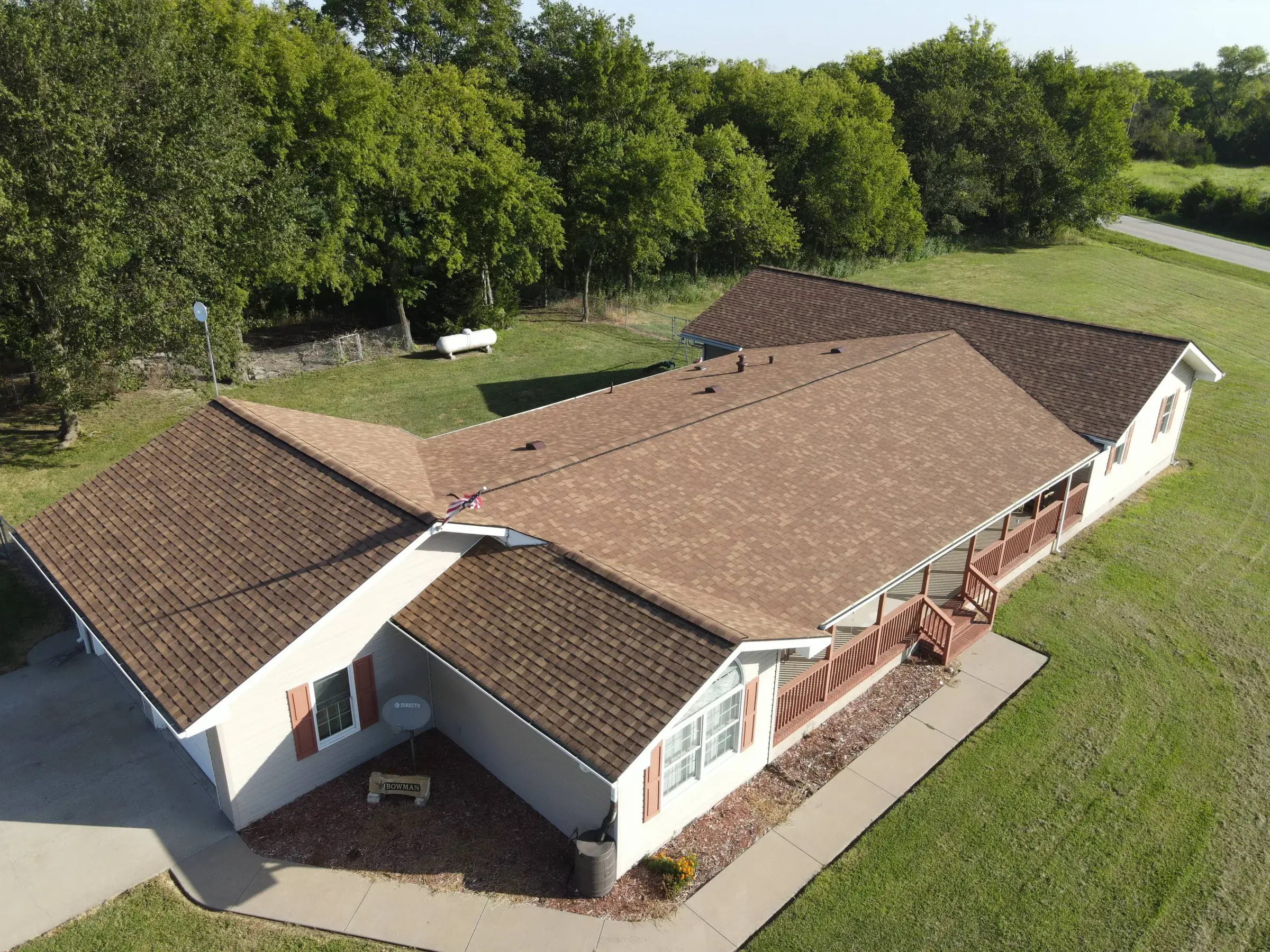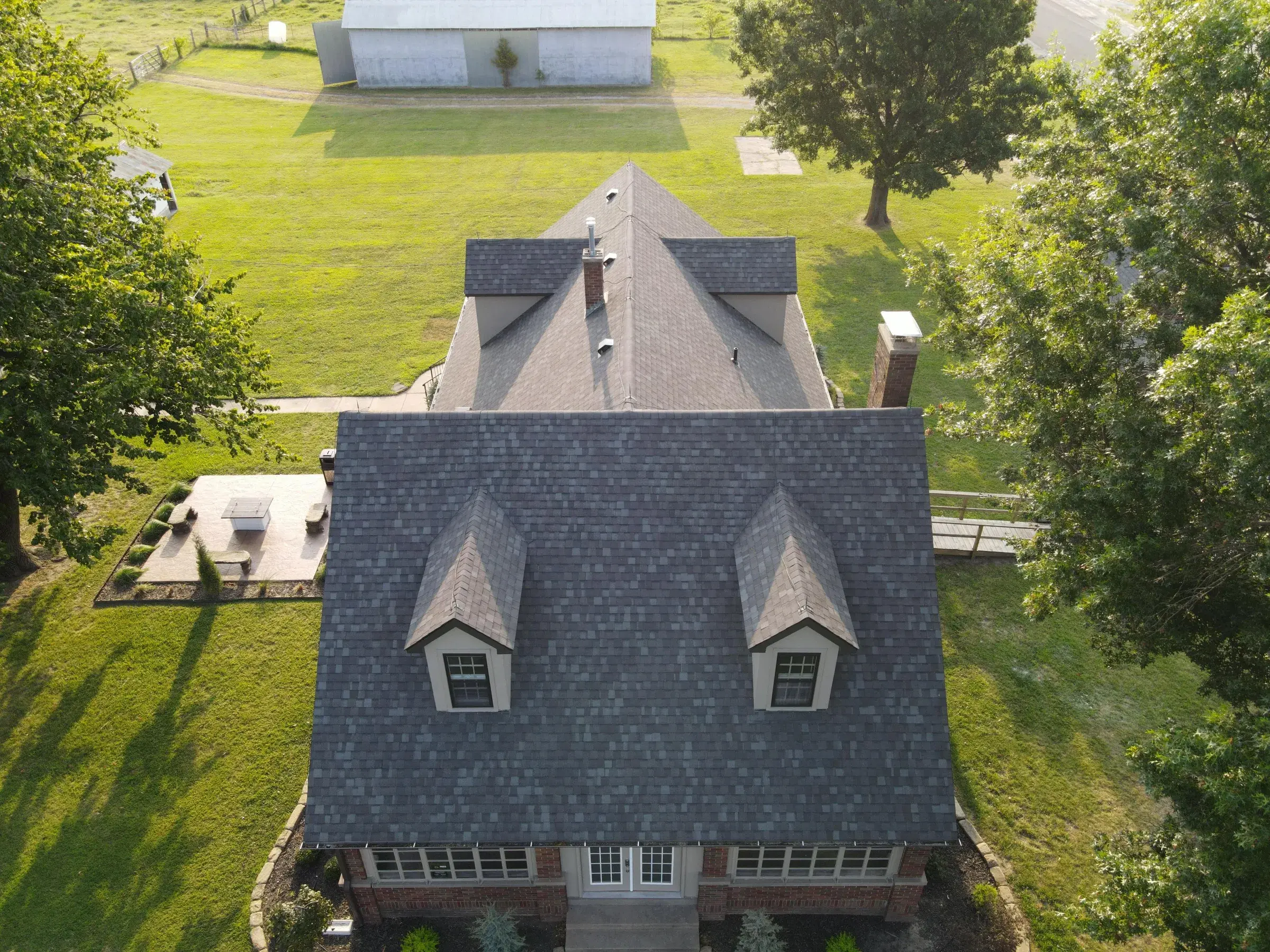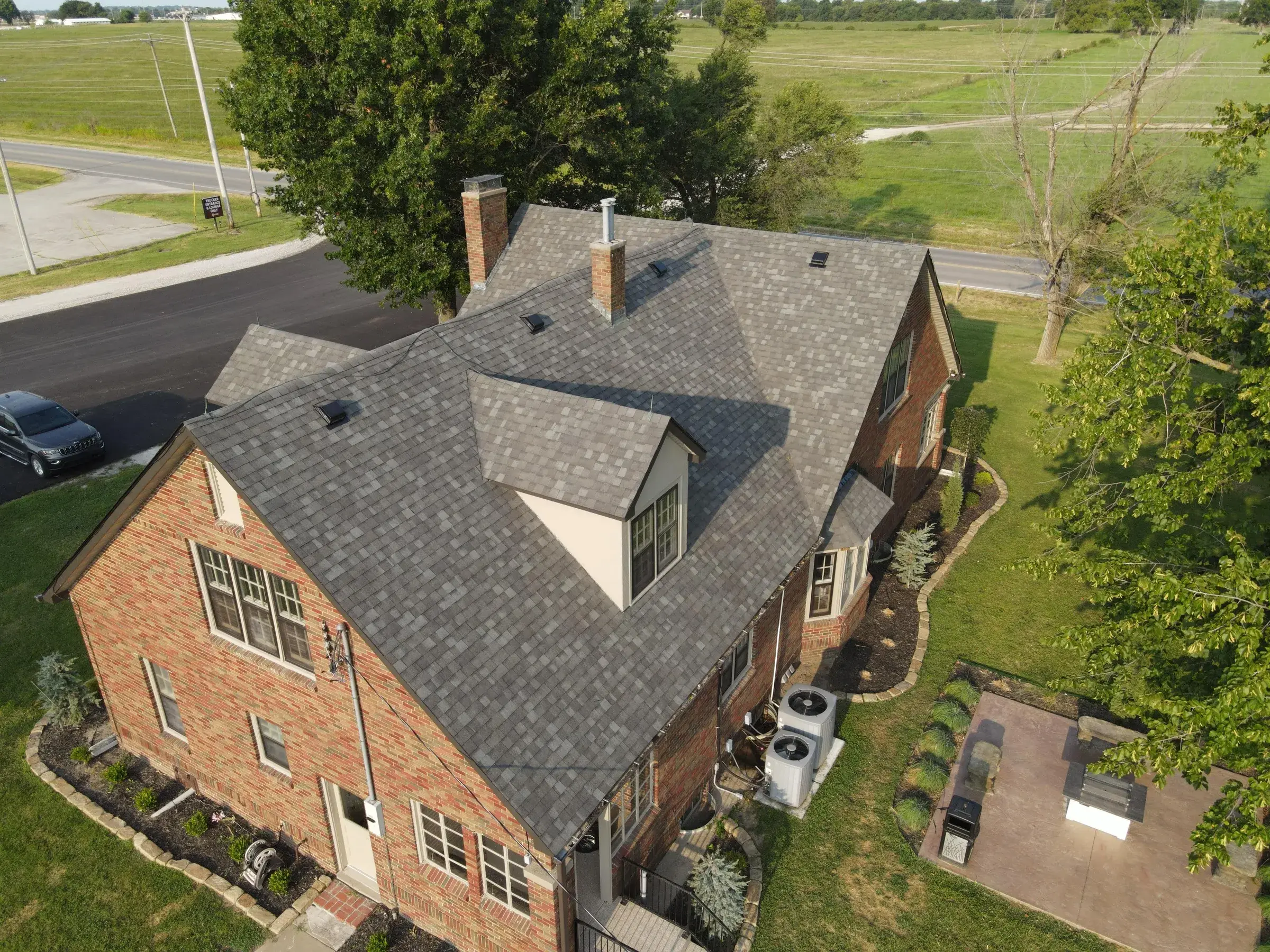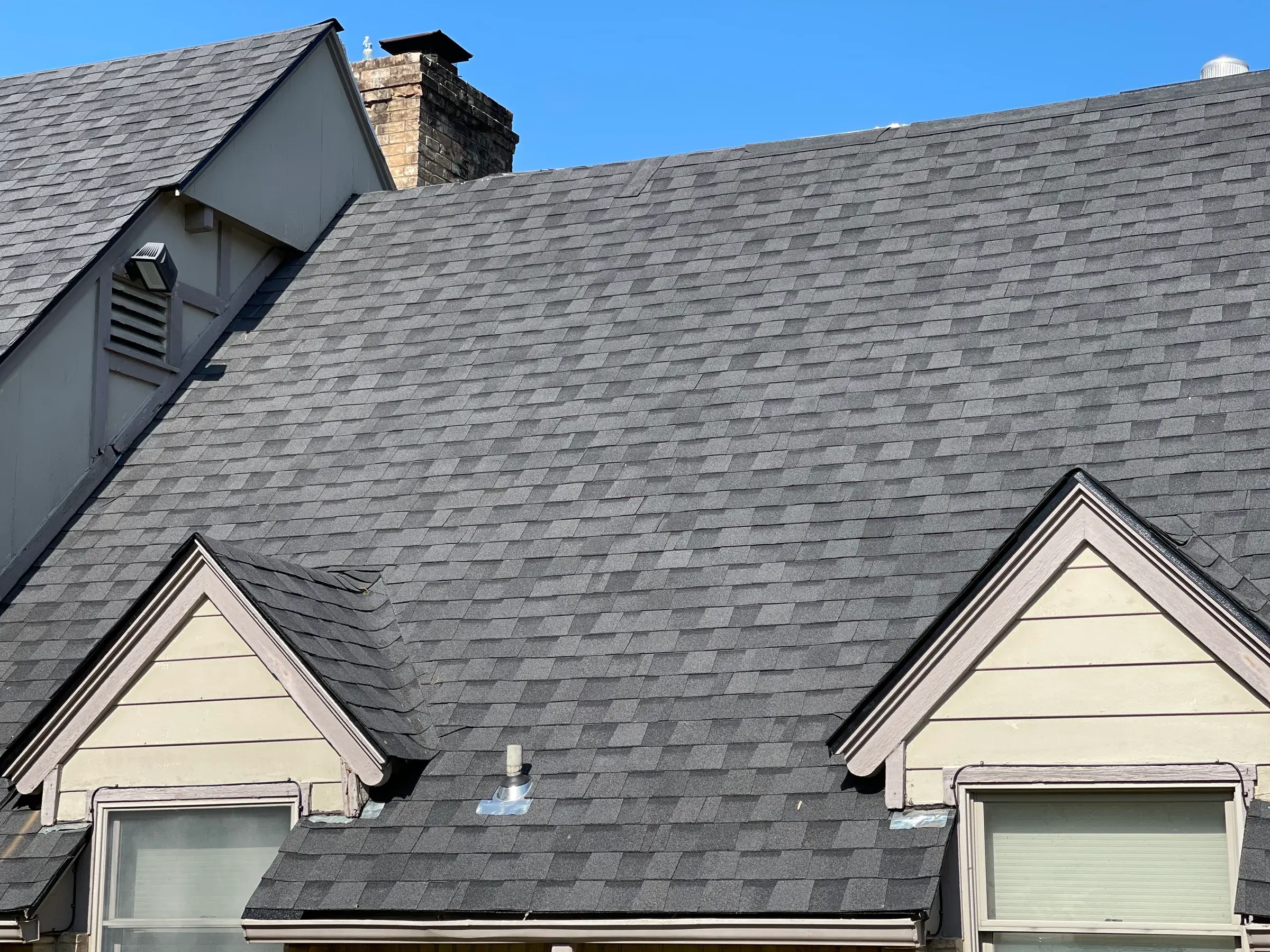
Class 4 is the highest impact rating under UL 2218. To earn it, a shingle must survive two drops of a two-inch steel ball on the same spot without the mat cracking. It signals lab-tested toughness, not immunity — a Class 4 shingle can still be damaged by hail, and the rating says nothing about wind, granule loss, or age.
What UL 2218 actually is: the steel-ball drop test
The full name of the standard is UL 2218, Standard for Impact Resistance of Prepared Roof Covering Materials. The test itself is simple enough to describe in one sentence. A shingle sample is fastened to a deck the way it would be installed on a house, and a solid steel ball is dropped down a guide tube onto the same spot twice. Then someone inspects the sample — front and back — for cracking, splitting, tearing, or any other fracture of the mat. The mat is the fiberglass core underneath the granules. If it fractures, the sample fails.
Notice what is not in that description. No hail. No wind. No temperature. No sun. A ball, a tube, and an inspection light. That is the whole event.
UL 2218 defines four classes. Each step up uses a bigger ball dropped from a greater height, which means more impact energy. Class 4 is the top of the scale.
| Class | Steel ball diameter | Drop height | Relative impact energy |
|---|---|---|---|
| Class 1 | 1.25 in | 12 ft | Lowest |
| Class 2 | 1.50 in | 15 ft | Low |
| Class 3 | 1.75 in | 17 ft | High |
| Class 4 | 2.00 in | 20 ft | Highest on the scale |
Two details get skipped in most sales conversations, and both of them matter. First, the ball hits the same spot twice — that is deliberate, because a single bruise a shingle can absorb is different from a second hit on already-stressed material. Second, the impacts are aimed at the weak places on purpose: over joints, near fasteners, across unsupported spans. That targeting is a real part of why the rating means something. It is a stress test of how the shingle is built, not a check of how tough the surface looks.
The third detail is the biggest one. UL 2218 is pass/fail. There is no score, no margin, no ranking within a class. A shingle that barely survived the second drop and a shingle that shrugged it off both print "Class 4" on the wrapper. That single fact explains most of the confusion in this category.
How FM 4473 differs — ice balls, not steel — and why you may see both cited
There is a second impact standard in circulation: FM Approvals 4473. Instead of dropping steel, FM 4473 uses molded ice balls fired from a pneumatic launcher at a velocity intended to approximate what a falling hailstone would reach. It is the more physically honest medium, for an obvious reason — ice shatters on impact and steel does not, so the two deliver their energy to the shingle in genuinely different ways.
| UL 2218 | FM 4473 | |
|---|---|---|
| Test medium | Solid steel ball | Molded ice ball |
| Delivery | Free-fall down a guide tube | Fired from a pneumatic launcher at a set velocity |
| Impacts per location | Two, on the same spot | Per the standard's stated impact pattern |
| What passes | No cracking, splitting, tearing, or fracture of the mat on either face | No rupture or fracture of the covering under the specified impact |
| Class scale | Class 1 through Class 4 (4 is highest) | Class 1 through Class 4 (4 is highest) |
| Where you'll usually see it | Residential asphalt shingle data sheets; most insurer discount programs that exist reference it | FM Approvals-listed assemblies, more often commercial and low-slope systems |
For a house in Ottawa County with asphalt shingles, UL 2218 is almost always the relevant one. If a salesperson quotes you an FM class while the manufacturer's published data sheet lists a UL class — or the reverse — that is not automatically a problem, but it is worth one question: which listing does this exact product actually hold, and can I see the sheet that says so?
What the rating does not measure
The Asphalt Roofing Manufacturers Association has been clear in its technical guidance on impact-resistant shingles that UL 2218 is a laboratory comparison between products, not a prediction of field performance in real hail. That is not a manufacturer hedging. It is an accurate description of what a controlled drop test can and cannot tell you. Here is what falls outside the rating entirely.
Granule loss
The UL 2218 pass criterion is about the mat fracturing. Granule loss is a separate thing, and in practice it is one of the most common forms of real hail damage — the stones knock the mineral surfacing off and expose the asphalt underneath to sunlight. A Class 4 shingle can lose granules and still be a Class 4 shingle. Exposed asphalt ages faster, and northeast Oklahoma gets roughly 62% of possible sunshine annually, so that exposure is not trivial here.
Wind
Impact resistance and wind resistance are measured by different standards that have nothing to do with each other. Wind performance for asphalt shingles is evaluated under ASTM D3161 and ASTM D7158; the UL 2218 class says nothing about it. This distinction is worth holding onto on the west side of Ottawa County, where the Neosho Lowlands are open prairie and farmland with long wind fetch and nothing to slow a gust down. A Class 4 roof installed with the wrong nailing pattern is still a roof with the wrong nailing pattern.
Age
The tested shingle was new. Yours will not be, for most of its life. Asphalt stiffens as it ages, and stiff asphalt is more brittle under impact. Add 89 nights a year below freezing — the Oklahoma Climatological Survey's 1991–2020 normal for this area — and a full freeze-thaw cycle count that most of the country does not deal with, and you have a material that is quietly changing every winter. Nobody re-runs UL 2218 on a twelve-year-old roof.
Functional versus cosmetic damage
This is a policy question, not a product question, and it catches people. Some homeowners policies distinguish between damage that affects the roof's ability to keep water out and damage that only affects how it looks. Ask your agent directly whether your policy contains a cosmetic damage exclusion or endorsement, and how it applies to an impact-resistant roof. Your insurer decides coverage under your policy — a roofer cannot tell you what your policy says, and should not try.
SBS-modified, rubberized, and mesh-backed: three ways to reach Class 4
Because UL 2218 is pass/fail, manufacturers are free to reach Class 4 by whatever route they choose. Three broad approaches dominate, and they behave differently even though the wrapper says the same thing.
SBS-modified asphalt
SBS stands for styrene-butadiene-styrene — a rubber polymer blended into the asphalt itself. The result is asphalt that stays flexible at lower temperatures and tends to rebound from a strike rather than fracture. In a market with 89 freeze nights a year and a record low of -28°F, cold-temperature flexibility is not an abstraction. This is the approach most often described as the shingle absorbing the hit.
Rubberized or polymer-modified constructions
A related family uses a polymer-modified layer or a rubber-like component in the shingle build rather than a fully SBS-modified asphalt throughout. The intent is similar — add elasticity where the impact lands — but the amount and placement of the modifier vary considerably product to product. This is exactly the kind of difference the pass/fail rating hides.
Mesh-backed or scrim-reinforced
The third approach laminates a fabric mesh or scrim to the underside of the shingle. The mesh holds the mat together so it cannot split, which is the literal pass criterion. That is a different mechanism from staying flexible — the shingle is reinforced against fracture rather than resilient to the blow. This is where the Insurance Institute for Business & Home Safety becomes worth your time. IBHS has published impact-resistant roofing research and runs a hail ratings program that grades UL 2218 Class 4 products against one another rather than treating them as interchangeable, precisely because the field performance spread within the class is wide. If you are spending money on Class 4, spend ten minutes on the IBHS ratings first.
So the useful question at the kitchen table is not "is it Class 4." It is "how does this one get there." Ask which mechanism the product uses, and ask what the data sheet says about cold-weather flexibility. Those two answers separate the products more than the rating does.
Why hail-region homeowners in northeast Oklahoma look at this rating at all
Because the hail is real and it is regular. The Oklahoma Climatological Survey puts this area at roughly 4 to 5 days per year with hail larger than 0.75 inch. That is not a catastrophe statistic — it is a maintenance-planning statistic. It means a roof installed here will be struck, repeatedly, across its service life, and the only variable is how hard.
If you want the specific history for your own address rather than a regional normal, the NOAA National Centers for Environmental Information Storm Events Database lets you query by county and date range, and NWS Tulsa is the forecast office covering Ottawa County. Pull Ottawa County, set your own window, and read what is actually there. We would rather you look it up than take a number from a roofing blog — including this one.
The housing stock matters too. Ottawa County has 13,701 housing units, 76.7% of them detached single-family homes and 12.2% mobile or manufactured. That is a lot of individually owned asphalt roofs making this decision one at a time. And the geography splits the county in half: east of Miami you are in the Ozark Plains, rockier and wooded, where tree cover shades roofs, drops debris, and encourages moss; west you are in open lowlands with nothing between your roof and the weather. The same shingle ages differently on the two sides of town.
There is also a plain economic reality. Median home value in Ottawa County is $123,300 and median household income is $49,947. A Class 4 upcharge is a genuine household decision here, not a rounding error on a big number. That is the honest frame for the rest of this article.
Insurance premium discounts: how to ask, and why the answer comes from your insurer
Let us be precise, because this is where the marketing gets loudest. Oklahoma does not mandate that insurers give you a discount for an impact-resistant roof. There is no state law requiring it. Search the full text of Title 36 for "UL 2218" or "impact resistant" and you get nothing. Any roofer telling you a discount is required by law is wrong.
What is true is that some carriers voluntarily offer an impact-resistant roofing credit, and the terms are entirely theirs. The percentage, the eligibility rules, the documentation they want, whether it applies to the whole premium or just the wind-hail portion — all of that varies by company and by policy. We are not going to publish a number, because any number we published would be a guess about your carrier. The Oklahoma Insurance Department publishes consumer guidance on homeowners coverage and available discounts, and that is a neutral place to start reading before you call anyone.
To be clear about our own role: we can document damage with a photo report, we can give you a written estimate for the work we would perform, and we can meet your adjuster on site if you ask us to. We can help you understand the process. What we cannot do — what no roofing contractor in Oklahoma may lawfully do — is represent your interests to your carrier for compensation, negotiate your claim, or promise you an outcome. That is public adjusting, and it requires a license we do not hold. Your insurer decides coverage under your policy. If a contractor offers to handle your claim, get your roof approved, or do anything at all involving your deductible, that is your signal to stop the conversation.
Cost, weight, and appearance trade-offs against standard architectural shingles
| Standard architectural | Class 4 impact-resistant | |
|---|---|---|
| Construction | Laminated fiberglass mat, conventional asphalt | SBS-modified asphalt, polymer-modified build, or mesh/scrim-backed mat |
| UL 2218 rating | Often unrated or a lower class | Passes the 2 in / 20 ft steel-ball drop, twice on the same spot |
| Weight per square | Baseline | Generally heavier — ask for the actual figure from the data sheet, and confirm the deck and structure suit it |
| Appearance | Full color and profile range | Usually visually similar; color and profile choices can be narrower within a Class 4 line |
| Cold-weather behavior | Stiffens with cold and age | SBS-modified products are formulated to stay flexible; mesh-backed products resist splitting by reinforcement instead |
| Relative cost | Baseline | Higher — insist it appears as its own line item on the written proposal |
| Warranty terms | Per the manufacturer's written document | Often different from the standard line; terms vary — read the manufacturer's actual warranty document, not a summary |
On weight: heavier is not automatically a problem, but it is a question, especially on an older home or on a structure that has already carried more than one roof. On appearance: for most Class 4 products you will not be able to tell from the driveway, though the color palette inside a given impact-resistant line is sometimes shorter than the standard line. On cost: the upcharge is real, and against a $123,300 median home value it deserves a straight arithmetic conversation rather than a pitch. If you are already planning a [roof replacement](/services/roof-replacement), the marginal cost of stepping up to Class 4 is a much smaller number than it looks like in isolation — that is the moment to price it, not later.
How to verify a product's rating yourself before the job starts
"It's Class 4" is a sentence. Verification is a document. Every item below is something you can do yourself, before anyone tears anything off.
Verify a Class 4 claim in six steps
- Get the exact product name and line from the proposal — not "impact-resistant shingle," but the manufacturer's specific product designation.
- Pull that product's published data sheet from the manufacturer's own website and confirm it states UL 2218 Class 4 for that exact product and color line.
- Check the UL Product iQ certification directory for the listing rather than trusting a logo on a brochure.
- Photograph the packaging wrapper on the day of delivery — the class marking is printed on it, and that photo is the easiest documentation to hand an insurance agent later.
- Require the Class 4 product to appear as its own line item on the written proposal, with the product name spelled out, so there is no substitution question mid-job.
- Ask for the manufacturer's written warranty document for that specific product before you sign, and read the impact-related terms yourself.
- Verify the contractor's Oklahoma registration at verifyroofing.cib.ok.gov — the Construction Industries Board runs a free public lookup, and registration requires carrying at least $500,000 in liability insurance for residential work.
- Confirm the permit: the City of Miami requires one for new roofs and re-shingles. We pull ours.
One more code point that bears directly on this. Oklahoma amended IRC section R908.3.1.1 to require tear-off rather than shingle-over in defined conditions, so in many cases you cannot simply lay a Class 4 product over the roof that is already there — and honestly, you should not want to. An impact-resistant shingle over a compromised deck is an expensive shingle on a bad foundation. A proper [roof inspection](/services/roof-inspections) before you spec the material tells you what the deck is actually doing. Requirements are set by the current Oklahoma residential code, so confirm the specifics with the City of Miami before the job rather than relying on what was true a few years ago.
When Class 4 is probably not the right spend
We would rather tell you this than sell you something you do not need. There are real situations where the upcharge does not earn itself.
- Your carrier offers no impact-resistant credit at all, and you have confirmed that by asking them directly — the payback then rests entirely on the roof lasting longer, which is a slower and less certain return.
- You expect to sell within a few years. Class 4 is not a line buyers price into an offer in this market, and the upcharge does not reliably come back at closing.
- The roof deck, structure, or ventilation has problems that the money would fix better. A premium shingle over rotted sheathing is the most expensive way to not solve a problem.
- The building is a detached garage, shop, or outbuilding where a hail replacement is an inconvenience rather than a crisis.
- You are patching, not replacing. Mixing a Class 4 product into a repair on a standard roof buys you nothing measurable and complicates any future documentation.
And where does it earn itself? Usually on a home you intend to keep, on the open west side of the county or anywhere with no tree buffer, where you are already replacing the whole roof, where your carrier has confirmed in writing that a credit exists, and where you have chosen the product on the strength of its data sheet and its IBHS rating rather than the phrase on the wrapper. That is a narrower recommendation than most roofers will give you. It is also the accurate one.
If hail has already hit and you are trying to work out what you are looking at rather than what to buy next, that is a different question — start with what [storm damage on an asphalt roof](/services/storm-damage-roof-repair) actually looks like up close, because a bruise reads very differently from a manufacturing blister once you know the difference.
We are at 111 S Main St in [Miami](/locations/miami-ok), on the old Route 66 alignment, and we work across Oklahoma, Kansas, Missouri and Arkansas. Inspections and quotes are free. If you want someone to walk your roof, tell you plainly whether [asphalt shingles](/services/asphalt-shingle-roofing) at Class 4 make sense for your particular house, and put the product name in writing on the proposal, call us at (209) 758-8550.
Questions people ask about this
Do Class 4 shingles prevent hail damage?
No. Class 4 means a shingle passed the UL 2218 test — a two-inch steel ball dropped twice on the same spot from 20 feet without the mat fracturing. It is a laboratory durability signal, not immunity. A Class 4 roof in northeast Oklahoma can still lose granules, bruise, crack, and need replacement after a storm. The Asphalt Roofing Manufacturers Association describes the standard as a comparison between products, not a prediction of field performance.
Does Oklahoma require insurers to give a discount for impact-resistant roofing?
No. There is no Oklahoma law mandating an impact-resistant roofing discount, and searching Title 36 for terms like "UL 2218" or "impact resistant" returns nothing. Some carriers voluntarily offer a credit, but the amount, eligibility and documentation rules are set entirely by the insurer. Ask your own agent whether they offer one and what it is worth on your specific policy, and check the Oklahoma Insurance Department's consumer guidance on available discounts.
What is the difference between UL 2218 and FM 4473?
UL 2218 drops a solid steel ball down a guide tube onto the shingle. FM 4473 fires a molded ice ball from a pneumatic launcher at a set velocity, which is a more physically realistic medium since ice shatters and steel does not. Both use a Class 1 through Class 4 scale. For residential asphalt shingles in Oklahoma, UL 2218 is the listing you will usually see on the manufacturer's data sheet.
Are all Class 4 shingles equally tough?
No, and this is the most useful thing to know about the rating. UL 2218 is pass/fail with no score, so a shingle that barely survived and one that shrugged it off both print Class 4. Manufacturers reach the rating in different ways — SBS-modified asphalt that stays flexible in cold, polymer-modified builds, or a mesh backing that reinforces the mat against splitting. The Insurance Institute for Business & Home Safety runs a hail ratings program that grades Class 4 products against each other, which is worth reading before you choose.
How do I confirm the shingles on my house are actually Class 4?
Get the exact product name on the written proposal as its own line item, pull that product's data sheet from the manufacturer's own site, and check the UL certification directory for the listing. On delivery day, photograph the packaging wrapper — the class marking is printed on it and that photo is the easiest thing to hand an insurance agent later. While you are verifying, check the contractor's Oklahoma registration free at verifyroofing.cib.ok.gov; registration requires at least $500,000 in liability insurance for residential work.