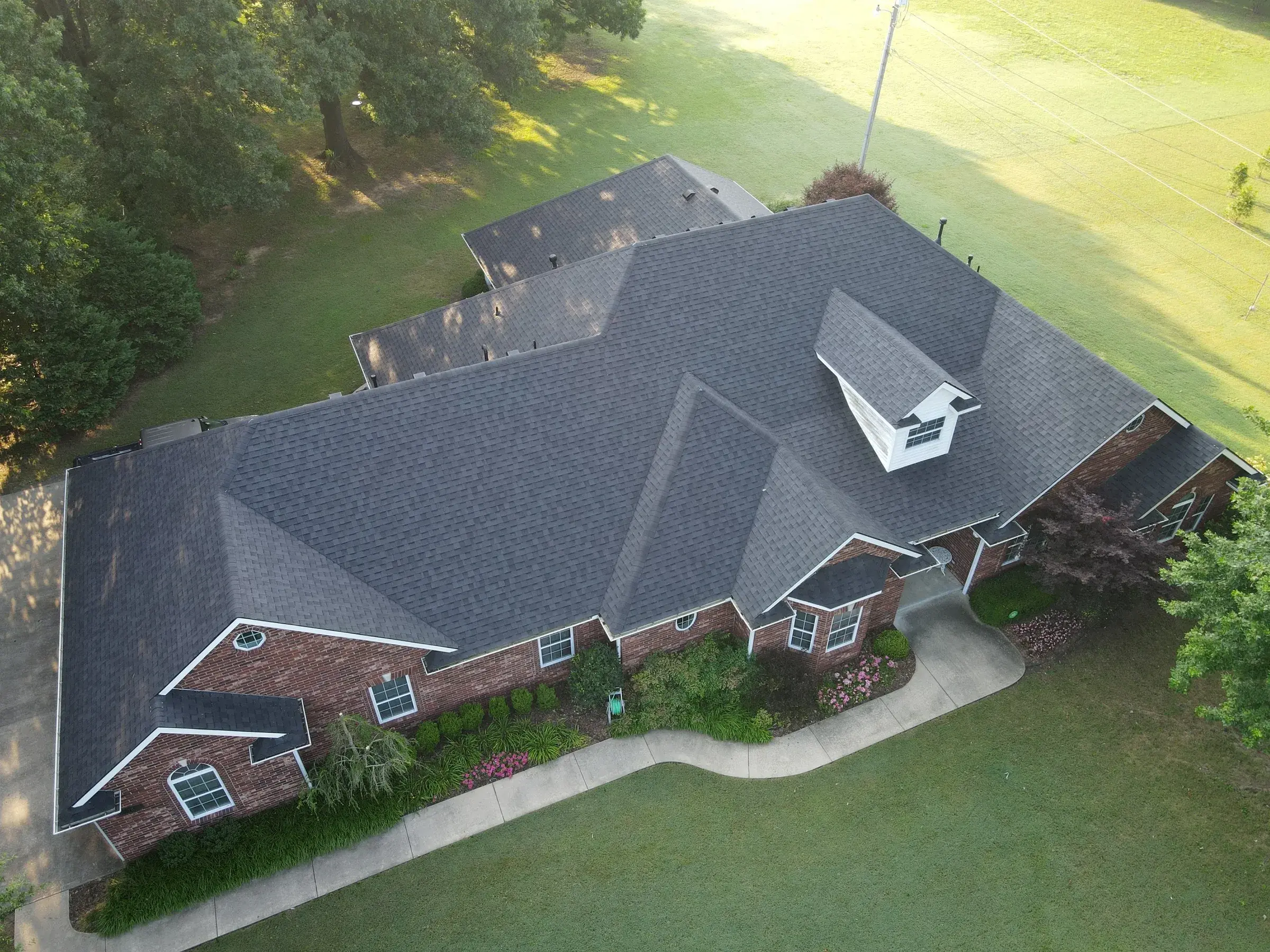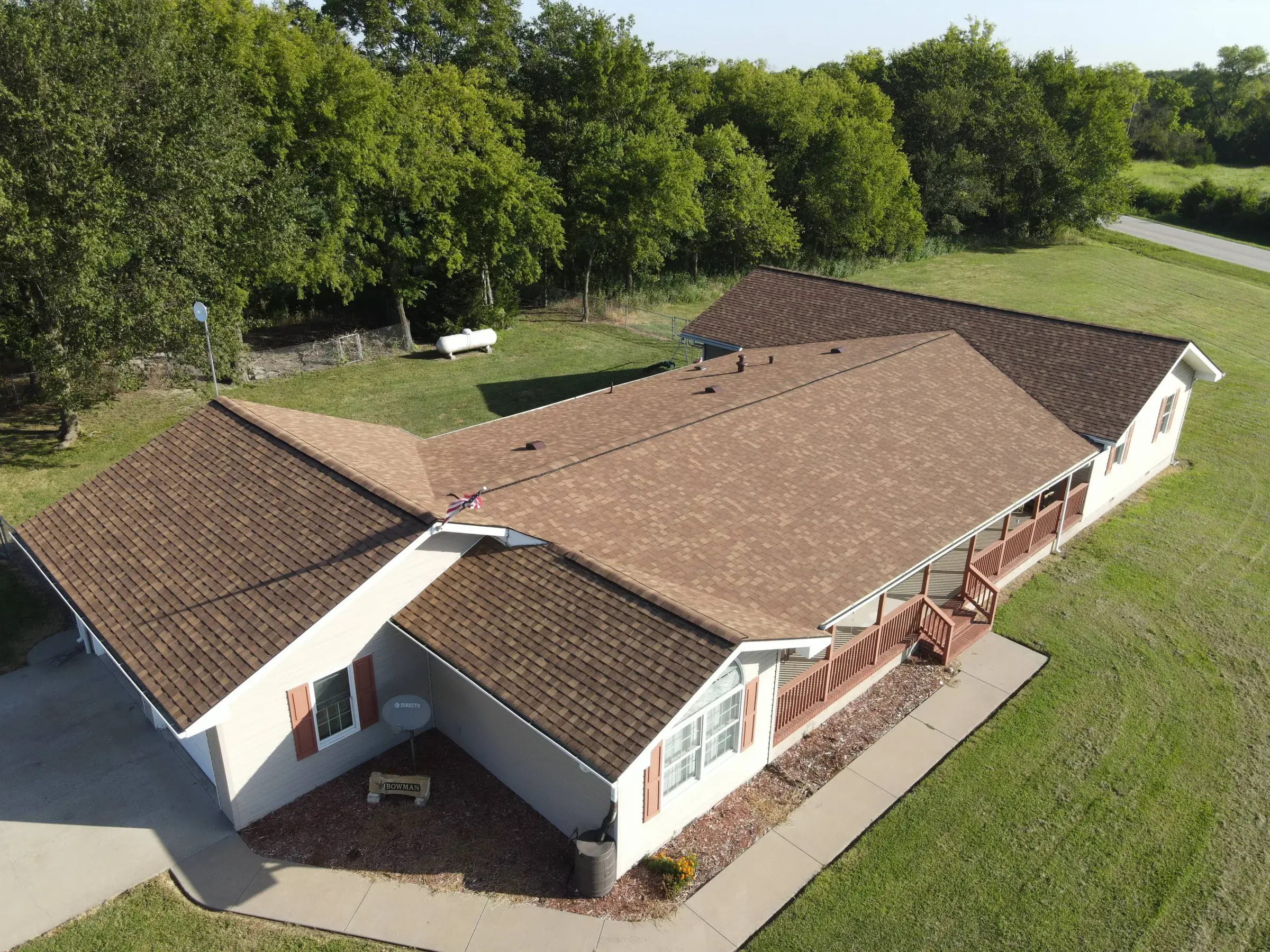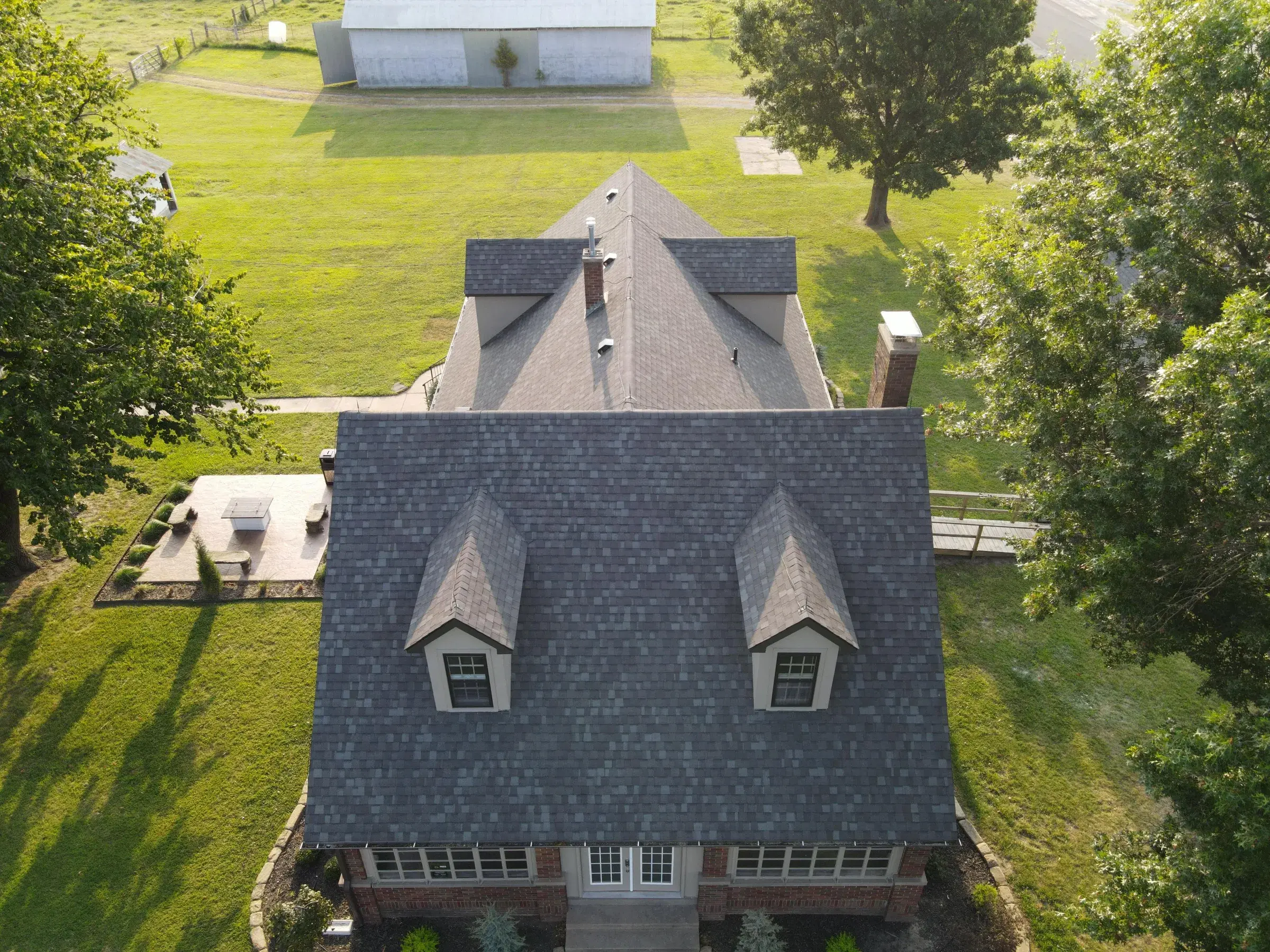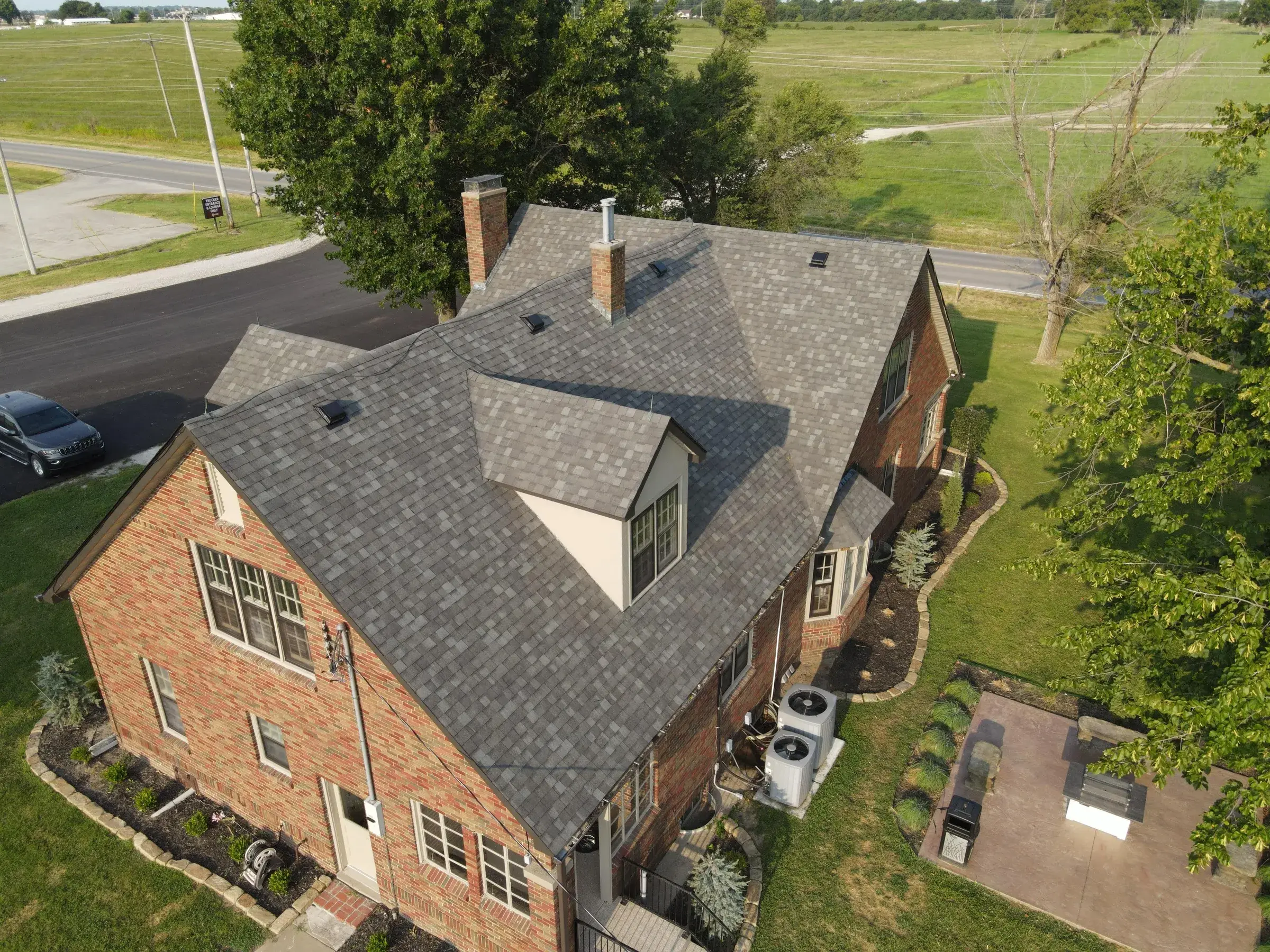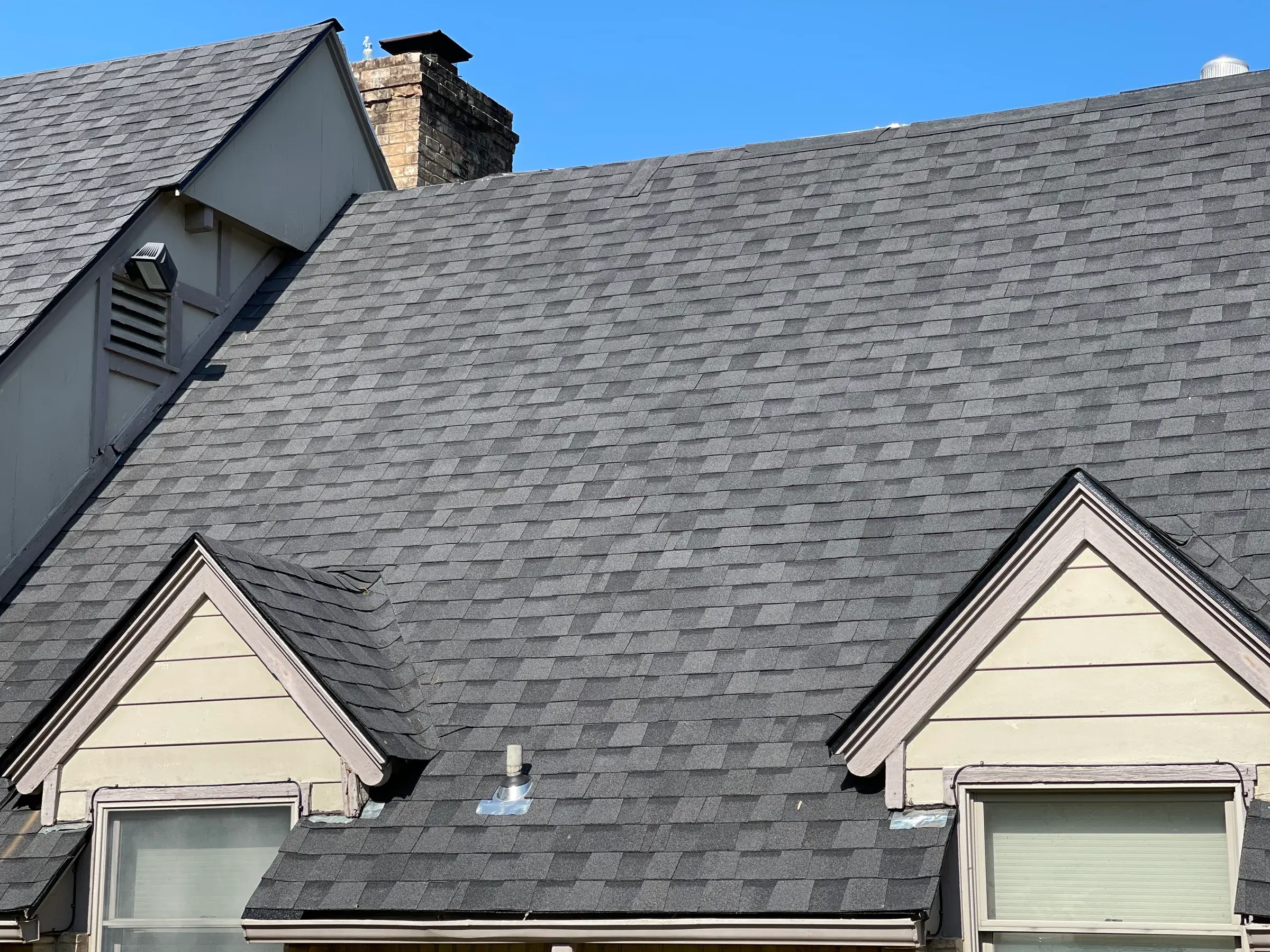
Flashing is the metal (and occasionally membrane) that seals every interruption in the roof plane. The main types are step flashing at sidewalls, counterflashing into masonry, kickout flashing where a roof meets a wall end, valley flashing, pipe boots at vent penetrations, and chimney flashing with a cricket. Most leaks originate at these details rather than in the field of the shingles.
Why leaks concentrate at penetrations and transitions, not in the field
The open middle of a roof — what roofers call the field — is the easy part. Shingles overlap each other in courses, gravity does the rest, and water runs off. Nothing there is asking much of the roof.
Trouble starts where that clean plane gets interrupted. A wall comes up through it. A chimney sits in it. Two slopes meet at an angle. A plumbing vent pokes out of it. At every one of those spots, somebody had to build a watertight joint out of metal, and that metal is called flashing.
The NRCA Roofing Manual's steep-slope volume treats flashing as its own discipline for exactly this reason: the shingle is a mass-produced part with a spec sheet, and the flashing detail is a decision a person made on a specific roof on a specific day. One of those two things is far more variable than the other.
Ottawa County adds its own pressure. The Oklahoma Climatological Survey's 1991–2020 normals record roughly 89 nights a year below freezing here, which means the mortar joints a counterflashing sits in go through dozens of freeze-thaw cycles annually. Add 57 days above 90°F, about 62% annual sunshine, and 4 to 5 days a year with hail larger than three-quarters of an inch, and you have a climate that works metal, rubber and sealant hard in both directions.
So when a ceiling stain shows up, the shingles are usually not the story. The interruption near that stain is.
| Flashing type | Where it's used | Typical failure mode | Visible from ground? |
|---|---|---|---|
| Step flashing | Where a sloped roof runs alongside a vertical wall | Installed as one long bent strip instead of individual pieces; face-nailed through the exposed leg; reused on a reroof | Partly — you can often see the stepped edges if it's done right |
| Counterflashing | Over the top of step or chimney flashing, set into masonry or under siding | Reglet joint cracks open; sealant-only mount lets go; mortar erodes around it | Yes, on chimneys and brick walls |
| Kickout flashing | At the bottom end of a roof-to-wall run, above the gutter | Simply absent — the most common omission in the trade | Yes, if you know to look at that corner |
| Valley flashing | Where two roof slopes meet in a V | Debris dam, undersized metal, nails driven too close to the centerline | Open metal valleys, yes; closed-cut and woven, harder to judge |
| Pipe boot | Around plumbing vent stacks | Rubber collar cracks from UV and heat cycling — usually the first flashing on the roof to fail | Sometimes, with binoculars |
| Chimney flashing + cricket | Around a chimney, especially the uphill face | No cricket on a wide chimney; snow, ice and debris pile on the high side | Yes |
| Skylight / curb flashing | Around skylights and curbed units | Kit parts mixed with generic metal; head flashing not lapped correctly | Rarely |
| Drip edge | Along eaves and rakes | Missing at rakes; wrong sequence relative to underlayment | Yes |
| Apron / headwall flashing | Where a slope dead-ends into a wall | Too short a vertical leg; no counterflashing above it | Sometimes |
Step flashing: the piece-per-course rule and what continuous 'L' flashing gets wrong
Step flashing is the L-shaped metal — one leg up the wall, one leg out onto the roof — that ties a sloped roof into a vertical wall running up the slope. Think of a garage roof running alongside the house wall, or a dormer side.
The rule that matters: one piece per shingle course. Each piece is woven in as that course goes down, so every piece laps over the one below it, like scales. Water that gets past the wall covering lands on a piece of metal, runs down onto the next piece, and exits onto the shingles. NRCA's steep-slope details show this weave, and the International Residential Code's asphalt shingle flashing provisions (the section numbered R905.2.8 in recent editions — numbering can shift between editions, so it's worth confirming against the residential code edition currently in force in Oklahoma) call for base flashing at sidewalls in this stepped arrangement rather than a single continuous piece.
- Underlayment goes up the wall a few inches before any flashing.
- Shingle course one is laid.
- A step flashing piece is set on that course, roof leg out, wall leg up. It is nailed high on the wall leg only — never through the exposed roof leg.
- Shingle course two is laid over that piece's roof leg, hiding the nail and the metal.
- A second step piece goes on course two, overlapping the first piece by several inches.
- Repeat all the way up the wall — one piece, one course, one piece, one course.
- Wall covering (siding or counterflashing into masonry) comes down over the wall legs afterward, never sealed tight to the roof deck.
What goes wrong: someone bends a long strip of coil stock into a continuous L and runs it up the whole wall in one piece. It looks tidy. It's faster. And it fails, because there is now a single unbroken seam between metal and wall covering, and the only thing holding water out of that seam is caulk. Caulk in a climate with 89 freeze nights and 90°F-plus summers is a consumable, not a detail.
The other common shortcut is face-nailing — driving a nail through the exposed roof leg of the flashing to hold it while the shingle goes down. That puts a hole in the one piece of metal whose entire job is to have no holes in it.
Counterflashing and reglets: sealing the top edge into masonry
Step flashing handles water on the roof side. But the top edge of those wall legs is still open. Something has to cover it. On siding, that's the siding itself, held up off the roof. On brick, stone or a chimney, that's counterflashing.
Counterflashing is a separate piece of metal that laps down over the step flashing's wall legs like a rain jacket over a shirt cuff. It is not fastened to the step flashing. The two layers are meant to move independently, because brick and metal expand at different rates, and every August day above 90°F is a day they're doing exactly that.
How the top edge is anchored
The SMACNA Architectural Sheet Metal Manual describes several ways to terminate that top edge. The two you'll meet on houses in Miami:
- Reglet (through-wall or surface-cut): a groove is cut into the mortar joint, the metal is bent into it, wedged, and the groove is sealed. This is the durable version. The metal is mechanically captured by the wall.
- Surface-mounted: the metal is fastened flat to the brick face and the top edge sealed. Faster, cheaper, and entirely dependent on the sealant bead. On a chimney that sees freeze-thaw most of the winter, this is the joint that opens first.
When you look at a chimney and see a hairline dark line along the top of the metal, that's a sealant joint that has given up. It's a small repair if it's caught while it's still a sealant problem, and a much larger one once water has been running behind the flashing into the chimney chase for a couple of seasons. That's the kind of thing a roof inspection is meant to catch before it becomes a roof repair.
Kickout flashing: the small piece whose absence rots a wall from the inside
This is the one worth knowing about, because it's small, it's cheap, it's frequently just not there, and its absence does damage you can't see.
A kickout is the last piece at the bottom of a roof-to-wall run, where the roof edge ends at a wall. It has a flared lip that kicks water sideways, away from the wall and out into the gutter. Without it, the water coming down that wall-roof junction reaches the bottom and keeps going — straight down behind the siding.
- Rain runs down the wall and down the step-flashed junction.
- At the bottom, the junction ends. The roof turns away; the wall keeps going down.
- With a kickout: the flared piece redirects that concentrated stream out over the gutter. Done.
- Without a kickout: the stream runs behind the siding, into the sheathing and framing at the base of that wall.
- No stain appears on the ceiling, because the water never entered the roof. It entered the wall.
- Damage shows up years later as soft sheathing, rot at the rim joist, or interior wall staining well below the roof — and by then it is a framing repair, not a roofing repair.
The U.S. Department of Energy's Building America program has published guidance treating kickout flashing as a basic wall-moisture control measure, precisely because the failure is hidden and cumulative. It's not an upgrade. It's a missing part.
You can check for this from the driveway. Find where a roof edge meets a wall above a gutter. There should be a visible flared piece of metal turning the water outward. If the roof edge just runs into the wall with nothing there, note it.
Valley flashing: open metal vs. closed-cut vs. woven
A valley is where two slopes meet and dump their combined water into one channel. It carries more water than anything else on the roof, so how it's detailed matters.
There's a real geographic split here in Ottawa County. The eastern side of the county sits in the Ozark Plains — rockier, wooded, rolling. Roofs there collect leaves and needles, and valleys are where that debris ends up. West of Miami, out in the Neosho Lowlands, it's flat prairie and farmland with long open wind fetch and far fewer trees. The same valley detail behaves differently on those two roofs, and the tree cover should influence the choice.
| Detail | How it's built | Pros | Cons | Debris behavior |
|---|---|---|---|---|
| Open metal | A metal valley liner stays exposed; shingles are cut back on both sides of the centerline | Fastest water shedding; longest-lived under heavy flow; easiest to inspect visually | Metal is visible (some dislike the look); requires correct fastening well off the centerline | Best. Debris tends to wash through the smooth metal channel — the sensible choice under trees |
| Closed-cut | Shingles from one slope run through; the other slope is cut in a straight line near the centerline | Clean monolithic appearance; common and familiar to most crews | Cut edge sits in the water path; relies on underlayment beneath; harder to judge from the ground | Middling. Debris catches on the cut edge and holds moisture against it |
| Woven | Courses from both slopes alternate across the valley | No cut edge; no exposed metal | Not appropriate for all shingle types (laminated/architectural shingles resist the bend); creates thick spots that don't lie flat | Poor to middling. The weave is uneven and traps material |
The IRC's valley provisions for asphalt shingles establish minimum requirements for valley linings and their laps. The universal rule across NRCA's details, regardless of which style is used: nothing gets fastened near the centerline. Nails go well back from the middle of the channel, because a nail in the flow path is a hole in the flow path.
A valley full of packed leaves isn't just ugly — it's a dam. Water backs up, finds the lap joints sideways instead of running over them, and gets under the shingle edges. Keeping valleys clear is the single highest-value thing a homeowner in the wooded eastern half of the county can do for their roof.
Pipe boots: the rubber collar that reliably fails first
Look at your roof. Those short vertical pipes are plumbing vents. Around each one is a flashing with a metal or plastic base and a rubber collar that grips the pipe. That collar is, on most roofs, the first thing to fail — often years before the shingles are anywhere near done.
Why it's predictable: the collar is EPDM or similar rubber, fully exposed to sunlight, sitting on a surface that in Miami sees an August daily high normal of 91.5°F and roughly 62% annual sunshine. UV breaks the rubber's surface down. Then the pipe and the roof deck expand and contract at different rates through 89 freeze nights and 57 days above 90°F, working that collar a little every single day. Eventually it splits, usually in a ring right at the pipe.
The tell is a dark hairline crack around the base of the pipe, or a collar that's gone chalky and hard instead of flexible. The leak lands in the attic near the vent stack, often traveling along a rafter before it drops, which is why the ceiling stain is frequently nowhere near the pipe.
The longer-lived alternatives use a lead sleeve folded into the pipe, or a two-part boot with a replaceable collar and a metal storm collar shielding the rubber from direct sun. Neither is exotic. Both matter more here than they would in a cloudier state.
Chimney flashing and crickets: the uphill-side water problem
A chimney is a box sitting in a sloped plane. Three sides are manageable. The uphill side is the problem, because every drop of water coming down that slope arrives at the chimney and has to go somewhere.
A chimney flashing assembly has four parts working together: apron flashing across the downhill face, step flashing up both sides, head flashing across the uphill face, and counterflashing set into the masonry over all of it.
What a cricket does
A cricket (sometimes called a saddle) is a small peaked structure built onto the roof behind the chimney's uphill face. It's a miniature roof that splits the water and sends it around both sides instead of letting it pile against a flat wall.
On a narrow chimney on a steep roof, head flashing alone may be enough. On a wide chimney, especially a shallower slope, water and debris collect against that uphill face and sit there. In a freeze-thaw climate, sitting water is the worst possible condition — it gets into the joint, freezes, expands, and pries it open a little more each cycle. The IRC contains a cricket requirement keyed to chimney width; the trigger dimension and the exact section number are edition-dependent, so it's worth checking against the code edition currently adopted in Oklahoma rather than trusting a number you read online.
If your chimney is wide and there's a shallow tray of leaves permanently living behind it, that's what a cricket exists to prevent.
Skylight and curb flashing: kits, curbs, and where installers cut corners
Skylights come in two broad families: deck-mounted units that sit low on the roof deck, and curb-mounted units that sit on a built-up wooden curb. Both need flashing that works exactly like a small chimney — apron below, steps up the sides, head flashing above.
Manufacturers sell flashing kits matched to the specific unit, slope and roof covering. The kit exists because the geometry is fussy and the manufacturer has worked it out. The general shortcut in the trade — not a claim about any particular company, just a pattern the NRCA details are written to counter — is substituting generic bent coil stock for kit parts, or mixing half a kit with field-fabricated pieces. The parts stop lapping the way the designer intended, and the head flashing is usually where it goes wrong, since that's the piece taking the uphill water.
Skylight flashing has enough of its own detail to deserve separate treatment, and our skylight services page goes deeper on units, curbs and re-flashing than makes sense here. The short version for leak diagnosis: a wet spot at the corner of a skylight shaft almost always means flashing, not glass, and not the seal.
Drip edge, apron, and headwall/sidewall flashing: the rest of the family
A few more pieces round out the vocabulary, and they show up on quotes.
- Drip edge: L-shaped metal along eaves and rakes that carries water off the deck edge and into the gutter instead of letting it wick back under the shingle and rot the fascia. The IRC's flashing provisions (R903.2 in recent editions) require it. The sequence matters: at the eave it goes under the underlayment; at the rake it goes over. Getting that backwards defeats it.
- Apron flashing: a single bent piece where a slope dead-ends into a wall face — the bottom of a dormer, for example. The vertical leg needs real height, not an inch and a half, and it needs something covering its top edge.
- Headwall flashing: the same idea at the top of a slope meeting a wall. This one takes the full slope's water at the point where it has nowhere left to run, which is why the vertical leg height and the counterflashing above it are not negotiable.
- Sidewall flashing: the general name for the step-flashed condition already covered — worth knowing because quotes often list it that way.
Roughly 12% of Ottawa County's 13,701 housing units are mobile or manufactured homes, and flashing on those follows the manufacturer's system rather than conventional stick-built details. If that's your house, the details above are the concept, not the parts list.
Materials and galvanic compatibility: don't mix these metals
Put two dissimilar metals in contact with moisture between them and you've built a battery. One metal corrodes to protect the other. This is galvanic corrosion, and it's why a perfectly good copper flashing can destroy a perfectly good aluminum gutter in a few years.
The metals in play are covered by ASTM material standards — ASTM A653 for zinc-coated (galvanized) steel sheet, ASTM B209 for aluminum sheet. SMACNA's manual publishes compatibility guidance for the combinations.
| Combination | Verdict | What happens |
|---|---|---|
| Copper touching aluminum | Avoid | Aluminum corrodes rapidly. Also applies to copper runoff landing on an aluminum gutter downstream — no contact needed |
| Copper touching galvanized steel | Avoid | Zinc coating is consumed, then the steel rusts through |
| Copper with copper nails / lead | Compatible | The standard pairing. Copper and lead are close enough to coexist |
| Aluminum touching galvanized steel | Generally acceptable | Close enough on the scale to be a low-risk pairing in most exposures |
| Aluminum against pressure-treated lumber | Avoid | Modern treatment chemistry attacks aluminum and thin galvanizing. Use stainless or heavy hot-dip fasteners, or isolate |
| Stainless steel with most metals | Compatible in practice | The safe default when you must mix, especially for fasteners |
| Galvanized nails through copper flashing | Avoid | A small fastener sacrificing itself in a large copper field fails fast, and every failed fastener is a hole |
The practical rule: match the fastener to the flashing, and think about what's downhill. Water leaving a copper chimney flashing eventually lands somewhere. If that somewhere is aluminum, you have a problem even though nothing is touching.
How to inspect flashing from the ground and from the attic
You can learn most of what you need without leaving the ground or the attic floor. Binoculars are the right tool. A ladder is not.
Flashing walkthrough — ground level and attic only
- From the driveway with binoculars: find every place a roof meets a wall. Look for stepped metal edges rather than one long continuous strip.
- At the bottom of each roof-to-wall run, above the gutter: is there a flared kickout piece turning water outward? Or does the roof edge just die into the siding?
- Chimney: look along the top edge of the metal against the brick. A dark hairline or a lifted edge means the counterflashing joint has opened.
- Chimney, uphill side: is there a small peaked cricket behind it, or a flat tray where leaves collect?
- Valleys: are they clear, or packed with leaves and needles? Under the tree cover east of town, check this every fall.
- Vent pipes: look for a cracked ring at the base of the collar, or rubber that's gone gray and hard rather than black and flexible.
- Eaves and rakes: is there metal drip edge along the edges, or does the shingle overhang bare wood?
- Wall below any roof-to-wall junction: peeling paint, blistered siding, or staining at the base is the classic missing-kickout signature.
- Attic, on a bright day, lights off: look for daylight anywhere it shouldn't be — around vent stacks, at the chimney chase, along valleys.
- Attic, after rain: feel the sheathing near penetrations. Dark staining or a rusty nail ring means water is arriving there.
- Attic: trace stains uphill. Water runs along rafters before it drops, so the entry point is almost always higher and often several feet to one side.
- Note the date and take photos. A stain that grows between two rain events is active; one that doesn't may be old and already repaired.
One local wrinkle worth naming: about 13% of Ottawa County's housing units sit vacant, a lot of that being second homes around Grand Lake o' the Cherokees. An unoccupied house has nobody to notice a stain for months. If you own one, the attic walkthrough above is worth a trip after storm season, not just when something looks wrong.
If the walkthrough turns something up, flashing repairs are usually contained. A pipe boot, a counterflashing joint, a missing kickout — those are targeted roof repair jobs, not reasons to replace a roof. It's when flashing failures are widespread, or when the shingles are near the end anyway, that a roof replacement or new installation becomes the sensible move, since that's the only time step flashing can actually be renewed. The City of Miami requires a permit for new roofs and re-shingles, and we pull it as part of the job.
Free inspections and free written estimates are how we start, and we document what we find with photographs so you can see the flashing detail yourself rather than take our word for it. Call (209) 758-8550 if you want a set of eyes on it.
Questions people ask about this
How do I know if my leak is a flashing problem or a shingle problem?
Location is the strongest clue. If the stain traces back uphill to a wall, chimney, valley, vent pipe or skylight, it's almost certainly flashing. Leaks that originate in the open field of the shingles are comparatively rare and usually follow obvious physical damage — a limb strike, or hail impacts you can see. Ottawa County averages 4 to 5 days a year with hail larger than three-quarters of an inch, per the Oklahoma Climatological Survey, so field damage does happen here; it just isn't the default explanation for a random ceiling stain.
Can flashing be replaced without replacing the whole roof?
Some of it, yes. Pipe boots, counterflashing, kickouts, drip edge and chimney aprons can generally be addressed on their own as a targeted repair. Step flashing is the exception — it's woven under the shingle courses, so reaching it means removing shingles along that wall. That's one reason step flashing tends to get renewed during a roof replacement rather than as a standalone repair.
Why do pipe boots fail so much sooner than the shingles around them?
They're rubber, and rubber is the shortest-lived material on the roof. The collar sits fully exposed to sunlight in a climate with roughly 62% annual sunshine and an August daily high normal near 91.5°F, while the pipe and deck expand and contract at different rates through 57 days a year above 90°F and 89 nights below freezing. The shingle is engineered for that exposure; the rubber collar is a wear part. Two-part boots with a metal storm collar, or lead sleeves, hold up considerably longer.
My roofer's quote doesn't mention flashing at all. Is that normal?
It's common, and it's worth asking about. A quote that lists shingles and underwriting but is silent on step flashing, counterflashing and pipe boots leaves open whether the old metal is being reused. Ask directly which flashing components are being replaced and which are being reused, and get the answer in writing on the estimate. Oklahoma's amendment to IRC section R908.3.1.1 requires tear-off rather than shingle-over in defined conditions, which is partly about not burying compromised flashing under a new roof.
Should I be worried about mixing metals if I'm only replacing one small piece?
Yes, and it's an easy thing to get wrong on a small repair. A copper counterflashing draining onto an aluminum gutter will eat that gutter even though nothing is in contact — the copper is carried in the runoff. Galvanized fasteners in copper flashing corrode quickly and each failed fastener becomes a hole. SMACNA's Architectural Sheet Metal Manual publishes the compatibility pairings; the practical shortcut is to match the fastener to the flashing metal and use stainless when you have no choice but to mix.