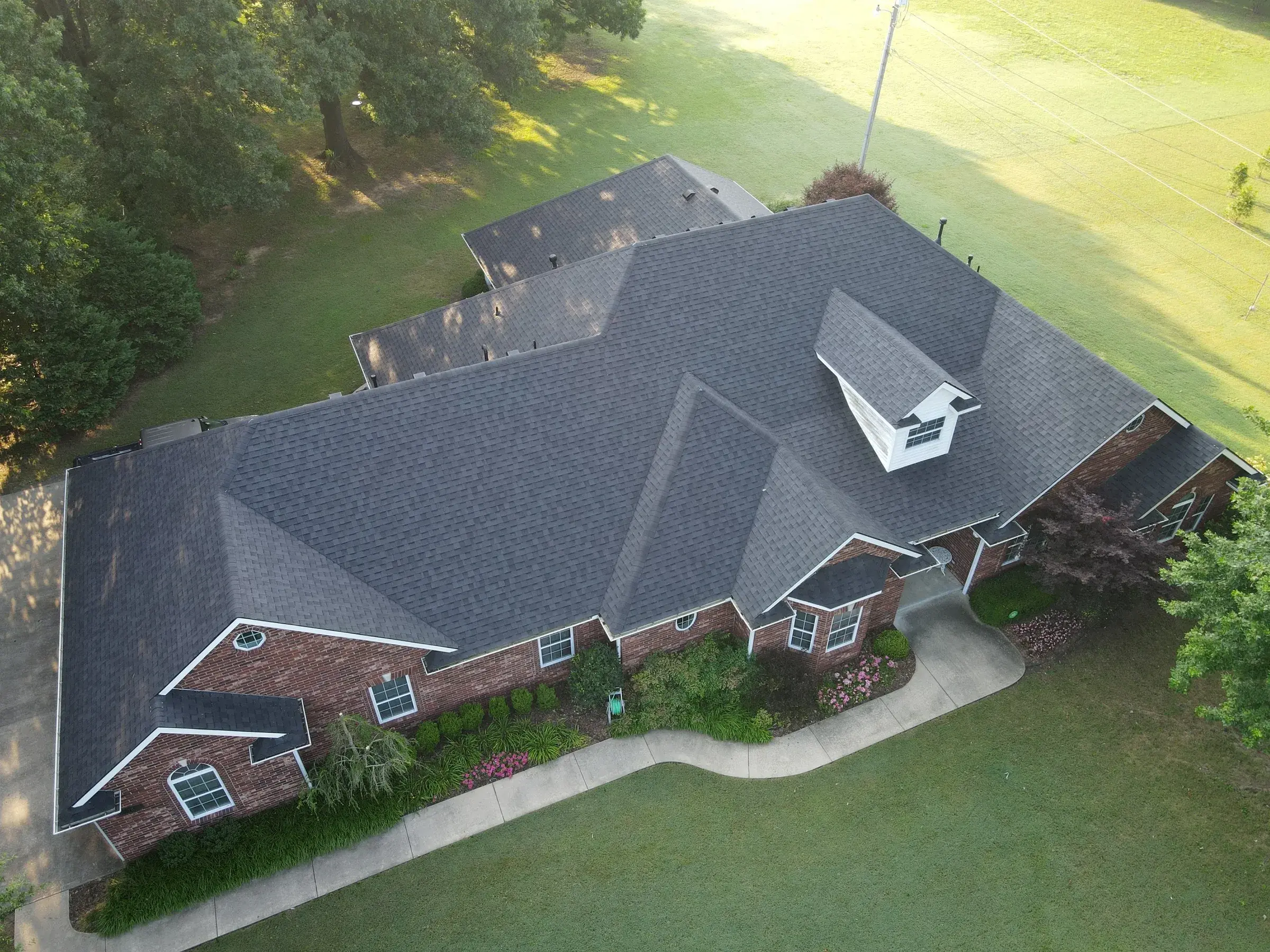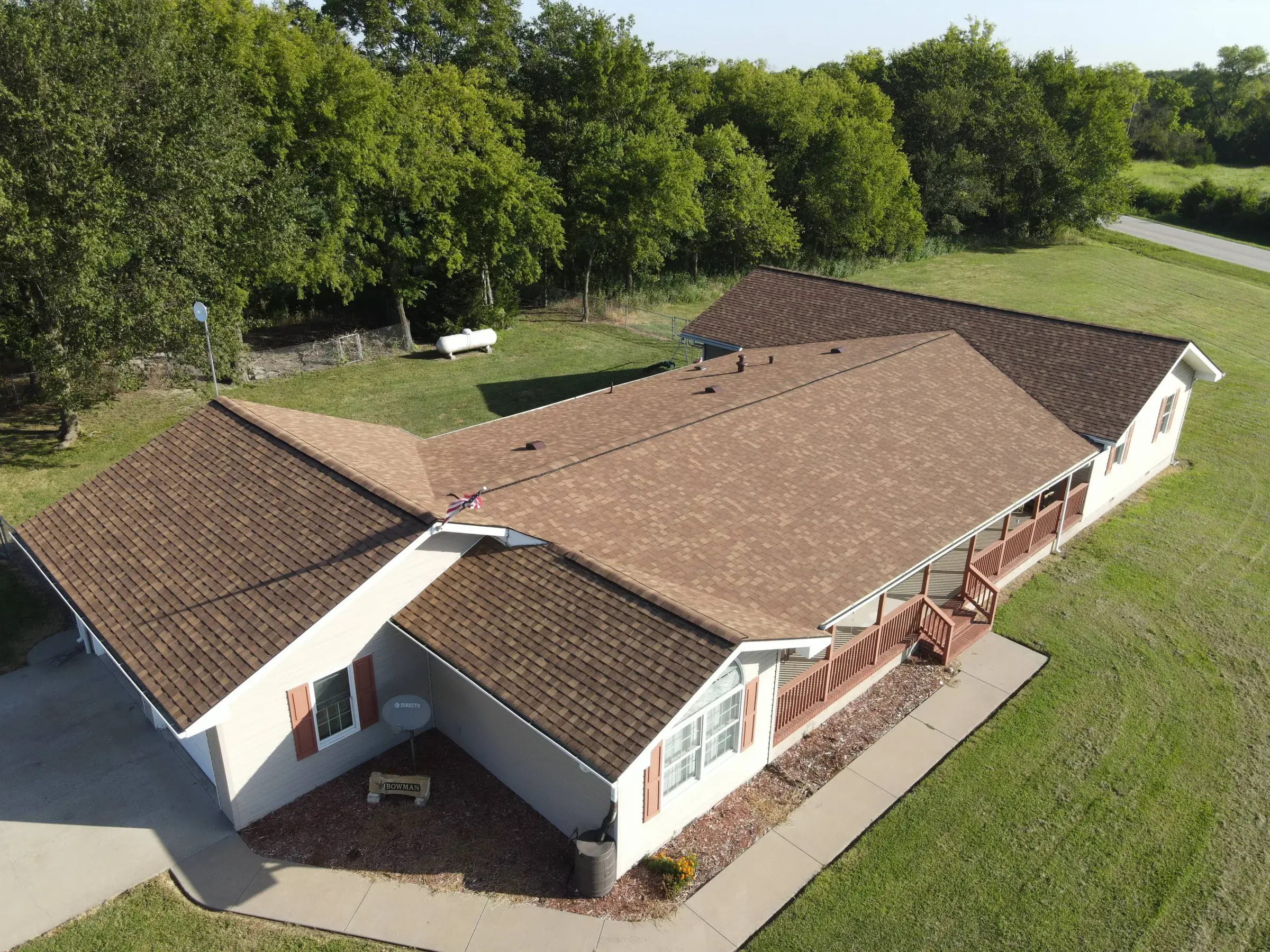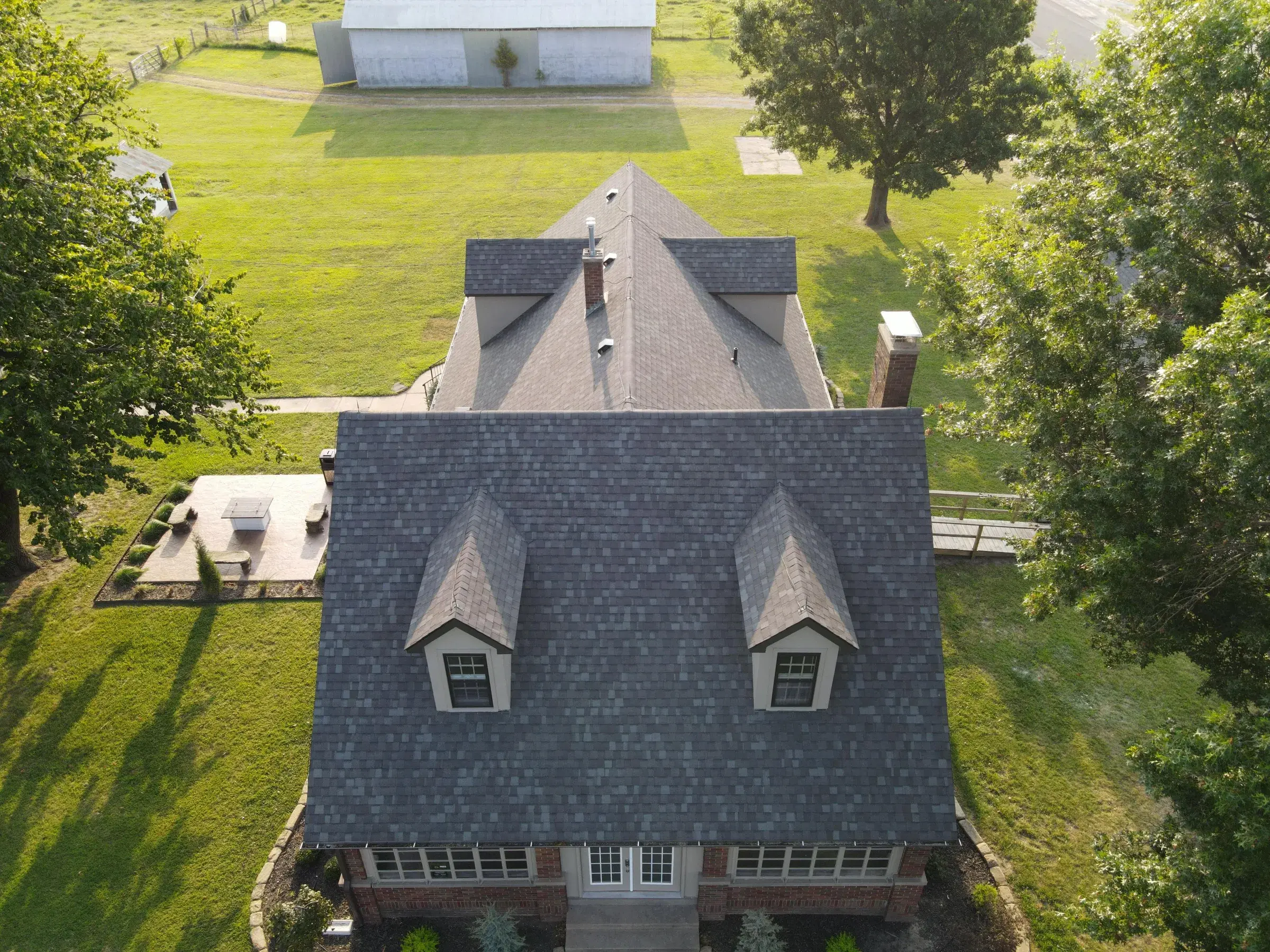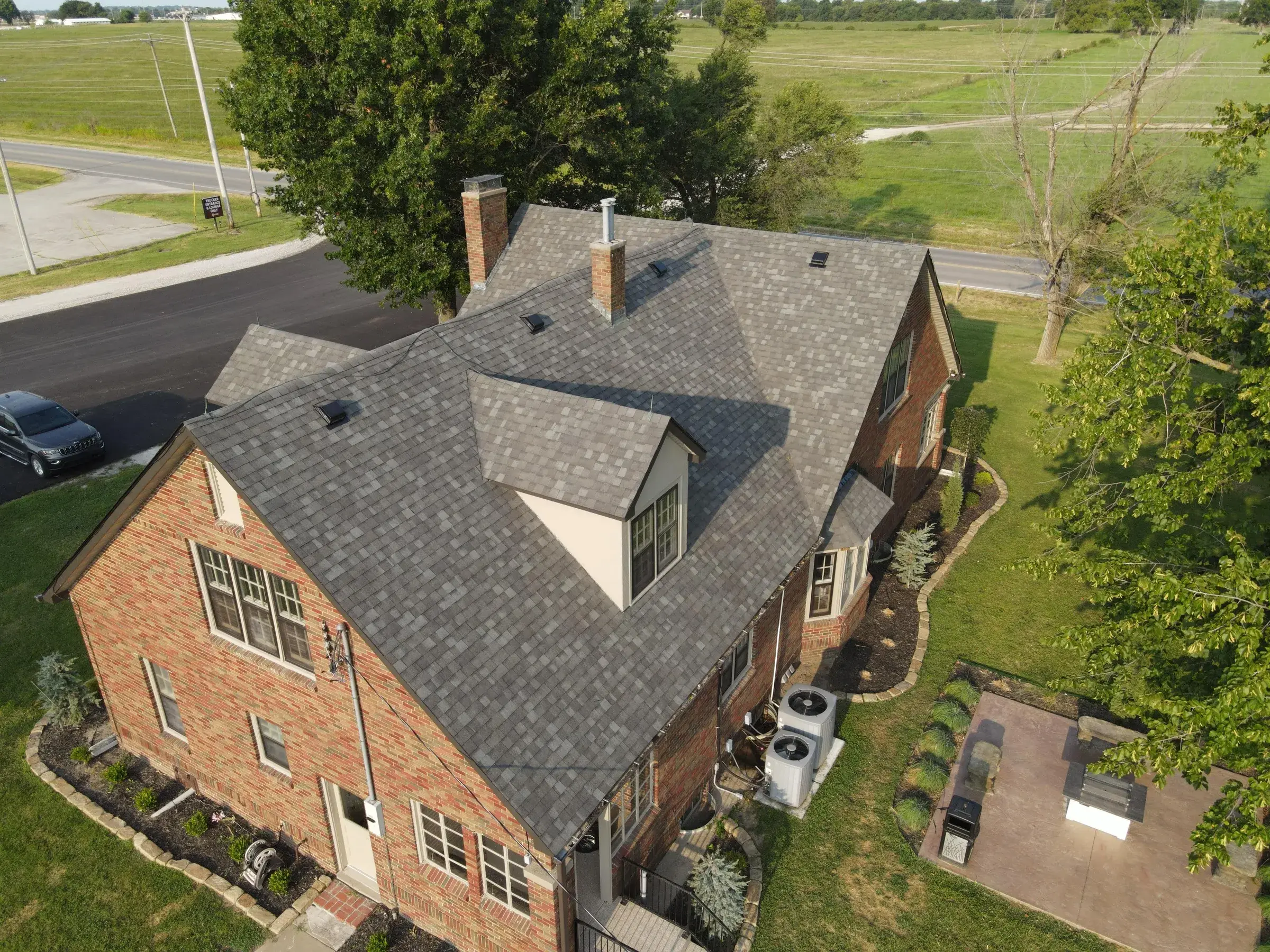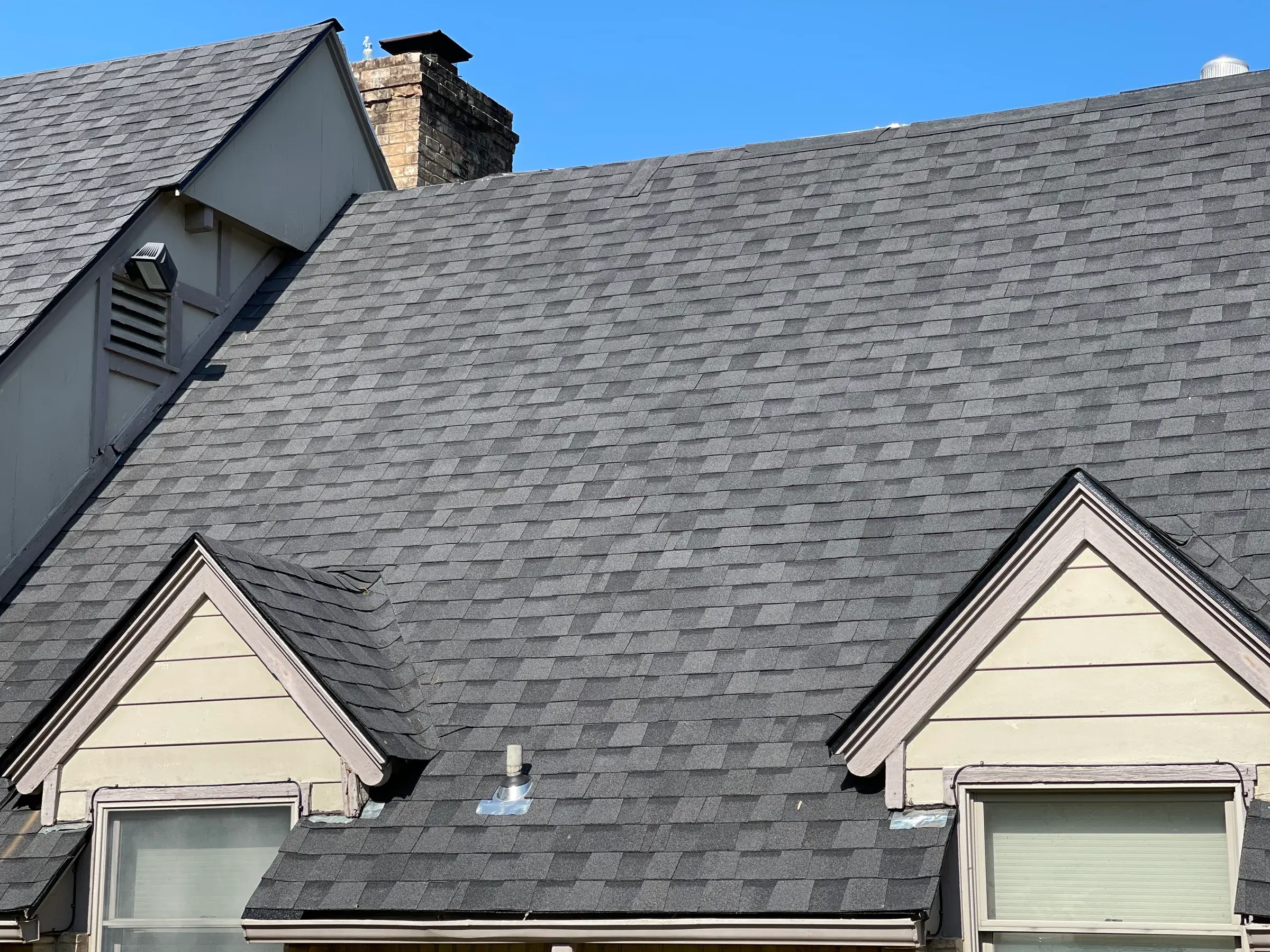
Quapaw homeowners deal with the same NE Oklahoma hail and wind as Miami, plus older housing stock and windblown dust from the surrounding landscape that settles in gutters and valleys. The practical priorities are annual gutter clearing, checking that attic intake vents aren't blocked with fines, and documenting roof condition before storm season.
Quapaw in context: Ottawa County's three-state corner
Quapaw sits about nine miles northeast of Miami, up near the corner where Oklahoma, Kansas and Missouri come together. Ottawa County is one of the few counties in the country that borders two other states, and Quapaw is close to the point where that actually shows up on a map.
The county splits down the middle in a way that matters for roofs. The eastern side runs into the Ozark Plains — rockier, wooded, rolling. The western side is Neosho Lowlands: flat prairie and farm ground with very little standing between an open field and your gable end. Quapaw sits in the northern reach of that county, and homes there tend to get some of both: tree debris where there's timber, and unbroken wind fetch where there isn't.
According to the U.S. Census Bureau's American Community Survey, Ottawa County has about 13,701 housing units, and 76.7% of them are detached single-family homes. Another 12.2% are mobile or manufactured housing — better than one in eight, which is a genuinely different roof with different fastening, different flashing details and different repair economics. Median home value across the county is $123,300. That number sets the frame for everything below: this is a market where a roof decision has to be a good decision, because there isn't a lot of room to make it twice.
We are not going to quote you a median year-built figure for Quapaw itself. At a town that size, ACS estimates carry margins of error wide enough that the number stops meaning anything. What is not in dispute, per the Oklahoma Historical Society: Route 66 was commissioned in 1926 and ran through Quapaw on its way to Commerce, Miami and Afton. The town was already there for the highway to be routed through. A meaningful share of the housing stock is old enough to have watched the road get paved, and that is the useful fact — not a statistic.
The wind and hail picture, cited to NWS/SPC rather than anecdote
Everyone in Ottawa County has a hail story, and the sizes in those stories grow about a quarter-inch per year of retelling. So here is the one number that is actually sourced: the Oklahoma Climatological Survey puts this area at four to five days per year with hail larger than 0.75 inch. That is the honest climatology. The NOAA Storm Prediction Center's severe reports database and NWS Tulsa are where to go for event-level history, and we would rather point you there than paraphrase it badly.
Four to five days a year sounds small until you multiply it by the life of a roof. Over a twenty-year shingle, that is eighty to a hundred hail days. Most of them do nothing. The ones that matter are the ones that fracture the shingle mat.
Size is not the thing that decides
A 0.75-inch stone is about penny-sized. One inch is a quarter, which is the threshold the National Weather Service calls severe. But size alone doesn't determine damage — density, fall angle, wind speed behind the stone and the age of the shingle all move the outcome. A soft, sun-tired shingle can bruise from stones that a three-year-old roof shrugs off.
What you are looking for is a bruise: a soft spot where the fibreglass mat underneath has cracked. Press it with a thumb and it gives, like a bruise on fruit. There is usually granule loss and sometimes exposed black mat. That is a real impact. A dark circle with granules still locked in place is usually just a scuff, and a scuff is not a claim.
Wind works differently. It almost never starts in the middle of a roof field. It starts at the edges — rakes, eaves, ridges — where uplift is highest and where the shingle only has to lose its factory seal strip to start levering. On an open lot with no windbreak, those edges are the first thing to check and the last thing anybody looks at.
Fine particulate and gutters: why intake vents and gutters clog faster here
Leaves are the debris everybody thinks about, because you can see leaves. The debris that actually costs you money around here is finer than that: windblown dust and mineral fines off open ground, gravel roads and tilled fields, mixed with granules shedding off your own shingles.
Fines behave nothing like leaves. Leaves float and eventually wash to the outlet. Fines act like wet sand — they pack into the bottom of the gutter, settle into a dense layer and stay put. You can look up at a gutter from the driveway, see no leaves, and be looking at an inch of packed sediment that is holding water along its entire run.
That standing water sits against the back of the gutter, the fascia board and the drip edge. Then winter arrives. The Oklahoma Climatological Survey counts 89 nights a year below 32°F in this area — that is roughly a quarter of the calendar spent in freeze-thaw. Water that cannot drain freezes, expands, and works the gutter away from the fascia a fraction at a time. Nobody notices this happening. Everybody notices the rotted fascia eight years later. Clearing gutters twice a year is the cheapest roof work that exists, and it is worth doing on schedule rather than on discovery — it's the core of what our [gutter cleaning](/services/gutter-cleaning) work is actually for.
The same fines get pulled into your soffit vents, because that is exactly what a soffit vent is for: pulling air in. The air brings dust with it, the insect screen catches the dust, and over a decade the screen loads up until it is effectively a solid panel.
Blocked soffit intake and what it does to an attic over a decade
Attic ventilation is a loop, not a collection of parts. Air enters low at the soffit — the underside of the eave overhang — and exits high at or near the ridge. Heat and moisture ride that current out. Break the intake and the loop stops; the exhaust vent up top has nothing to pull.
The residential code section that governs this is IRC R806, which is carried into the current Oklahoma residential code. The baseline is net free ventilating area of at least 1/150 of the vented attic area. That can drop to 1/300 when the ventilation is properly balanced — the code language requires that at least 40% and not more than 50% of the required area sit in the upper portion of the attic, with the balance at the eaves. Read that condition again. The reduction is conditional on having intake. Exhaust without intake isn't half a ventilation system. It's a broken one.
Here is what a decade of blocked intake actually does. In summer, this area sees 57 days above 90°F and about five above 100°F, with roughly 62% annual sunshine loading the deck. A stalled attic holds that heat, and the shingles cook from beneath as well as above — asphalt loses volatiles faster and goes brittle early. In winter, warm moist indoor air leaks up through ceiling penetrations into a cold attic with nowhere to go, and condenses on the underside of the sheathing. You get dark staining first, then nail-line rust, then soft decking. That's a sheathing replacement discovered during a tear-off, and it is not a small line item. We covered the summer half of this in more depth in our piece on [heat, attic ventilation and Oklahoma roofs](/blog/summer-heat-attic-ventilation-oklahoma-roofs).
One correction worth making: dust is not the leading cause of blocked intake. Blown-in insulation is. Somebody tops up the attic, the insulation gets pushed out over the top plate and packs into the eave, and the intake is gone. Baffles — rigid chutes that hold insulation back and keep an air channel open at the eave — are what prevent it, and older homes frequently have none.
Soffit intake blockage self-check
- Stand under the eave and look up at the soffit vents. Can you see through the perforations, or are they filmed grey with packed dust?
- Hold a strip of tissue an inch under a vent on a windy day. No movement at all across several vents suggests the path above is closed.
- Go into the attic in daylight with the lights off. You should see thin lines of daylight at the eave line. Solid dark all the way around means the intake is blocked.
- Look at where the attic floor meets the roof deck at the eave. If insulation is jammed tight into that wedge, the intake is gone regardless of what the soffit looks like from outside.
- Check whether baffles are present at each rafter bay. If you can't see any chutes, assume there aren't any.
- Check the underside of the sheathing in the coldest corner of the attic, ideally on a cold morning. Dark staining or rusty nail tips means moisture is condensing and not being flushed out.
- If you have a ridge vent but no visible intake, treat that as a finding, not a feature. It is the most common ventilation fault we see on older roofs.
If several of those come back wrong, that's a [roof ventilation repair](/services/roof-ventilation-repair) conversation rather than a wait-and-see.
Older housing stock: layers, plank decking, and original flashing
Three things show up over and over on homes that predate the interstate era, and all three change what a re-roof costs.
Layers
Older houses often carry two or even three layers of shingle, because for decades the cheap answer was to go over the top. Weight adds up fast, and you cannot properly inspect a deck you cannot see.
Plank decking
Older roofs are frequently decked in 1x6 or 1x8 boards with gaps between them, rather than continuous plywood or OSB sheets. Gaps mean a shingle nail can land in open air instead of wood, and a nail in air holds nothing. Manufacturer nailing patterns and wind-resistance ratings on the spec sheet assume a continuous deck. When the gaps are too wide, the fix is re-sheeting over the planks — a real cost, and one that should be raised before the contract is signed, not discovered on tear-off day.
Original flashing
Step flashing — the L-shaped pieces of metal that tie a roof plane into a sidewall, one piece per shingle course — is often the oldest metal on the house. It gets reused across re-roofs because pulling it means pulling siding. Old galvanized flashing rusts from the back where you can't see it, and thins out until it's foil. And on a lot of chimneys you'll find caulk and roof cement smeared where flashing should be. Caulk is not flashing. It is a five-year material pretending to be a thirty-year one, and it fails from behind. Most of the leaks we get called out for on [roof repair](/services/roof-repair) start at a flashing detail, not in the field of the shingle.
Roofs on outbuildings and shops: metal panels, fasteners, and sealant
Plenty of properties around Quapaw have a shop, barn or equipment shed under exposed-fastener metal panel — the kind where screws go through the face of the panel with a rubber washer under the head. That washer is the entire waterproofing strategy at every one of those hundreds of holes, and it is a wear part.
It wears for reasons this climate supplies generously. Roughly 62% annual sunshine puts UV on the washer year-round. The panel expands and contracts through 57 days above 90°F and 89 nights below freezing, and every cycle works the screw against its hole. The washer hardens, cracks, and stops sealing. The screw backs out a thread at a time. Eventually you have a screw standing proud of the panel with an open hole under it, and that hole drips.
What to check, once a year, before fall rain: walk the wall line and sight down each run of fasteners. A screw standing higher than its neighbours is a leak with a date on it. Also look for the opposite problem — an over-driven screw that dished the washer and squeezed the rubber out from under the head seals no better than a loose one. Butyl tape at the panel laps and sealant at the ridge cap are maintenance items with a service life, not permanent fixtures. And do not seal over rust; rust under sealant keeps going, quietly, until the panel is paper. On open ground with no windbreak, the ridge and edge fasteners take the most uplift, so start there.
A realistic annual maintenance rhythm for a Quapaw home
None of this needs to be a project. It needs to be a rhythm — about four short sessions a year, most of them from the ground.
| When | What to do | Why it matters here |
|---|---|---|
| Late winter (Feb–Mar) | Clear gutters and downspouts; confirm water actually exits the outlet | Fines pack down over winter and hold water; with 89 freezing nights a year (Oklahoma Climatological Survey), trapped water expands and works the gutter off the fascia |
| Early spring (Mar–Apr) | Dated ground photos of all four elevations, before severe season | Establishes documented condition ahead of the SPC's peak severe months, while the roof is still undamaged |
| Spring (Apr–May) | Attic walk on a cold morning: daylight at the eaves, damp or stained sheathing, rusty nail tips | Blocked intake shows up as moisture long before it shows up as a ceiling stain |
| Summer (Jun–Aug) | Attic check on a hot afternoon; feel for stalled, superheated air | 57 days above 90°F and ~5 above 100°F; an attic with no intake bakes the shingle from underneath |
| Late summer (Aug) | Fastener walk on the shop, barn and any metal-panel roof | Thermal cycling backs screws out; catch them before fall rain finds the holes |
| Fall (Oct–Nov) | Second gutter clearing after leaf drop; clear valleys and behind chimneys | Wooded ground on the county's east side sheds into valleys, which stay damp and rot from debris, not water |
| After any hail or high wind | Dated ground photos the same day, from the driveway. Do not climb | Fixes the date to the event; a roof after a storm is not a safe place to satisfy curiosity |
| Every few years | Professional inspection from the roof surface, not from a ladder | Mat bruising is a look-and-feel finding. It cannot be assessed from the ground or from a photo |
That last row is the one people skip. Everything above it you can do yourself. That one you can't, and it's the one that catches the expensive problems while they're still cheap — which is the whole point of a [roof inspection](/services/roof-inspections).
Documenting condition before storm season — and why photos beat memory
Memory is a terrible witness about roofs. Nobody can say with confidence whether that granule bare spot was there last April. A dated photo can.
The point of pre-season documentation isn't to build a case. It's to be able to answer one question honestly: what changed? A folder of March photos and a folder of June photos answers it in about ninety seconds, for you and for anyone else who asks.
Pre-storm-season documentation checklist
- Dated ground photos of all four elevations, taken from far enough back that the whole roof plane is in frame
- A second pass of closer shots on each slope — corners, ridges, rakes and eaves, since that's where wind damage starts
- Photos of any spot you already know is bad, so a pre-existing issue never gets confused with new damage
- Straight-down photos into the gutters showing how clear they are, plus a shot of each downspout outlet
- Attic photos: underside of the sheathing, the eave line where intake should be, and any existing staining
- A photo of the shingle wrapper or a spare bundle if you have one in the garage — product and colour matter for repairs
- Photos of the shop or outbuilding roof, including the fastener lines
- Get the whole set off your phone. Email it to yourself or drop it in cloud storage. A phone in a truck during a storm is not an archive
Verifying any contractor who knocks on your door
After a hail day in Ottawa County, out-of-state crews arrive. Some are competent. The verification takes two minutes either way, and it's the same two minutes regardless of who's standing on your porch — including us.
Start with vocabulary, because the industry abuses it. Oklahoma, Kansas and Arkansas issue roofing registrations, not licences. Missouri has no state roofing licence at all. So "licensed and bonded" is close to meaningless in this four-state corner — no state here requires a surety bond for roofing. Skip the adjectives and check the record.
Contractor verification quick-box
- Ask for the Oklahoma CIB registration number and check it yourself at verifyroofing.cib.ok.gov — don't accept a screenshot
- Ask for a physical local address you could drive to today, not a PO box or an out-of-state corporate office
- Get a written estimate that names the product, the layer count, whether the deck is being re-sheeted, and the flashing scope, before any money changes hands
- Ask who is pulling the permit. The City of Miami requires a permit for new roofs and re-shingles and we pull it; requirements vary town to town, so ask what applies at your address
- Ask which condition in Oklahoma's amended R908.3.1.1 permits a shingle-over, if one is being proposed. Specific answer good, vague answer bad
- Walk away from anyone who offers to cover, waive, discount or absorb your deductible — that offer is unlawful to advertise in Oklahoma
- Walk away from anyone who promises an approval, a payout, or a 'free roof.' They do not control that decision and neither do we
- Be wary of pressure to sign anything on the spot, especially a document that assigns your claim or authorises work contingent on insurance
We wrote a longer piece on how to tell a local outfit from a travelling crew, in [local roofer vs. storm chaser in northeast Oklahoma](/blog/local-roofer-vs-storm-chaser-northeast-oklahoma). The short version: ask where they'll be in three years, then check whether the answer is verifiable.
If you want another set of eyes on a Quapaw roof, we're at 111 S Main St in Miami — about nine miles down the road — and inspections and quotes are free. You can read more about how we work in [Quapaw](/locations/quapaw-ok) and around [Miami](/locations/miami-ok). Call (209) 758-8550 whenever you want to walk through what you're seeing.
Questions people ask about this
How often should I clean gutters on a Quapaw home?
Twice a year is the practical rhythm: once in late winter, and again in fall after leaf drop. The reason isn't leaves — it's windblown dust and mineral fines off open ground and gravel roads, mixed with shingle granules. That mix packs into the bottom of the gutter like wet sand and holds water instead of draining. With 89 nights a year below freezing per the Oklahoma Climatological Survey, that trapped water freezes and expands against the fascia and drip edge.
How much hail does Quapaw actually get?
The only sourced figure worth quoting is from the Oklahoma Climatological Survey: four to five days a year with hail larger than 0.75 inch in this part of northeast Oklahoma. For event-level history, the NOAA Storm Prediction Center's severe reports database and NWS Tulsa are the authoritative sources. Be skeptical of any roofer quoting you a specific storm date, a hail size record, or a claim-approval statistic — those numbers generally don't have a source behind them.
Can a contractor shingle over my existing roof instead of tearing it off?
Sometimes, but Oklahoma is stricter than most states about it. Oklahoma amended IRC section R908.3.1.1 to require tear-off rather than shingle-over in defined conditions. If someone proposes going over the top, ask them to name the specific condition in R908.3.1.1 that permits it at your house. On older Quapaw homes that may already carry two or three layers, a tear-off is often the only lawful option anyway — and it's the only way anyone can actually see the condition of the decking underneath.
How do I check whether my soffit intake vents are blocked?
Go into the attic in daylight with the lights off and look toward the eaves. You should see thin lines of daylight at the eave line all the way around. Solid dark means the intake path is closed. Then check whether blown-in insulation is packed into the wedge where the attic floor meets the roof deck — that's the most common cause, more so than dust. Insulation baffles are rigid chutes that hold it back and keep an air channel open, and older homes often have none.
How do I verify a roofing contractor in Oklahoma?
Use the Oklahoma Construction Industries Board's free public lookup at verifyroofing.cib.ok.gov. Ask the company for its registration number and enter it yourself rather than accepting a screenshot. Oklahoma issues registrations, not licences, and requires proof of at least $500,000 in liability insurance for residential roofing registration — so an active registration is a meaningful signal. Missouri has no state roofing licence at all, which is worth knowing when a crew from across the line tells you they're licensed.