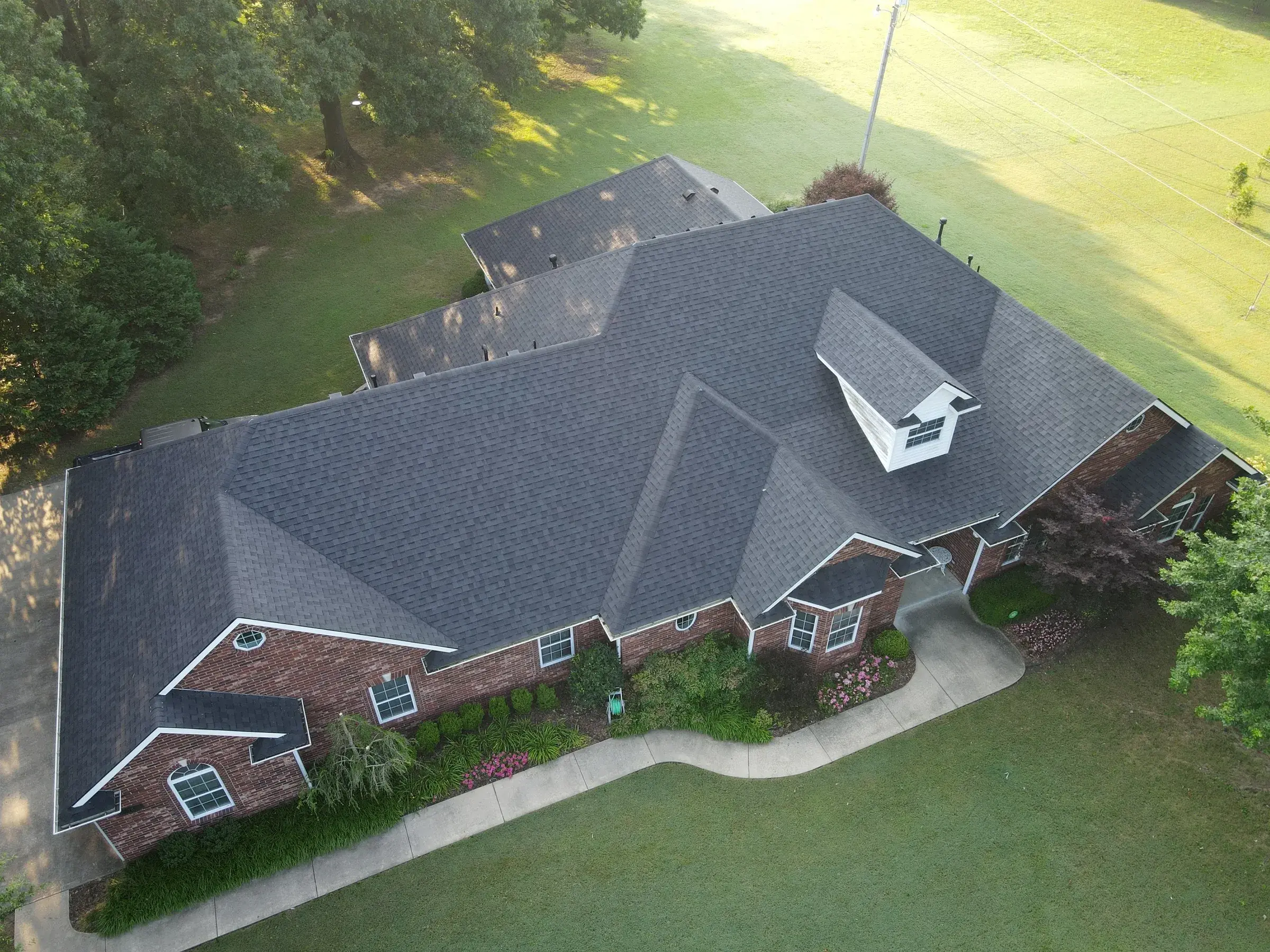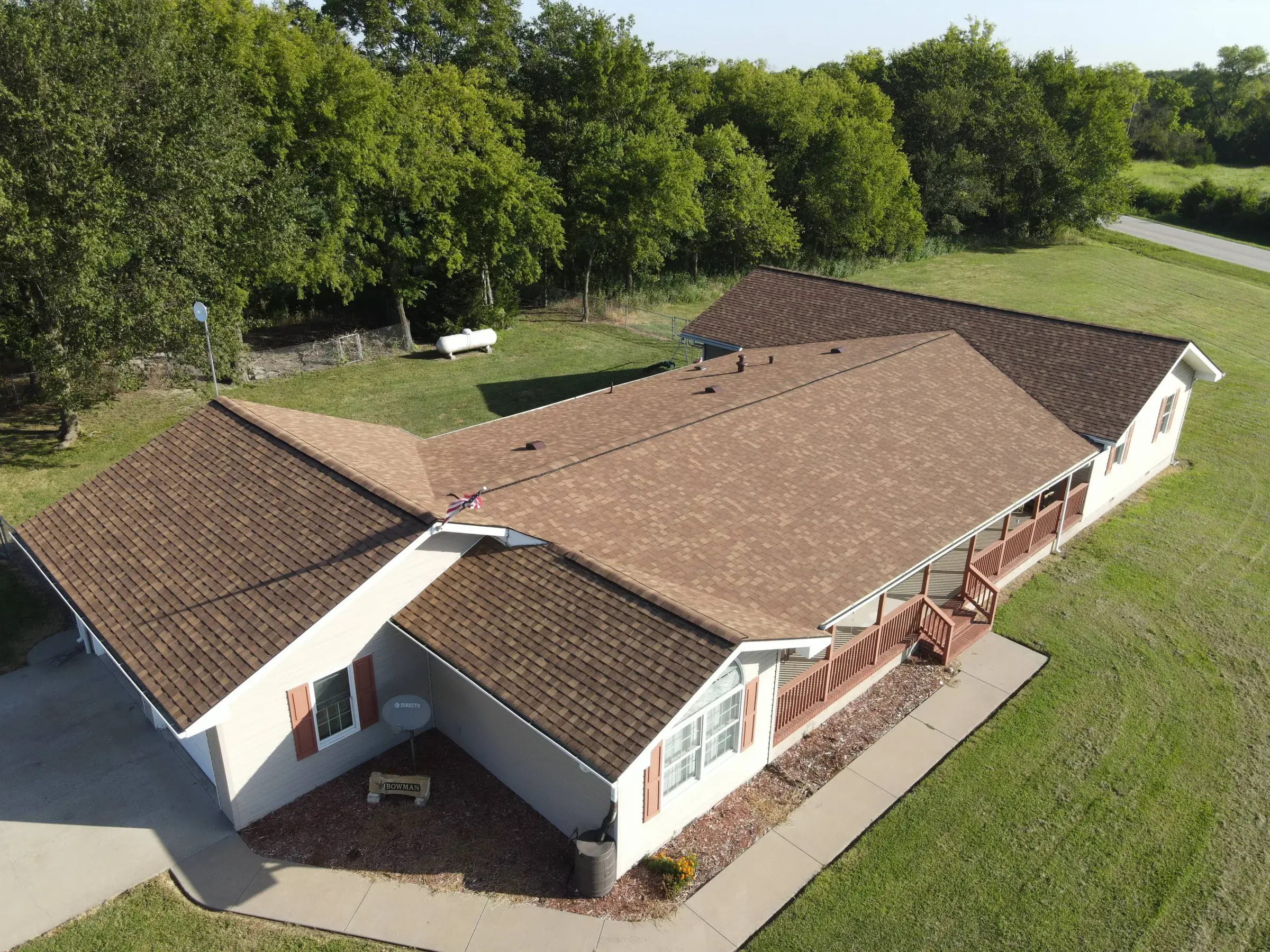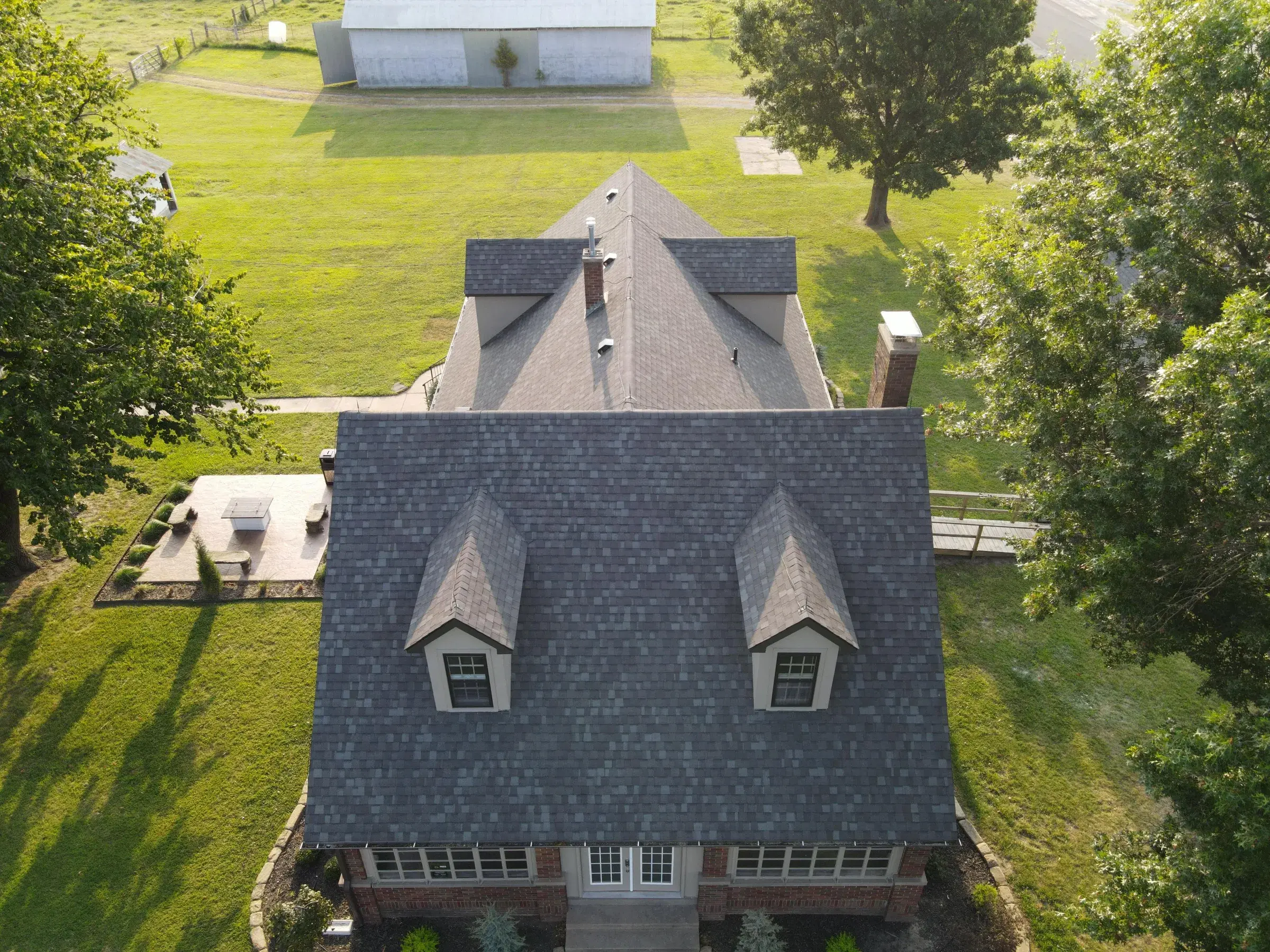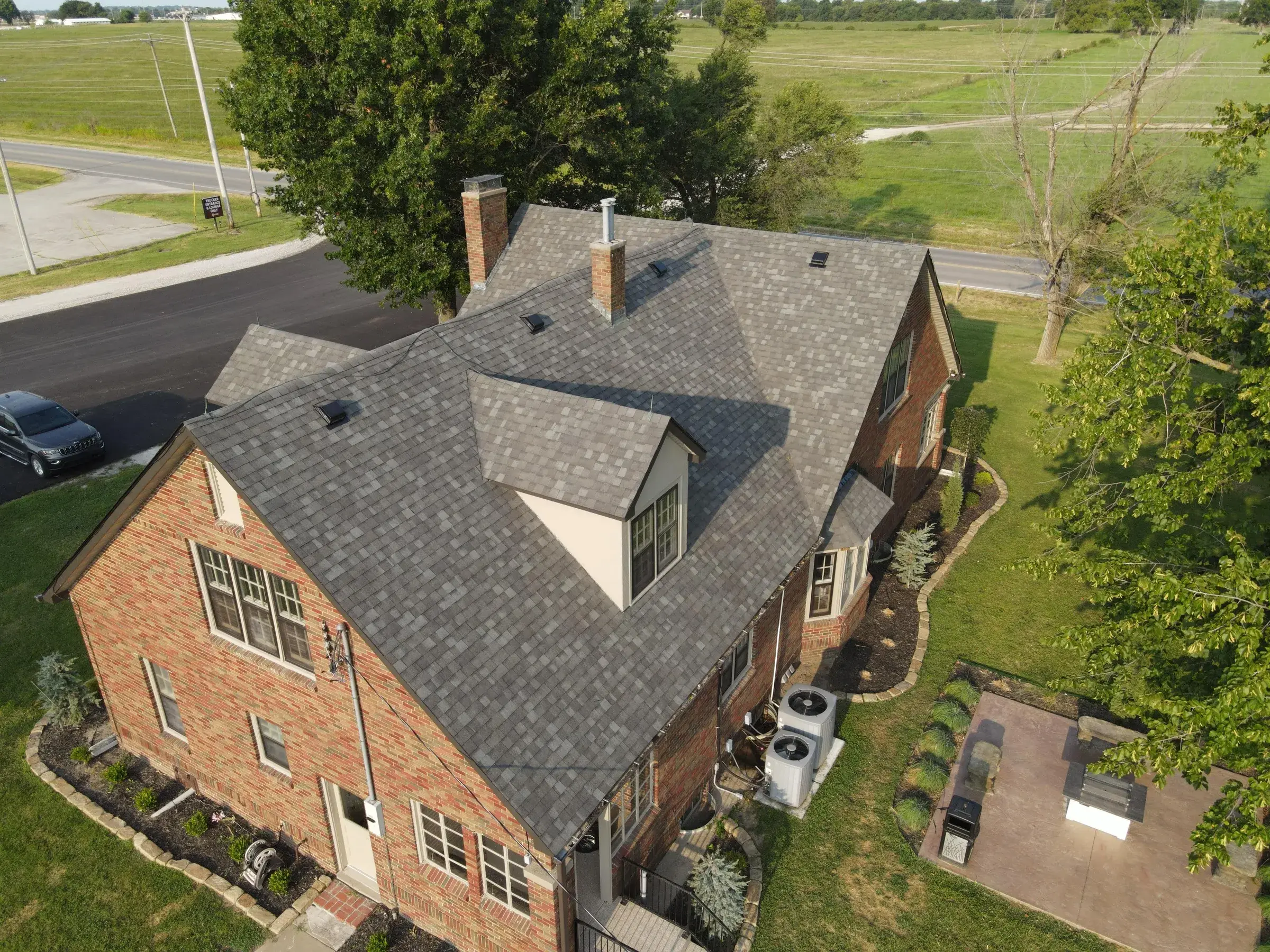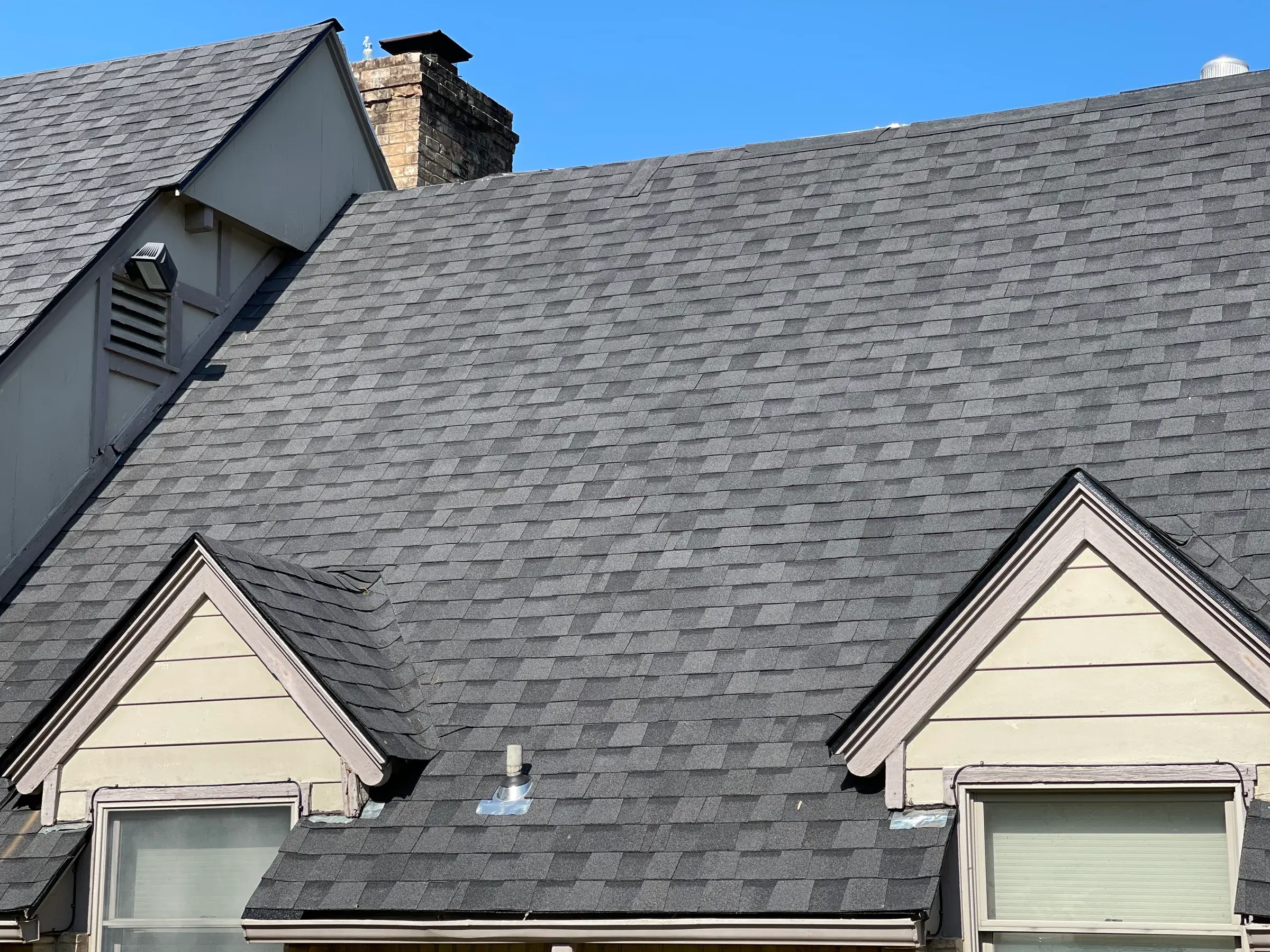
Most roofs in northeast Oklahoma benefit from a professional inspection once a year, plus a look after any significant hail, high-wind, or ice event. A thorough inspection covers the roof field, flashing, penetrations, and gutters — and the attic underside, because leaks usually start at transitions and show up inside long before the surface fails.
The short answer: annual, plus event-driven
Once a year is the baseline. The other half of the schedule is the part most people skip: a look after weather that actually did something to your house.
"Significant" is worth defining, because it shouldn't be a feeling. A storm earns a call when one of these happened at your address — not in the next county, at your address: hail you could hear hitting the window or the hood of your truck; wind strong enough to bring limbs down or move patio furniture; ice that sat on the roof for more than a day or two; or a limb, a piece of trim, or anything else landing on the slope.
When you schedule the annual one matters too. Late spring, after Oklahoma's most active hail stretch, catches storm damage while it is still fresh and legible. Fall, before the first hard freeze, catches the sealant and flashing gaps that turn into leaks in January. Pick one and keep it in the same month every year. Roofs fail on a fairly predictable schedule. The trouble is that homeowners inspect on a schedule they can't remember.
Where you live in Ottawa County changes what the inspection finds. East of Miami you're into the Ozark Plains — rockier, wooded, rolling. Those roofs pack leaf litter into the valleys, grow moss on shaded north slopes, and take limb strikes. West of town the Neosho Lowlands open into flat prairie and farmland, and wind gets a long, uninterrupted run at your ridge and rake edges. Same county, two different failure patterns, and a walk-around that ignores which side of town you're on isn't worth much.
Why northeast Oklahoma roofs justify an event-driven schedule
In a mild climate, annual is plenty. Here it isn't, and the numbers are the reason.
The Oklahoma Climatological Survey puts this part of the state at four to five days a year with hail larger than three-quarters of an inch. That is not four to five storms that destroy roofs. It is four to five separate chances per year for something hard and frozen to hit your shingles at speed. The National Weather Service office in Tulsa forecasts for Ottawa County, and the NOAA Storm Prediction Center archives the hail and wind reports that come out of it. If you want to know whether your address was genuinely under something, those are the two places to check — not a door hanger that says "your neighborhood was hit."
Then the roof gets worked over for the rest of the year. The OCS 1991–2020 normals put Miami at 89 nights a year below freezing. Every one of those is a freeze-thaw cycle: water finds a hairline gap in sealant or slips under a lifted tab, freezes, expands, and makes the gap slightly bigger. Do that 89 times and a gap nobody could see in October is a gap anybody can see in April.
Sun finishes the job. Miami averages 57 days a year above 90°F and five above 100°F, with roughly 62% annual sunshine — and the record high here is 116°F, set in 1954. Deck temperatures run well above air temperature. Asphalt shingles age by shedding the granules that shield the asphalt from UV, and ARMA, the Asphalt Roofing Manufacturers Association, treats granule loss and exposed mat as the central things to look for on an aging shingle roof. Sunlight does that slowly and evenly across the slope. Hail does it instantly, in spots, in a pattern a trained eye can read. An annual visit catches the first. Only an event-driven visit catches the second while it still means anything.
What a real roof inspection covers: field, flashing, penetrations, edges, gutters, attic
A real inspection is two inspections. There is the one on the roof, and there is the one under it. Skip the second and you're guessing. Here is what each half actually looks at.
| On the roof and exterior | In the attic and from inside |
|---|---|
| Shingle field: granule loss, hail bruising, creased or missing tabs, exposed mat | Decking underside: dark staining, water tracks, soft or delaminated plywood |
| Step flashing — the L-shaped metal that ties the roof into a wall — and the sealant above it | Shiners: nails that missed a rafter, and rusted nail tips, which are a condensation tell |
| Pipe boots — the rubber collars around plumbing vents — checked for cracking and pull-back | Insulation: matted, darkened, or displaced batts sitting directly under a leak path |
| Valleys: packed debris, granule scour, open or lifted metal | Rafters and trusses: mold, rot, or old repairs concentrated at valleys and eaves |
| Ridge and hip caps, and whether the ridge vent is seated and fastened | Airflow: whether that ridge vent is actually open, and whether soffit intake is blocked |
| Drip edge and rake edges for lift, gaps, and wind damage | Daylight: pinholes at penetrations, valleys, or the eave line |
| Penetrations: chimney counter-flashing, skylight curbs, satellite mounts, exhaust caps | Exhaust ducts: whether bath and kitchen fans terminate outside or dump into the attic |
| Gutters and downspouts: granule accumulation, dents, pitch, secure hangers | Frost or condensation on the underside of the deck during cold weather |
| Soft spots underfoot — a walk-on check for compromised decking | Layer count and deck type, visible from below where sheathing is exposed |
The field is where hail shows up — and where it hides
Hail damage on asphalt is a bruise: a soft, dented spot where the impact fractured the fiberglass mat under the surface. Press it and it gives, like a bruise on an apple. It often doesn't leak for a year or more, which is exactly why people miss it. IBHS — the Insurance Institute for Business & Home Safety, the research group that runs the lab where they fire hail at real roof assemblies — makes the same point in its post-storm evaluation guidance: what matters is functional damage to the assembly, not whether the roof looks bad from the driveway. You cannot see a bruise from the ground. You often can't see it from a ladder at the eave.
Flashing and penetrations are where leaks actually start
Ask where a roof leaks and most people point at the middle of a slope. That's rarely it. Leaks start at transitions — where the roof meets a wall, a chimney, a skylight, a vent pipe. Those are the places with a seam, a sealant joint, and a piece of metal doing the real work. Pipe boots are the classic northeast Oklahoma failure: the rubber collar takes 62% sunshine and 89 freezes a year, goes brittle, splits at the top, and drips into a bedroom ceiling. It's a cheap part. Catching it is the whole point of the annual visit, and it's the most common thing that turns into a small [roof repair](/services/roof-repair) instead of a large one.
The edges and gutters tell you about wind
Wind doesn't peel a roof from the middle. It gets a fingernail under an edge — the eave, the rake, the ridge — and works from there. So the edges get read first after a wind event: lifted drip edge, creased tabs along the rakes, ridge caps that have gone loose. Gutters are the cheat sheet. A pile of granules in the downspout elbow after a hailstorm is a real signal, and unlike the roof, you can check it from the ground.
Why the attic half of the inspection is the half that finds problems
If we could only do one, honestly, some days we'd take the attic.
Here's why. The roof surface tells you what happened to the roof. The attic tells you what happened to the house. A stain on the underside of the decking is a record of every leak that ever ran through that spot, whether or not it ever reached the drywall. Rusted nail tips mean moisture is condensing up there in winter — which usually means ventilation, not a leak, and replacing shingles won't fix it. Matted insulation directly under a valley means water has been finding that valley for a while.
Ventilation is the quiet one. A roof needs balanced intake at the soffit and exhaust at the ridge. Block the soffits with insulation, or install a ridge vent over a slot nobody actually cut, and you build an oven under the deck in August and a condensation chamber in January. That cooks shingles from underneath and can shorten the life of a roof that looks perfectly fine from the street. It's common, it's invisible from outside, and it's why [ventilation problems](/services/roof-ventilation-repair) get checked on every inspection rather than treated as a separate service call.
One more attic item worth naming: bath fans that vent into the attic instead of through the roof or wall. We find them. They dump warm, wet air straight onto cold decking, all winter, 89 nights a year.
Inspection cadence by roof age
"Once a year plus events" is the rule. This is the version with the exceptions in it.
| Roof age, material, or event | What's being looked for | Inspect |
|---|---|---|
| New roof, 0–5 years | Workmanship — most early leaks are flashing and sealant details, not shingle failure | Once a year, plus after any hail or high-wind event |
| Asphalt shingles, 5–10 years | Sealant strips, pipe boots, first measurable granule loss | Once a year, plus after events |
| Asphalt shingles, 10–20 years | Cumulative hail bruising, brittle boots, lifted tabs, valley wear | Once a year without fail, plus after events |
| Asphalt shingles, 20+ years | Whether you're maintaining or replacing — and whether the deck is still sound | Twice a year, spring and fall, plus after events |
| Metal roof, any age | Fastener backout, sealant at seams and penetrations, cosmetic oil-canning vs. real denting | Once a year, plus after hail |
| Manufactured or mobile home | Low slope, seam integrity, edge attachment — wind gets under these first | Once a year, plus after any wind event |
| After hail larger than a quarter | Bruising that is invisible from the ground and may not leak for months | Within a few weeks |
| After a high-wind or tornado-warning night | Creased tabs, lifted ridge caps, displaced drip edge | Within a few weeks |
| After a prolonged ice or freeze event | Ice at the eaves, backed-up water behind the drip edge, gutter and hanger damage | As soon as it's safe, ideally before the next freeze cycle |
| After a limb strike or anything landing on the roof | Fractured decking under shingles that still look intact | Right away |
| Buying or selling in Ottawa County | Remaining service life, layer count, evidence of prior repair | Before your contract deadline |
| Lake house or second home you don't visit weekly | Nobody's inside to notice a stain spreading — roughly 13% of Ottawa County's housing units sit vacant much of the year | Twice a year, and after any storm you hear about |
That mobile and manufactured row isn't filler. Census figures put 12.2% of Ottawa County's 13,701 housing units in that category — one in eight homes here. They behave differently in wind than a stick-built house with a 6:12 pitch, and an inspector who only knows steep-slope asphalt will walk right past the things that matter on them.
Inspection vs. estimate vs. sales visit — how to tell them apart
These three things get called the same word, and they are not the same thing. An inspection is a fact-finding visit: someone looks, documents, and tells you the condition of your roof — including the answer "it's fine, see you next year." An estimate is a price for specific work, produced after the inspection. A sales visit is neither. It's a visit whose conclusion was written before the ladder came off the truck.
You can usually tell within five minutes.
Red flags: you're getting a sales call, not an inspection
- They knocked after a storm but can't tell you which storm, or what date, they're talking about.
- They tell you your roof is totaled from the ground, before going up.
- They won't give you a business name you can look up, or they get vague when you say you're going to check.
- They mention your deductible — covering it, discounting it, "working with you" on it, or anything in that neighborhood. In Oklahoma it is unlawful to even advertise that (59 O.S. §1151.30), and a contractor who leads with it is telling you exactly what kind of company they are.
- They offer you something of value — cash, a gift card, a discount — for a yard sign, a referral, or a review on an insurance job. Also prohibited under the same statute.
- They say they'll handle, file, fight, or negotiate your claim for you. That's public adjusting, and it's licensed work in this state.
- They want you to sign something — an authorization, a contingency agreement, a "just so I can get on the roof" form — before you've seen a single photograph of your own roof.
- They promise approval, a "free roof," or any specific insurance outcome.
- They quote a price without measuring, or the price expires today.
- Their photos are generic. No shot establishing your address, no chalk marks, no close-ups with anything in frame for scale.
- They're staying at a motel and will be gone in three weeks — worth asking, and worth reading up on how [storm chasers work in northeast Oklahoma](/blog/local-roofer-vs-storm-chaser-northeast-oklahoma) before you sign anything.
What you should receive afterward
An inspection that ends with a verbal "yeah, you've got some damage" is not an inspection. You should end up holding something. Here's the standard worth insisting on, from us or from anyone else.
What a real inspection leaves you with
- Dated photographs of your roof — not stock images — including wide shots that establish it's your address.
- Close-ups of every item flagged, with something in frame for scale.
- Attic photos, including the underside of anything flagged from outside.
- A plain-language condition summary: what's fine, what's aging normally, what needs attention now.
- A clear line between what is failing and what is merely old. Those are different findings with different answers.
- Ventilation findings, stated separately from roof-surface findings.
- A written estimate for the work we would actually perform, itemized — so you can hand it to someone else and compare like for like.
- The report itself, in your hands, whether or not you hire anybody.
That last one is the test. A free inspection is only free if you can walk away with the findings. We do free inspections and free quotes, and the photo report is yours either way — it's useful to you regardless of who ends up doing the work, and it's the baseline you'll want the next time something comes through.
What an inspection cannot tell you
An inspection tells you the condition of your roof. It does not tell you what your insurance company will do about it. Those are two separate questions decided by two separate parties, and the second one isn't ours to answer.
Here's what we can do, stated plainly. We document the damage with a photo report. We provide a written estimate for the work we would perform. If you ask, we can meet your adjuster on site and show them what we found. We'll help you understand how the process works. Your insurer decides coverage under your policy — and the Oklahoma Insurance Department publishes consumer guidance on claims and adjusters that's worth reading before you make the call.
A few other honest limits. An inspection can't tell you exactly how many years are left in your roof — anyone giving you a number to the year is guessing. It can't guarantee no leaks, because a roof is an assembly, not a promise. And on impact-resistant shingles: Oklahoma does not mandate an insurance discount for them, whatever a salesman says. If you're considering Class 4, ask your insurer directly whether they offer one and what it's worth on your policy. That's a question for them, not for a roofer.
The honest version of this whole article is short. Get up there once a year, get up there after weather, and get the attic looked at both times. If you'd rather do the ground-level parts yourself between visits, our [spring maintenance checklist](/blog/spring-roof-maintenance-checklist-northeast-oklahoma) covers what's genuinely doable without a ladder.
Absolute Royalty Roofing & Construction is a family-owned outfit at 111 S Main St in Miami — on the historic Route 66 alignment through town — and we work across northeast Oklahoma and into Kansas, Missouri, and Arkansas. [Roof inspections](/services/roof-inspections) and quotes are free, and you keep the photo report. If your roof hasn't been looked at in a year, or a storm came through and you're not sure whether it counted, call (209) 758-8550 or [get in touch](/contact). We'll tell you what we find, including "nothing yet."
Questions people ask about this
Do I really need an inspection if I can't see anything wrong from the ground?
Yes, and the reason is that the two most consequential findings are both invisible from the ground. Hail bruising is a fracture in the mat under the shingle surface — you have to feel it — and it often doesn't leak for a year or more. Attic problems like condensation, blocked soffit intake, or a bath fan venting into the attic never show up outside at all. A roof that looks fine from the driveway is the normal starting condition for both.
How much does a roof inspection cost?
Ours are free, and so are the quotes. The thing to check is what "free" includes: you should leave the visit holding dated photos of your own roof, attic photos, and a plain-language condition summary, whether or not you hire anyone. A free inspection you can't take with you isn't an inspection, it's a sales call.
Should I call my insurance company before or after I get an inspection?
Having documentation first generally makes the conversation easier, because you'll know what's actually on your roof rather than guessing. What we can do is document the damage with a photo report, give you a written estimate for the work we'd perform, and meet your adjuster on site if you ask us to. Your insurer decides coverage under your policy — we don't file, negotiate, or interpret claims, because in Oklahoma that's licensed public adjusting under 36 O.S. §6202. The Oklahoma Insurance Department publishes consumer guidance on the process.
Can I inspect my own roof?
You can do the ground-level half safely, and it's worth doing between professional visits: check the downspout elbows for piles of granules after a hailstorm, look for creased or missing tabs along the rake edges with binoculars, and watch for ceiling stains inside. Getting on the roof itself is where we'd push back — walking a hail-damaged or aging roof causes damage and puts you on a slick surface, and the bruising you're looking for takes a trained hand to read. The attic you can look at yourself with a flashlight: dark staining on the decking underside and rusted nail tips are both real signals.
How do I check that a roofer is registered in Oklahoma?
Use the Construction Industries Board's free public lookup at verifyroofing.cib.ok.gov and search the company name. Oklahoma requires roofing contractors to register under the Roofing Contractor Registration Act (59 O.S. §§1151.1–1151.30), and registration requires at least $500,000 in liability insurance for residential work. Note that Oklahoma issues registrations rather than licenses, and no state in this region requires a roofing surety bond — so "licensed and bonded" is a phrase worth questioning.