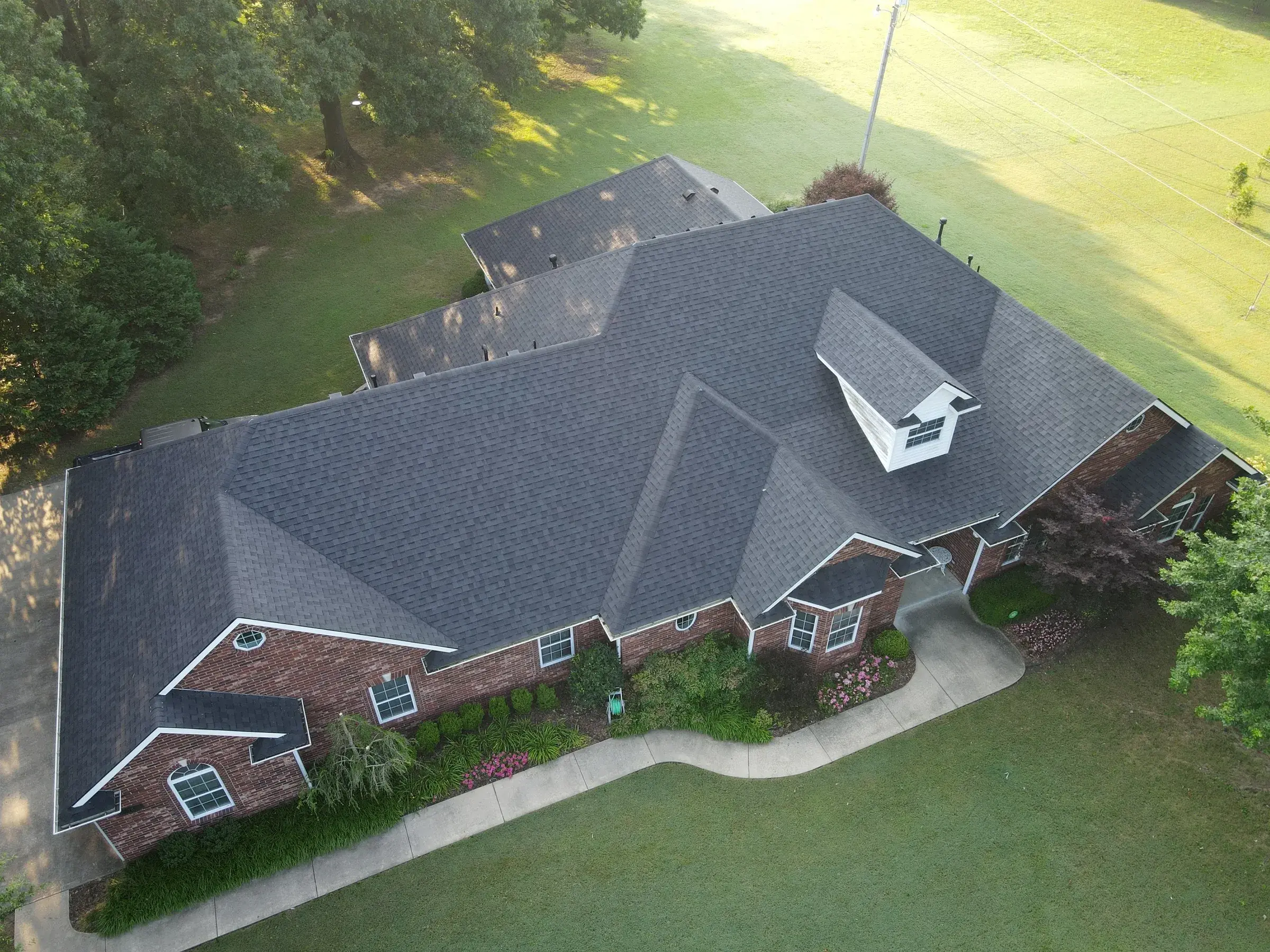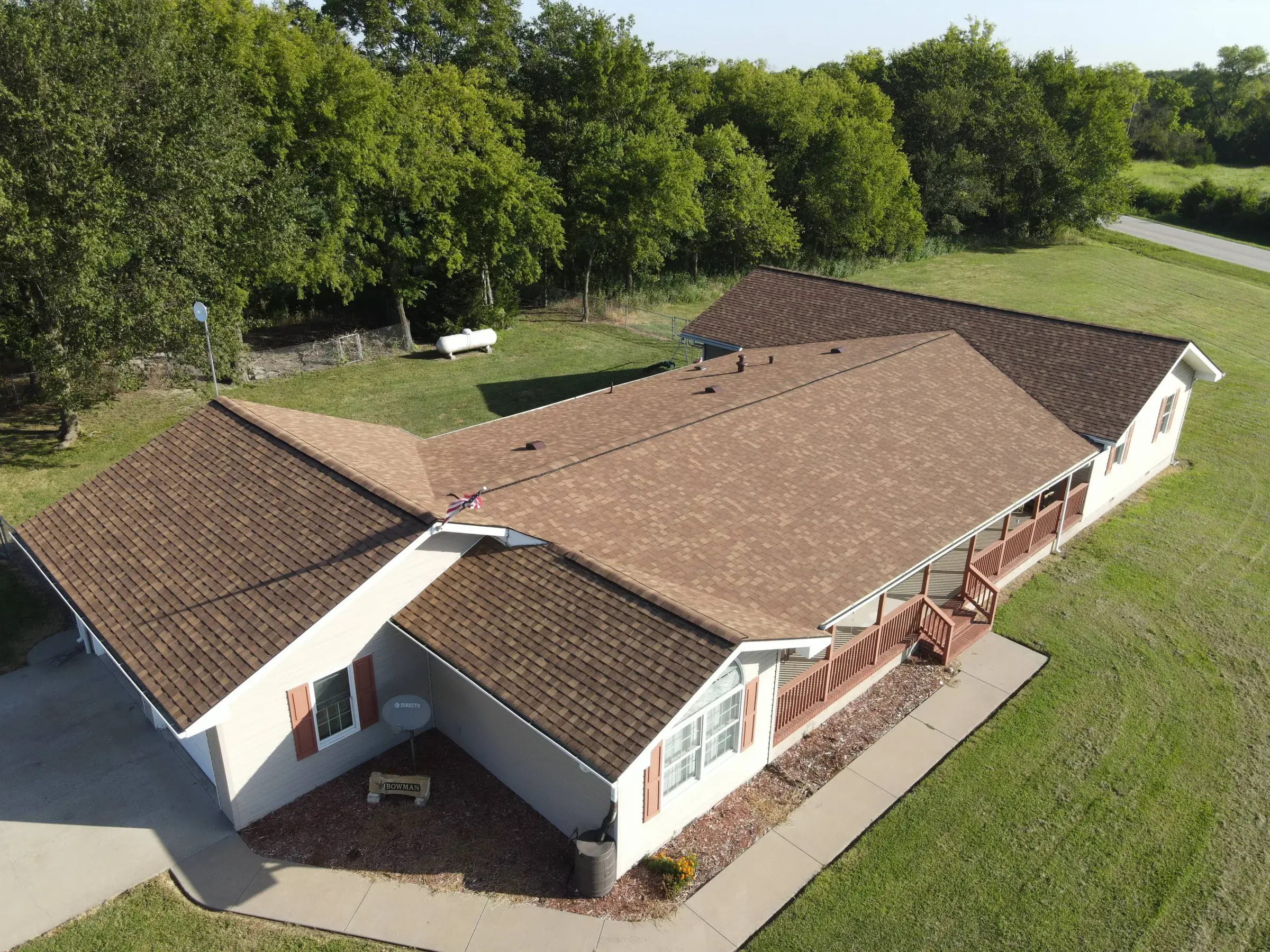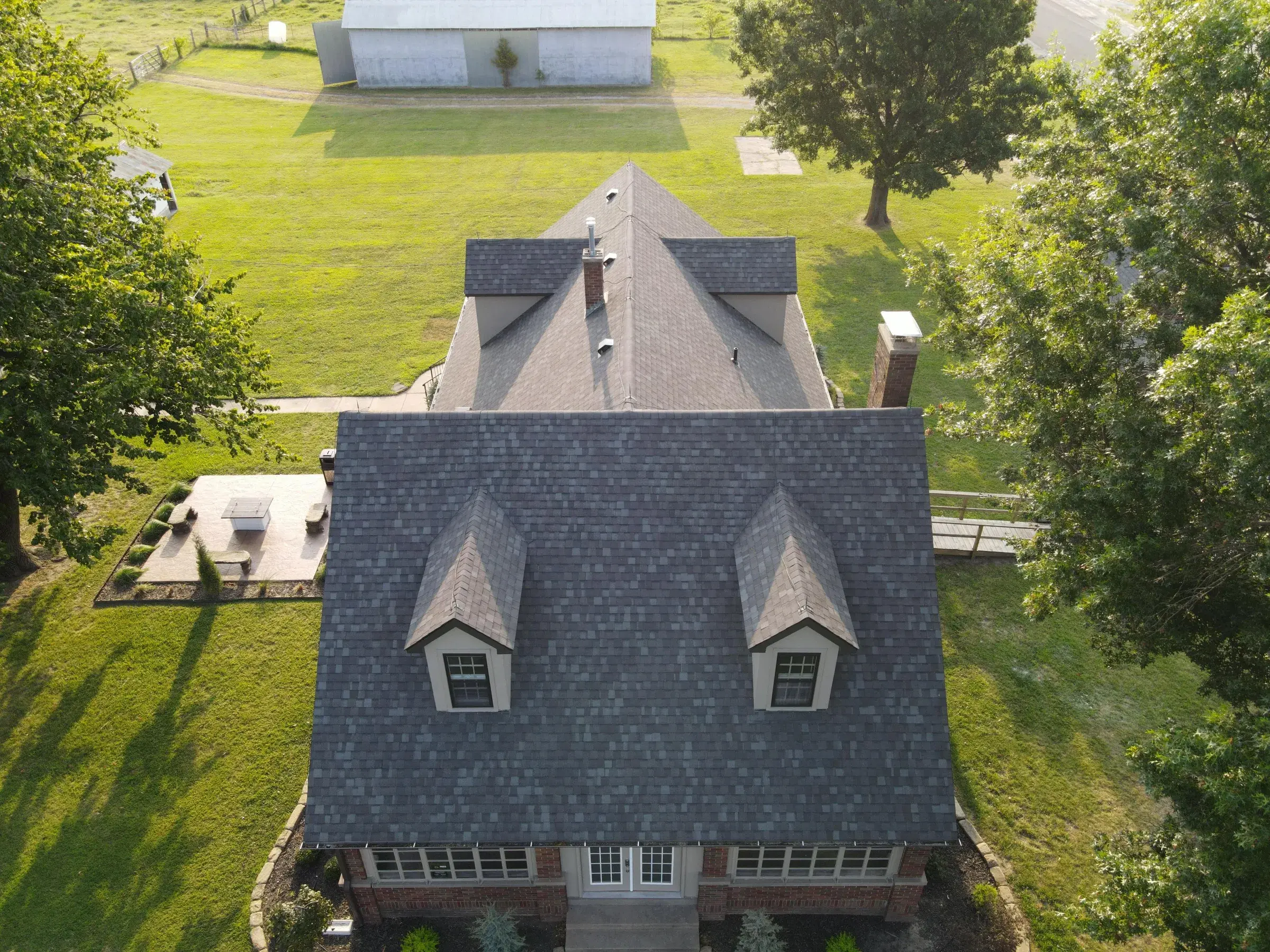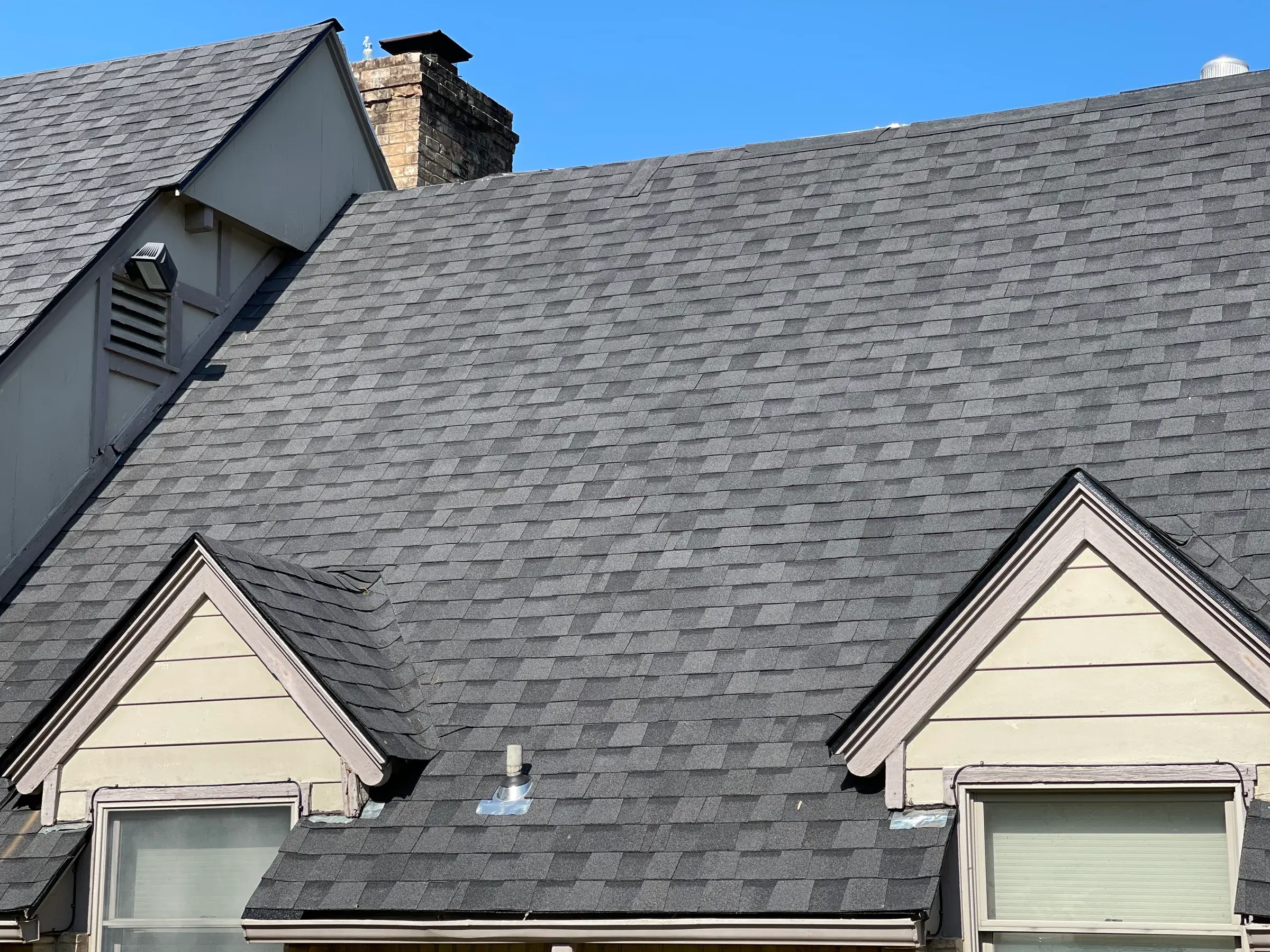
Fall roof maintenance in northeast Oklahoma is mostly about water and debris. Clean gutters after the leaves drop, confirm downspouts discharge away from the foundation, clear valleys and behind chimneys, check attic insulation depth and ventilation openings, seal exposed nail heads and pipe boots, and schedule any repair work before the first hard freeze.
Why fall order of operations matters: don't clean gutters before the leaves finish
Most fall roof advice is a list. Lists don't have an order. Around here, the order is the whole thing.
Two of the jobs on a fall roof list are temperature-dependent. Roof sealant and shingle adhesive both need warmth to do what they're supposed to do. Once daytime highs settle into the 40s, those repairs change character — they still get done, but they get done differently and they cost more attention.
One job is calendar-dependent in a way you don't control at all. Gutter cleaning depends on when your trees finish dropping, not on when you have a free Saturday. And in Ottawa County, the trees finish later than most people assume.
So the sequence runs close to backwards from how most homeowners do it. Inspect early. Do the sticky, warm-weather repairs early. Do the gutters last, once the trees are genuinely done. Clean a gutter in mid-October under a pin oak and you will be back up there in December doing it again.
| Step | When | What it depends on | What goes wrong if you do it out of order |
|---|---|---|---|
| 1. Roof and attic inspection | Early fall, while it's still shirt-sleeve weather | Nothing. Do it first. | You find a split pipe boot in December, and now it's a cold-weather repair instead of a ten-minute one. |
| 2. Sealant, pipe boots, flashing repairs | While daytime highs are reliably above roughly 50°F | The findings from step 1 | Sealant applied below its label minimum skins over on top and stays soft underneath. New shingles don't self-seal. |
| 3. Gutter cleaning | After leaf drop actually finishes | Your trees, not the calendar | Clean too early and you refill before the first freeze — with nobody looking. |
| 4. Downspout and drainage check | Same visit as the gutter clean | Clean gutters. You can't test flow through a packed trough. | Water dumps at the foundation all winter and freezes there. You won't see it until spring. |
| 5. Attic insulation and ventilation check | Before the furnace starts running hard | Nothing, but it's far more pleasant before it's 30°F up there | Warm, damp indoor air hits cold sheathing and condenses. People call it attic rain and blame the roof. |
Leaf drop timing in Ottawa County and what species around here actually clog gutters
Oklahoma Forestry Services and OSU Extension both describe northeast Oklahoma as a transition zone, and the tree list reflects that. What lands in your gutters here is mostly oak, hickory, elm, hackberry, sycamore, cottonwood, silver maple, sweetgum, and eastern redcedar — not one dominant species with one tidy drop date.
Oaks are the reason you're cleaning twice
Post oak and blackjack oak dominate the Cross Timbers edge, and pin oak shows up in a lot of yards and along drainages. Oaks are late droppers. Several of them are also marcescent — a forestry term meaning the dead leaves stay attached on the branch instead of falling. A marcescent oak can hold brown leaves into January and release them in batches every time the wind comes up.
That single fact reorganizes your whole fall. If your house sits under oaks, a gutter clean in late October is a down payment, not a job finished.
What each species does to a gutter
- Oak (post, blackjack, black, pin): thick, leathery leaves that mat into a solid plug rather than washing through. Drops late, sometimes in stages, sometimes into winter.
- Sycamore and cottonwood, common along the Neosho: large leaves that block a downspout opening whole. Sycamore also sheds bark plates that wedge in valleys.
- Elm and hackberry: small leaves that pack tight and hold water like a sponge. They're the ones that rot a fascia board quietly.
- Silver maple: fast-decomposing leaf litter that turns into gutter soil. Two seasons of it and you're growing seedlings up there.
- Eastern redcedar: sheds scaly foliage year-round, not on a schedule. Cedar debris is resinous and clings to shingle granules.
- Sweetgum: the leaves are manageable. The spiky seed balls are what jam a downspout elbow.
East county and west county are not the same job
Ottawa County splits down the middle, and it matters for roofs. The eastern side rises into the Ozark Plains — rockier, rolling, and genuinely wooded. Roofs there get real leaf loads, plus shade, which means slower drying, moss on north slopes, and debris packed into valleys.
West of that, you're into the Neosho Lowlands: flat prairie and farmland with open wind fetch and a lot fewer trees overhead. Those roofs collect less leaf litter and take more wind. Different fall list. West-county homes should spend their fall attention on lifted shingle tabs and ridge caps, not on gutters.
There's a third case worth naming. Roughly 13% of Ottawa County's 13,701 housing units sit vacant, and a good share of those are Grand Lake places that empty out after Labor Day. A second home with nobody in it drops leaves into a gutter for two months, freezes solid, and reports nothing. If you own one, fall is not optional there — it's the whole maintenance year.
Gutters, downspouts, and where the water is supposed to end up
A gutter's job is not to hold water. It's to move water somewhere it can't hurt anything. Most gutter problems in this county are actually downspout problems.
When you do your one real [gutter cleaning](/services/gutter-cleaning) of the fall, don't stop at scooping the trough. Run a hose in at the far end and watch three things: does the water reach the outlet, does it come out the bottom of the downspout at full volume, and where does it go once it lands?
That last question is where flat lots bite. Miami sits at 778 feet on the Neosho, and a lot of the west side of the county is close to level. On flat ground, a downspout that discharges at the corner of the house isn't draining — it's pooling. Then 89 nights a year below freezing turn that pool into a slab of ice against your foundation. Extensions or a buried drain line move it out. Splash blocks alone rarely do on ground this flat.
Two more things worth a look while you're there. Check whether water is running behind the gutter instead of into it, which usually means the drip edge or gutter apron isn't lapping into the trough — that's the metal strip that should carry water off the deck edge and over the lip. And check the fascia board behind the gutter for softness. Elm and hackberry litter holds moisture against wood for months, and rot there is cheap to fix now and not cheap later.
Valleys, chimney backs, and low-slope transitions that collect debris
Gutters get the attention because you can see them from the driveway. The places that actually leak are the ones nobody looks at.
Valleys are the V-shaped seams where two roof planes meet. They carry the most water on your roof, and they're exactly where oak leaves stop moving. A debris dam in a valley pushes water sideways, under the shingle courses, and it will find the nail line. Valleys need to be clear going into winter — not tidy, clear.
The back of a chimney is worse. The upslope side of any chimney is a wall standing in the path of everything running down the roof. Debris piles against it and stays wet. Under that pile is step flashing — the L-shaped pieces of metal that lap into each shingle course and tie the roof into the masonry. Wet debris sitting on step flashing for years is how flashing fails. Wide chimneys are supposed to have a cricket behind them, a small ridged saddle that splits water around the stack. If yours doesn't, that back corner is your highest-risk square foot.
Same logic applies to low-slope transitions: porch roofs, room additions, anywhere a shallow plane meets a steeper one. Shallow slopes don't self-clean. Whatever lands there stays there.
Sealant and pipe boots: the repairs that need warm weather to work
This is the part of the fall list that has a hard deadline attached to it, and it's the part most people leave for last.
Pipe boots are the rubber or synthetic collars sealing around your plumbing vent pipes. They fail more here than people expect, and the reason is overhead. The Oklahoma Climatological Survey's 1991–2020 normals put Miami at about 57 days a year above 90°F and roughly 62% of possible sunshine. That's a lot of UV and heat cycling on a piece of rubber. Boots crack at the base of the collar, the crack is usually on the upslope side where you can't see it from the ground, and the water runs down the outside of the pipe and into a ceiling ten feet away from the actual hole.
Exposed nail heads are the other one. Every fastener left face-nailed — ridge caps, hip caps, flashing edges, some vent flanges — gets a dab of roof cement over it. That cement is a consumable. It dries, shrinks, and cracks, and it needs to be renewed. ARMA, the Asphalt Roofing Manufacturers Association, treats sealant renewal and flashing checks as routine maintenance items, not repairs. Do it on a warm day and it's a maintenance visit. Do it in December and it's a service call that may not hold.
| Repair | Can it wait? | The reason |
|---|---|---|
| Renewing sealant over exposed nail heads on ridge and hip caps | No — beat the freeze | Roof cement has a minimum application temperature on the label. Below it, it never fully cures, and you've bought yourself a false repair. |
| Replacing a cracked pipe boot | No | The shingles you disturb around the boot need warmth to re-bond. Cold work here has to be hand-sealed, and the leak it prevents drains straight into a ceiling. |
| Re-securing lifted or loose shingle tabs | No | A lifted tab is a wind target, and it won't re-bond on its own once temperatures drop. This is the top priority on open, west-county roofs. |
| Chimney or wall flashing that's already leaking | No | Freeze-thaw makes it worse mechanically. Water gets into a gap, expands as it freezes, and widens the gap. Roughly 89 nights a year below freezing is 89 chances. |
| Gutter cleaning | Yes — waiting is the point | Cleaning before the oaks are done just means paying twice. Wait for actual leaf drop, then do it once, properly. |
| Attic insulation top-up | Yes, but sooner is cheaper | It isn't a water-intrusion risk. It is a heating-bill and condensation risk the moment the furnace starts running. |
| Full re-roof or shingle replacement | Depends on why | It can be done cold with hand-sealing and adjusted nailing. If the roof isn't actively leaking and isn't storm-damaged, warm weather gives you a better result. |
| Fascia paint, gutter touch-up, cosmetic work | Yes | Paint has its own temperature minimum, and none of it keeps water out of your house. |
Attic insulation depth and ventilation openings before heating season
Your attic is roof work. Homeowners file it under energy, and then wonder why their roof deck is wet.
Start with depth. The U.S. Department of Energy and ENERGY STAR publish attic insulation recommendations organized by climate zone, and the honest advice is to look up which zone Ottawa County falls in and read the number off their table rather than trusting a rule of thumb. But here's the field test that works regardless: go up with a tape measure and a flashlight. If your insulation is level with the tops of the ceiling joists or below them, you are almost certainly short of current recommendations. Older Miami-area houses very often are. Median home value in the county sits at $123,300, which tells you something about the age of the stock.
Ventilation openings are what keep the deck dry
A roof needs balanced airflow: intake low at the soffits, exhaust high at the ridge. When you're up there, check three specific things.
First, look at where the insulation meets the eave. If someone blew insulation right over the soffit vents, your intake is gone and your exhaust vents are pulling air from inside the house instead of outside. Baffles — rigid channels that hold the insulation back and keep an air path open — fix that. Second, count your exhaust. A ridge vent working alongside box vents or a powered fan on the same roof plane can short-circuit, with the ridge pulling air from the box vents instead of from the soffits. Third, follow your bathroom and kitchen fan ducts. If one of them ends in the attic instead of through the roof or a gable wall, you are pumping shower steam onto cold sheathing every morning all winter. That is the single most common cause of the mystery drips people call us about in January, and it is not a roof leak. If any of those three are off, [attic ventilation](/services/roof-ventilation-repair) is a fall job, not a spring one.
IBHS, the Insurance Institute for Business and Home Safety, puts attic checks on its pre-winter maintenance guidance for exactly this reason: what happens in the attic in October decides what the roof deck looks like in February.
Small repairs that get expensive if they wait until January
Nothing on a roof stays the same size. Freeze-thaw is a machine for making small things bigger. Water gets into a gap, freezes, expands about 9%, and pries the gap open. Then it thaws and goes deeper. With roughly 89 nights a year below 32°F in this part of Oklahoma, a hairline crack in November is a channel by March.
The items that reliably compound over a winter are short and predictable: one missing shingle (which exposes the nail line of the course below it to wind and water), a cracked pipe boot, a lifted step flashing, a nail pop that's tented the shingle above it, and a soft spot in the decking you can feel underfoot. Each of those is a small [roof repair](/services/roof-repair) in October. Each of them is drywall, insulation, and framing by spring.
One more note on timing. Oklahoma amended the residential code — specifically IRC section R908.3.1.1 — to require a full tear-off rather than shingling over the existing roof in defined conditions. That matters in fall because a tear-off is a weather-exposed job. If your roof is at the stage where a re-cover was your plan, find out now, in good weather, what the actual scope has to be. And in the City of Miami, new roofs and re-shingles require a permit. We pull it.
Your fall cutoff date — and what to do if you miss it
There isn't a date on the calendar you can circle. There's a condition, and you work backwards from it.
The condition is your first hard freeze. NOAA and the National Weather Service office in Tulsa publish freeze and frost climatology for northeast Oklahoma, including the probability of a 32°F reading by a given date. That's the page to look at — not a rule of thumb, and not what your neighbor's uncle says. It shifts year to year, and it arrives earlier in the low ground along the Neosho than it does on the higher, wooded ground east of town.
The practical version: schedule anything involving sealant, boots, or shingle adhesive while daytime highs are still reliably in the 50s and above, with sun on the roof. That's your warm-work deadline, and it lands well before the gutter deadline. Then let the trees tell you when to do the gutters.
If you miss it — and plenty of people do, because the oaks drag on and the first cold snap doesn't wait — you have not lost the year. You've changed the method. Cold-weather work gets hand-sealed rather than sun-sealed, which is a manufacturer-approved approach, just a more deliberate one. Emergency tarping exists to stop active water intrusion until conditions allow a real repair. And some things genuinely should wait for spring: if a roof isn't leaking and isn't storm-damaged, a March re-roof will seal better than a January one.
What you should not do is skip the look. A [roof inspection](/services/roof-inspections) works in any weather, and knowing what's wrong in December is worth a great deal more than finding out in March. If an inspection turns up storm damage, we document it with a photo report and give you a written estimate for the work we'd perform; your insurer decides coverage under your policy, not us.
Printable fall roof checklist — Miami and Ottawa County, OK
- Early fall, while it's warm: walk the roof or have it inspected. Make the repair list before the weather makes decisions for you.
- Photograph the roof from the ground on all four sides. It's your baseline for the next storm.
- Renew sealant over every exposed nail head — ridge caps, hip caps, flashing edges, vent flanges — while daytime highs are still above roughly 50°F.
- Inspect every pipe boot for cracking at the base of the collar, including the upslope side you can't see from the ground.
- Press-check for lifted or unbonded shingle tabs, especially on open, west-county roofs with wind fetch.
- Check step flashing where the roof meets any wall or chimney. Clear debris off the upslope side of the chimney.
- Clear all valleys completely. Not tidy — clear.
- Check low-slope transitions: porch roofs, additions, anywhere a shallow plane meets a steep one.
- Wait for actual leaf drop to finish. Under oaks, that's later than you think — some hold dead leaves into winter.
- Clean gutters once, after the drop finishes. Scoop first, then flush with a hose.
- Watch the water leave every downspout at full volume. Fix the ones that don't.
- Confirm every downspout discharges well away from the foundation. On flat lots, splash blocks are not enough.
- Check fascia behind the gutters for soft, punky wood.
- Confirm drip edge or gutter apron laps into the trough, not behind it.
- Attic: measure insulation depth against the ceiling joists. Level with the joists or below means you're short.
- Attic: confirm soffit vents aren't buried in insulation. Install baffles if they are.
- Attic: confirm bath and kitchen fans vent outside, not into the attic.
- Attic: look for rusty nail tips, dark staining, or damp sheathing — all signs of a ventilation problem, not a leak.
- Trim branches that overhang the roof. Less debris, less shade, fewer squirrels.
- Verify any contractor's Oklahoma registration at verifyroofing.cib.ok.gov before you sign.
- Note anything you deferred, and put it on the spring list before you forget it.
Fall and spring do different work. Fall is about water and debris going into the cold. Spring is about hail, wind, and clearing out maple and elm samaras — the little helicopter seeds that pack a gutter tighter than leaves ever will. If you want the other half of the year, the [spring checklist](/blog/spring-roof-maintenance-checklist-northeast-oklahoma) covers it. And if your house has a history of icicles along the eave, read up on [ice dams and winter roof prep](/blog/winter-roof-prep-and-ice-dams-in-northeast-oklahoma) before the first hard freeze, because the fix for those starts in the attic in October, not on the roof in January.
We're at 111 S Main St in [Miami](/locations/miami-ok), on the old Route 66 alignment, and we work across Ottawa County and into Kansas, Missouri, and Arkansas. Inspections and quotes are free. If you want a second set of eyes on the list above before the weather turns, call (209) 758-8550 and we'll come look.
Questions people ask about this
When should I clean my gutters in Miami, Oklahoma — is October too early?
Often, yes. It depends entirely on your trees rather than the calendar. Northeast Oklahoma has a lot of oak, and oaks drop late — several species are marcescent, meaning they hold dead leaves on the branch and release them in batches through winter. If your house sits under oaks, a late-October cleaning usually means a second cleaning in December. Wait until the drop actually finishes, then do it once and check that every downspout flows at full volume.
Can roof repairs be done in cold weather, or do I have to wait for spring?
They can be done, but the method changes. Asphalt shingles rely on a self-seal strip — a bead of factory adhesive that bonds only when sun and warmth activate it, generally above roughly 40–50°F. Below that, shingles get hand-sealed with an approved compound instead, which is a manufacturer-accepted approach. Roof cements also carry a minimum application temperature on the label. So an active leak gets fixed whenever it happens; a non-urgent re-roof will simply seal better in warmer weather.
How do I find my first freeze date so I know my deadline?
Use the freeze and frost climatology published by NOAA and the National Weather Service office in Tulsa, which covers northeast Oklahoma and gives probabilities rather than a single fixed date. It moves year to year, and it tends to arrive earlier in the low ground along the Neosho than on the higher, wooded ground east of Miami. The practical rule: get all sealant, pipe boot, and shingle adhesive work done while daytime highs are still reliably in the 50s with sun on the roof.
I keep finding water in my attic in winter but no one can find a roof leak. What is it?
It's very often condensation, not a leak. Warm, humid indoor air reaches the attic, hits cold roof sheathing, and condenses — then drips. The usual causes are a bathroom or kitchen fan that vents into the attic instead of outside, or soffit intake vents buried under blown insulation so the attic can't breathe. Check both before you spend money on the roof itself. Rusty nail tips and dark staining on the underside of the deck point the same direction.
How do I check whether a roofer in Oklahoma is legitimate?
Oklahoma registers roofing contractors through the Construction Industries Board rather than licensing them, so "licensed and bonded" isn't a real Oklahoma credential. Registration does require at least $500,000 in commercial general liability coverage for residential work. You can verify anyone's status free at verifyroofing.cib.ok.gov. Do it before you sign, and especially after a storm, when out-of-area crews turn up. Kansas, Missouri, and Arkansas each handle it differently, so verify under the rules of the state your property is in.