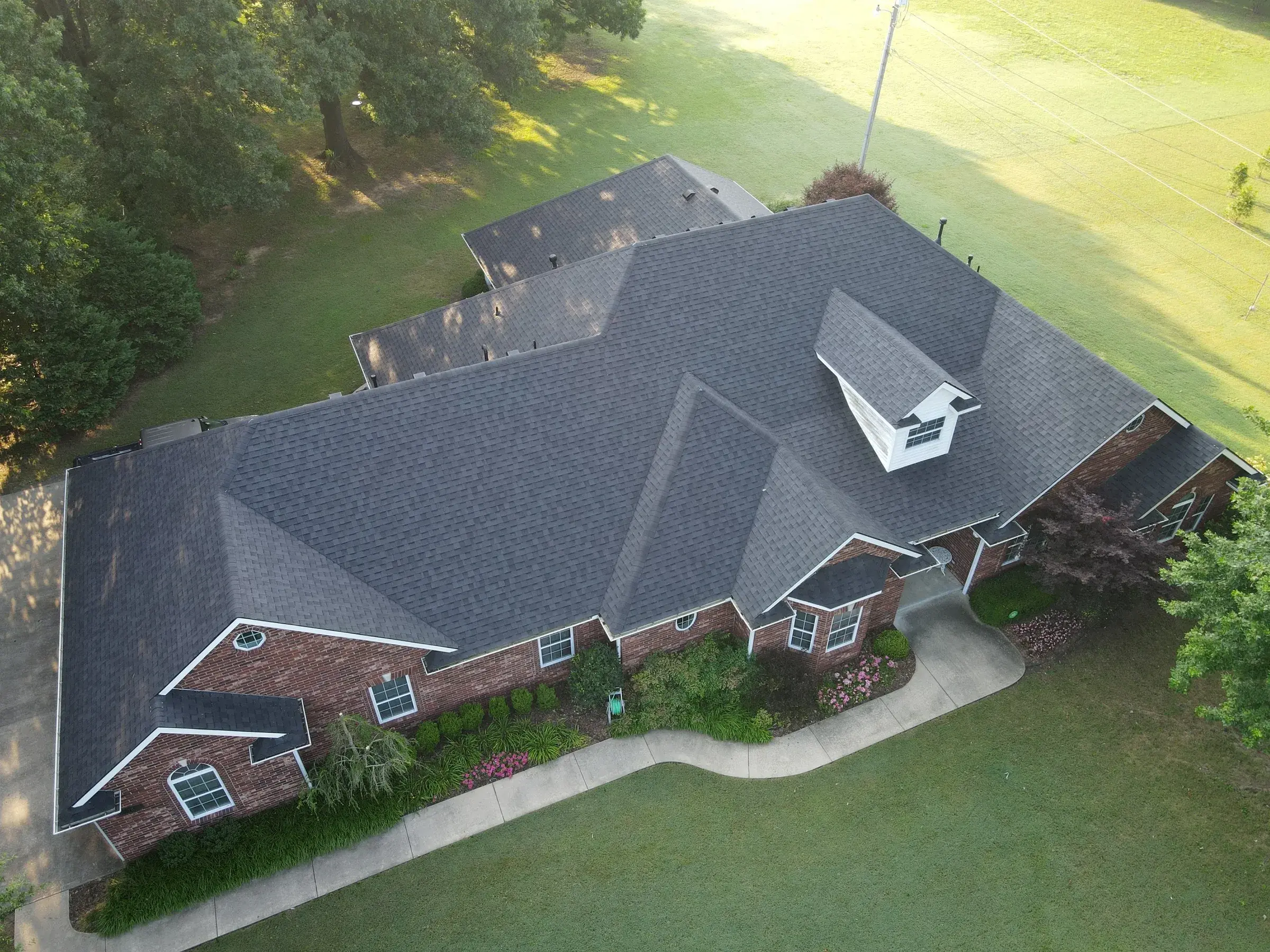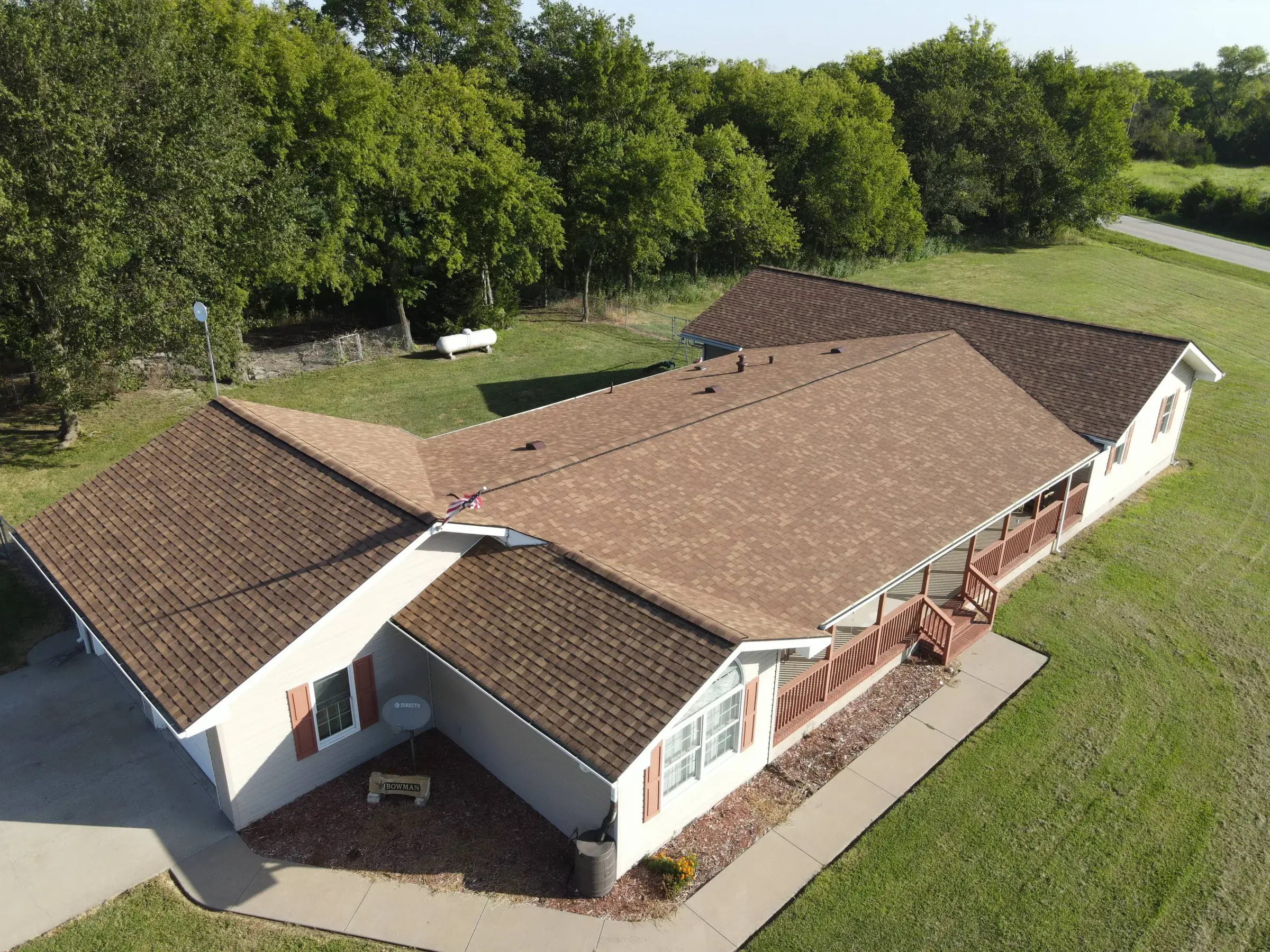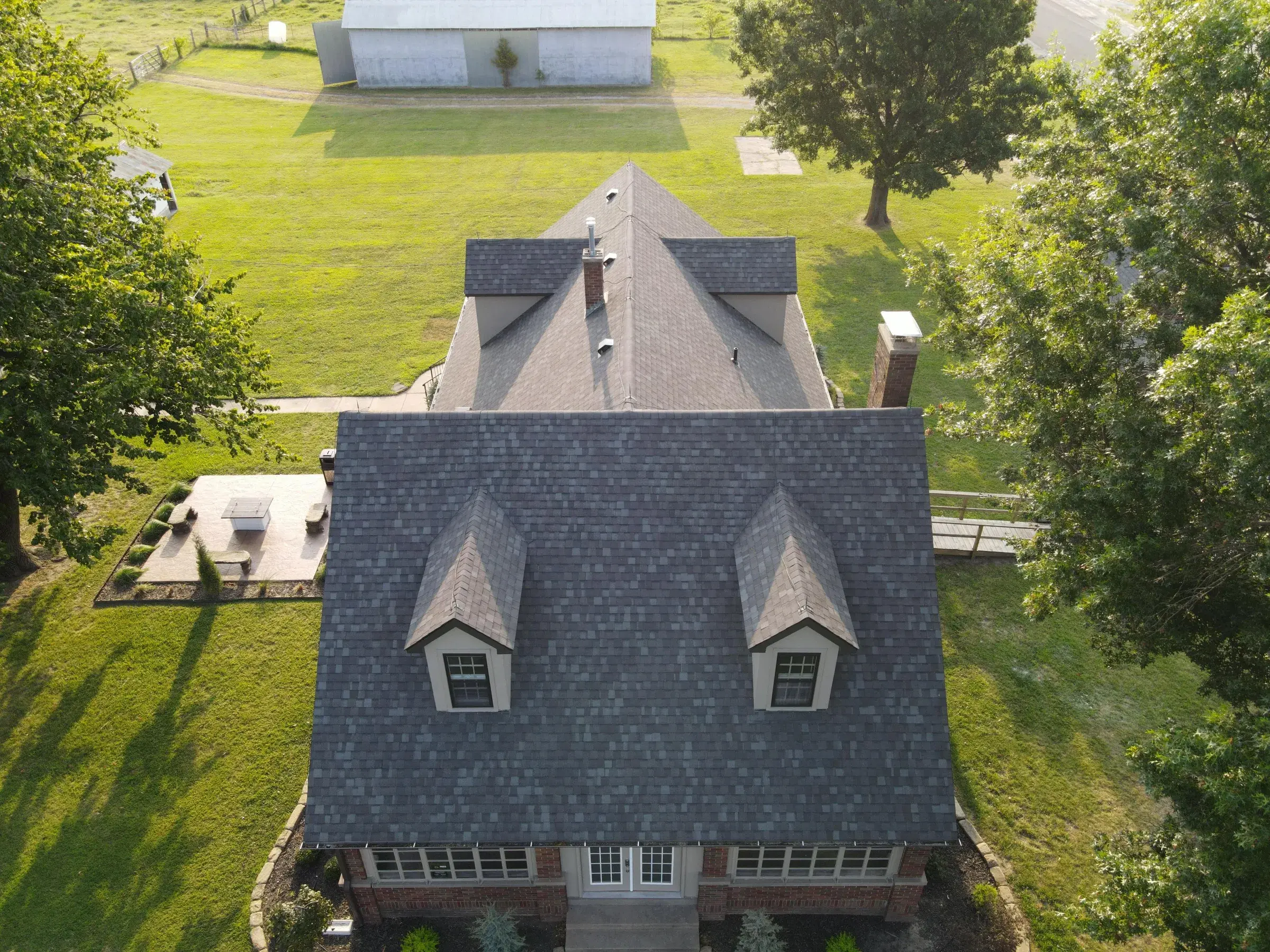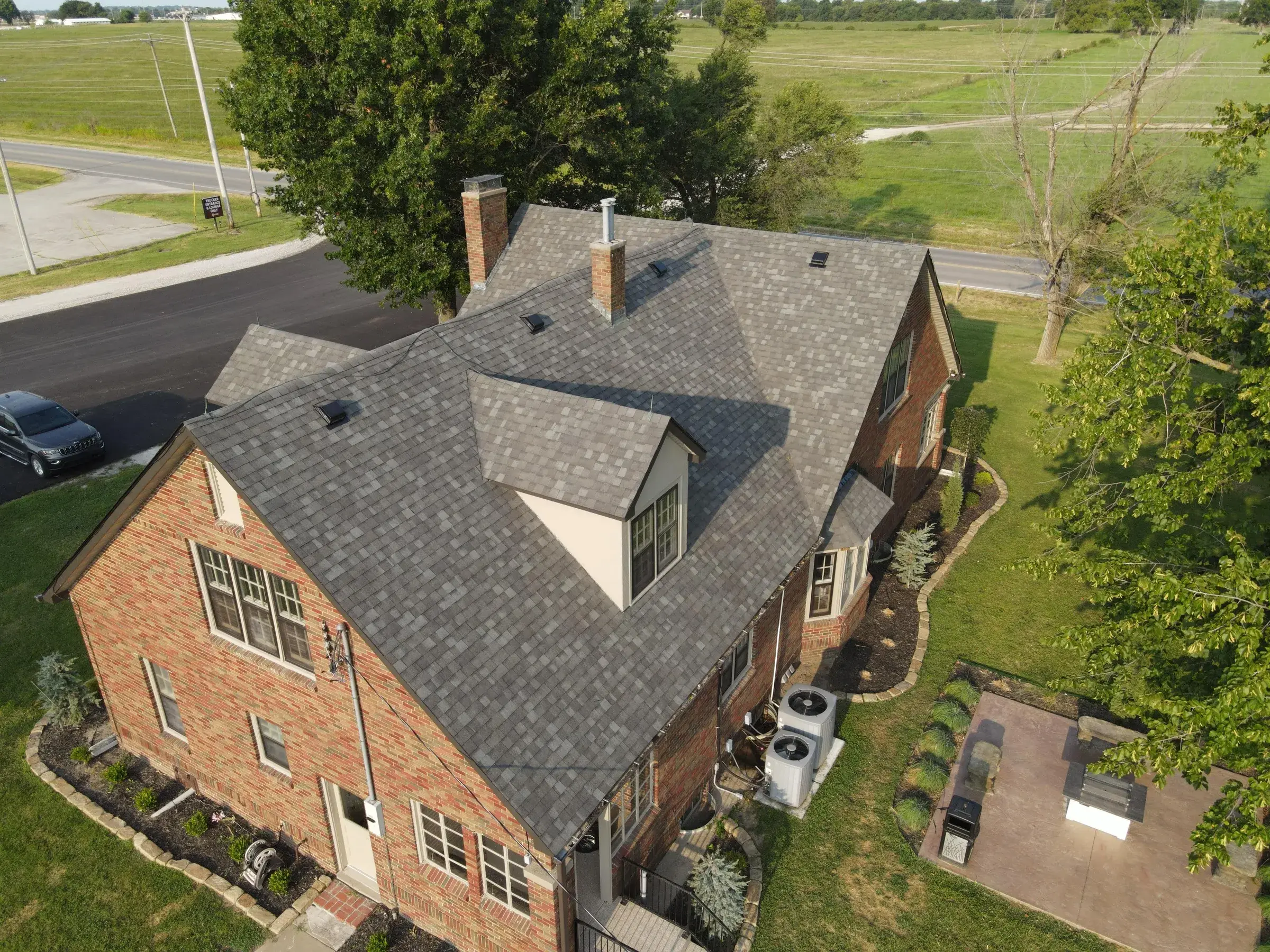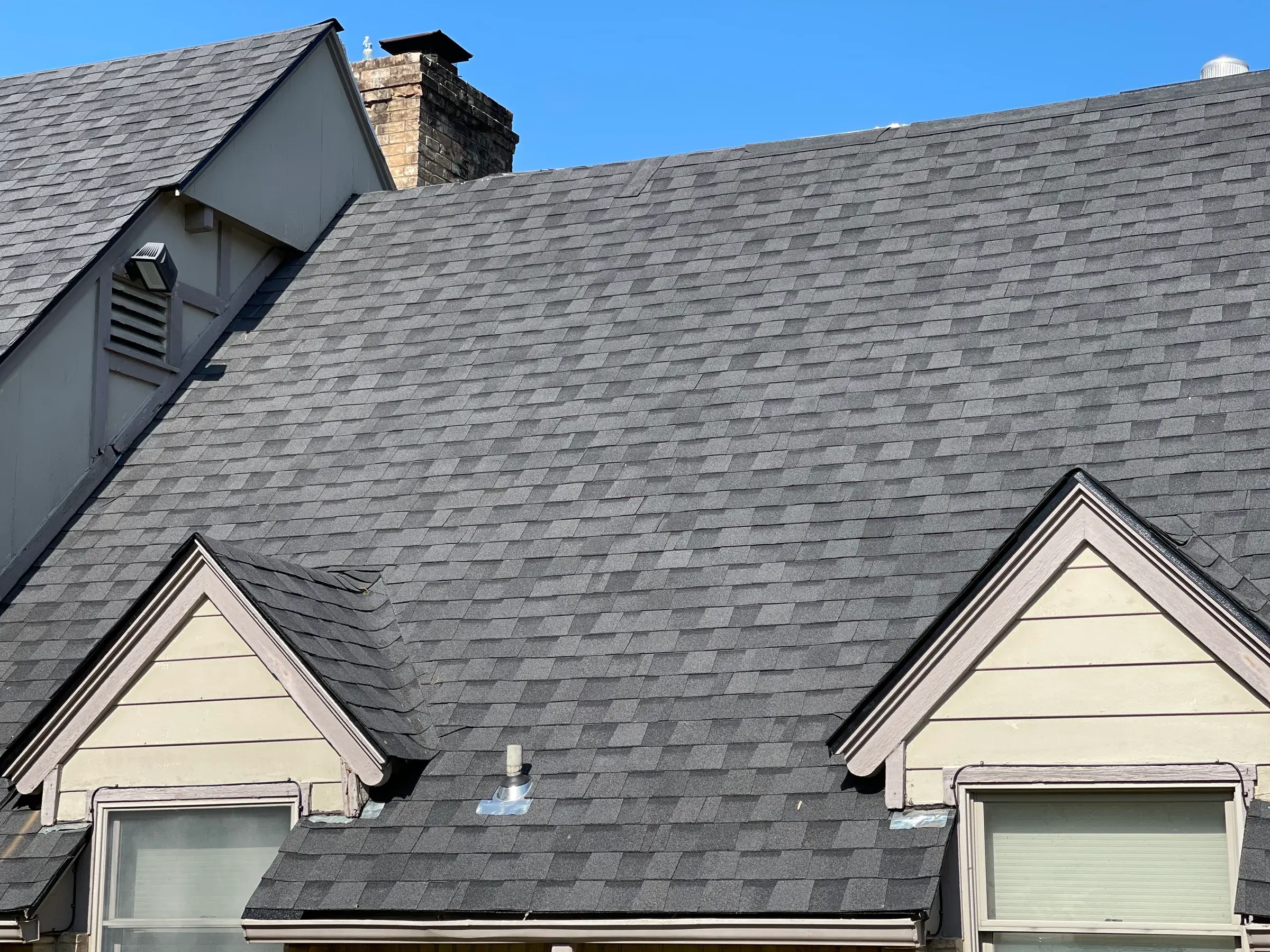
Fairland sits between Miami and Grand Lake, and many properties there include outbuildings — barns, shops, and detached garages — that get ignored until they leak. Metal panel roofs on those structures need fastener and sealant checks, not shingle checks. On the house itself, the priorities are gutter clearing, flashing, and attic ventilation.
Fairland in context: between Miami and the lake, in Ottawa County
Fairland sits in Ottawa County, in the northeast corner of Oklahoma, on the stretch of ground between Miami and Grand Lake o' the Cherokees. That location explains most of what makes roofing here different from roofing in a subdivision.
Ottawa County isn't one landscape. The east side runs into the Ozark Plains — rockier, wooded, rolling, lots of tree canopy. The west side is Neosho Lowlands: flat prairie and farmland with nothing to slow the wind down. Fairland-area properties tend to sit where those two conditions meet, which means some homes get shade, moss, and limbs overhead, while others sit in open fetch with a roof edge taking the full push of a south wind.
The U.S. Census doesn't publish the kind of granular detail for a town Fairland's size that people like to quote, but the county-level American Community Survey figures tell you more anyway. Ottawa County has about 30,285 residents and 13,701 housing units. Roughly 76.7% of those units are detached single-family homes and 12.2% are mobile or manufactured housing — a much higher share than most of Oklahoma. About 13% sit vacant, which mostly reflects lake-area second homes that nobody looks at between October and April. Median home value is $123,300; median household income is $49,947.
Those last two numbers matter more than they look. They set the arithmetic on whether a 40-year-old barn roof gets repaired, replaced, or torn down. We'll come back to that at the end.
The rural property reality: you probably have three or four roofs
In town, a house is a roof. On acreage around [Fairland](/locations/fairland-ok), a house is one of several. There's the house. Usually a detached garage or carport. Often a shop. Frequently a barn or loafing shed. Sometimes a well house, an RV cover, and a shed that came with the place and predates everyone's memory of it.
Here's the pattern we see over and over in how rural properties get maintained: the house roof gets checked because you look at it every day when you pull in. Everything else gets checked when something inside it gets wet. By then the fix is not a fix — it's a rebuild, because water has been in the structure for two or three years and the purlins or rafters have gone soft.
The first useful thing you can do costs nothing. Write down what you own.
| Structure | Roof type | Approx. age | Last checked | Next action |
|---|---|---|---|---|
| House | Asphalt shingle / metal / other | |||
| Detached garage | ||||
| Barn or loafing shed | Usually exposed-fastener metal | |||
| Shop | ||||
| Carport / RV cover | Often open-frame metal | |||
| Well house / pump house | ||||
| Shed (unknown vintage) |
Print it, fill it in once, and keep it with your insurance paperwork. The "last checked" column is the one that changes behavior. Most people find out they have not looked at the barn roof in six years only when they're forced to write the number down.
The house: standard NE Oklahoma priorities in a rural setting
The house is still the priority, and the priorities on it are the same ones that apply anywhere in Ottawa County — just with a rural twist on each.
Gutters and what's actually in them
On the wooded east side of the county, gutters don't fill with dust. They fill with oak leaves, cottonwood fluff, and the seed litter that comes off whatever is hanging over the eave. Full gutters push water back under the shingle edge and rot the fascia from behind, where you can't see it. If you've got mature trees over the house — and a lot of properties out this way do — the topic is bigger than the gutters themselves, which is why we wrote a separate piece on [trees, limbs, and roof debris in northeast Oklahoma](/blog/trees-limbs-and-roof-debris-in-northeast-oklahoma). [Gutter cleaning](/services/gutter-cleaning) twice a year is not overkill under a canopy.
Flashing, because that's where leaks actually start
Most roof leaks are not shingle failures. They're flashing failures. Step flashing — the L-shaped pieces of metal that tie a roof into a wall, one per shingle course — is the usual culprit, along with chimney flashing and the boots around plumbing vents. Rubber pipe boots crack from UV before anything else on the roof does. Oklahoma gets roughly 62% of possible sunshine in a year, and that ultraviolet load is what turns a flexible boot into a split, gray ring. It's a cheap [roof repair](/services/roof-repair) if you catch it and an expensive ceiling if you don't.
Attic ventilation
Intake at the soffit, exhaust at the ridge. Balanced. The Oklahoma Climatological Survey's 1991-2020 normals put Ottawa County at about 57 days a year above 90°F, with an August daily-high normal of 91.5°F. An underventilated attic under that sun cooks the shingles from the underside and shortens the roof's life for no good reason. The same survey counts about 89 nights a year below freezing, which is the other half of the problem — warm moist attic air hitting a cold deck condenses, and people mistake that for a leak every winter.
Permits
In the City of Miami, a permit is required for new roofs and re-shingles, and we pull it — that's covered on our [Miami page](/locations/miami-ok). Outside city limits, the process is different, so ask your contractor directly who is pulling what rather than assuming it's handled.
Exposed-fastener metal panels: gasketed screws, backing out, and the 15-year problem
Now the barn. Almost every agricultural outbuilding in this part of Oklahoma is roofed with exposed-fastener metal panel — corrugated or R-panel, screwed straight through the face of the panel into wood purlins or steel. Every one of those screws has a rubber washer under its head. That washer is the roof's waterproofing. Not the panel. The washer.
The Metal Construction Association's maintenance guidance for exposed-fastener systems keeps returning to the same point: on this type of roof, the fasteners are the maintenance item, and they wear out on a schedule the panel doesn't share. The steel and its coating can easily outlive the rubber that seals it.
Here's the mechanism, and it's specifically an Oklahoma mechanism. Metal panels expand and contract with temperature. Between roughly 57 days a year above 90°F and 89 nights below 32°F — the Climatological Survey's numbers again — a panel in Ottawa County goes through thousands of expansion-contraction cycles across its life. The panel moves. The screw doesn't want to. Over years, that cycling walks screws out of the purlin a fraction of a turn at a time, wallows the hole in the panel into an oval, and compresses and cracks the washer until it's a hard black ring instead of a gasket.
That's why a re-screw is a normal, expected event somewhere in an exposed-fastener roof's second decade — not a sign that someone did it wrong. The screws are consumable. Budget for them the way you'd budget for tires.
Exposed-fastener metal roof inspection checklist (barn, shop, detached garage)
- Screws standing proud: sight down each purlin line from a low angle. A screw head that sits higher than its neighbors has backed out.
- Gasket condition: the washer should still be compressed and flexible. Cracked, flattened, squeezed-out, or missing rubber means that screw is no longer sealing.
- Over-driven screws: a washer squished out sideways past the screw head is as bad as a loose one — the rubber is crushed and split.
- Oval or elongated holes: if the hole in the panel is no longer round, a same-size screw won't seal it. It needs an oversized fastener.
- Screws that missed the purlin: they spin freely and hold nothing. Common along the eave and at panel ends.
- Ridge cap fasteners and closures: check the foam or metal closure strips under the ridge cap. Foam degrades under UV and crumbles, leaving an open gap.
- Eave and rake edges: the first place wind gets a grip. Look for lifted edges, missing trim screws, and daylight.
- Transitions and valleys: anywhere two roof planes meet, or a lower roof ties into a wall.
- Penetrations: stove pipes, vents, old antenna mounts, abandoned holes from equipment nobody uses anymore.
- Panel end laps: check that laps are still tight and the sealant tape between them hasn't dried out.
- From inside, on a bright day: stand in the barn with the lights off and look up. Pinpoints of daylight are holes. This is the single most informative two minutes you can spend.
- From inside, after rain: look for rust streaks running down the purlins and staining on the framing. Water leaves a record.
Sealant, closures, and ridge caps on outbuildings
The other consumable on a metal outbuilding roof is sealant. Butyl tape between panel laps, foam closure strips at the ridge and eave, and gun-grade sealant at trim conditions all have a service life, and UV is what ends it. Oklahoma's roughly 62% annual sunshine is generous for growing things and hard on anything rubber or foam that sits exposed.
Foam closures are the ones people miss. They're the profiled strips that fill the corrugation gaps under the ridge cap so wind-driven rain, dust, and wasps can't get in. When they crumble — and they do — you don't get a dramatic leak. You get wind-blown rain making it up under the cap in a south wind, and a slow rusting of the panel from underneath at the ridge. Look for daylight at the ridge from inside the building.
One correction worth making: sealant is not a repair strategy on its own. Smearing a tube of caulk over a leaking screw buys you a season and hides the fact that the hole is oval and the purlin under it may be rotten. It also makes the real repair harder and more expensive later. Sealant belongs in the assembly as designed, not on top of it as a bandage.
Rust, oil-canning, and panel movement: what's cosmetic and what's a leak
Metal roofs generate a lot of anxiety about things that don't matter and very little about the things that do. Here's the sorting.
| What you see | What's causing it | Cosmetic or functional | What to do |
|---|---|---|---|
| Oil-canning — visible waviness in the flat areas of the panel | Inherent to light-gauge flat metal. Stresses from rolling, fastening, and thermal movement. | Cosmetic | Nothing. It is not a defect and it does not leak. It gets more visible at a low sun angle. |
| Chalking — a powdery film that comes off on your hand | The paint's binder breaking down under UV. | Cosmetic, but it dates the coating | Note it. It tells you the finish is aging. It doesn't affect watertightness. |
| Fading, uneven color between panels | UV exposure, plus different production runs. | Cosmetic | Nothing structural. Matters only if you're adding panels and want them to match. |
| Surface rust at a cut edge or a scratch | Bare steel exposed where the coating stopped. | Usually cosmetic early, functional if ignored | Clean and touch up. Watch it. Edge rust that's turned into flaking, layered scale is no longer surface rust. |
| Rust bleeding down from a screw head | The washer failed and water is sitting in the hole. | Functional | That screw needs replacing, likely with an oversized fastener. Check its neighbors. |
| Elongated or oval holes at fasteners | Years of thermal expansion and contraction walking the panel against the screw. | Functional | Oversized gasketed screws. A same-size replacement will not seal an oval hole. |
| Abandoned holes with no screw in them | Missed purlins, removed equipment, old repairs. | Functional | Each one is a direct hole to the inside. Patch properly — not with caulk alone. |
| Hail dents in the panel field | NE Oklahoma averages 4-5 days a year with hail larger than 0.75 inch, per the Oklahoma Climatological Survey. | Usually cosmetic on a barn panel | Denting isn't the same as breaching. But check every fastener afterward — impact loosens screws. |
| Panels rattling or lifting at the edge in wind | Fastener loss, or fasteners that never caught a purlin. | Functional and urgent | Fix before the next wind event. This is how a roof leaves in one piece. |
| Rust streaks on interior purlins | Water is getting in above and running down the framing. | Functional | Trace it uphill. The entry point is above where you see the stain. |
Wind exposure on open acreage: eaves, gables, and unbraced structures
A house in a Miami neighborhood has other houses, fences, and trees taking the edge off the wind before it arrives. A shop standing alone in a west-county pasture has none of that. Same storm, meaningfully different loading, and the difference is all at the edges.
Wind doesn't peel a roof from the middle. Research from the Insurance Institute for Business & Home Safety on wind performance keeps landing on the same conclusion: failure starts at the perimeter — eaves, rakes, corners, and ridges — where the airflow separates and pressures spike, and it starts at whatever fastener is weakest there. Once wind gets under one edge, it works the rest of the roof from the inside out. That's why the edge fasteners and the edge trim on an outbuilding deserve more attention than the field of the roof, not less.
The NWS office in Tulsa is the forecast office for Ottawa County, and it's the right place to watch for the severe wind and tornado warnings this region gets — not a national app that doesn't know where you live. Ottawa County is genuine severe-weather country: hail, straight-line wind, tornado, and ice. That's the load your buildings sign up for.
The other rural-specific issue is bracing. Pole barns, carports, and RV covers built by whoever owned the place before you may have no diagonal bracing at all, or bracing that's been cut out to make room for equipment. A roof can be perfectly screwed down and still fail because the frame under it racks. If your carport visibly moves in a wind, the roof is not the problem you have. OSU Extension publishes agricultural building maintenance guidance and has county offices across Oklahoma; it's a genuinely good, free resource on farm structures, and it's not trying to sell you anything.
Building a two-tier maintenance schedule
The whole point of separating these roofs in your head is that they fail differently and therefore need looking at differently. Checking a metal barn roof for "missing shingles" is looking for the wrong thing entirely.
| Shingle roof (the house) | Exposed-fastener metal (barn, shop, garage) | |
|---|---|---|
| What fails first | Flashing, pipe boots, sealed nail line at the ridge and hips | Fastener gaskets, foam closures, lap sealant |
| Sensible inspection interval | Annually, plus after any hail or high-wind event | Every 2-3 years as a baseline, annually once past the first decade |
| Fasteners | Hidden. You never think about them. | Exposed and consumable. Plan on a re-screw in the second decade. |
| Sealant | A minor component at flashings and penetrations | A primary component. Its UV life sets your service interval. |
| Debris and gutters | Critical — trapped debris rots the edge | Less critical, but debris packed in corrugations at a transition holds water against the panel |
| After hail | Look for bruises: soft, dark spots where the granules are gone and the mat is dented | Look for dents — usually cosmetic — but re-check every fastener. Impact loosens screws. |
| Walking on it | Possible with care | Only over purlins, only if the framing is known sound. Often the answer is simply no. |
| End-of-life signal | Widespread granule loss, curling, brittle shingles that crack when lifted | Perforation from rust-through, or so many oval holes that re-screwing no longer seals it |
The two-tier version is simple. The house gets a walk every spring and again after any storm that made noise. The outbuildings get a proper look every couple of years — and once a metal roof is past ten years old, move it to annual, because that's when fasteners start reporting for duty. Our [roof inspections](/services/roof-inspections) are free and they include a photo report of what we find, so you have documentation whether or not you do anything about it that year.
When an outbuilding roof isn't worth repairing
This is the conversation nobody has honestly, so let's have it.
Median home value in Ottawa County is $123,300. Median household income is $49,947. Against those numbers, spending real money on a fifty-year-old shed that stores a mower and some paint cans is a bad trade, and any contractor who won't say so is selling you something. Some outbuildings should get a roof. Some should get a tarp and a plan. Some should come down.
The honest test is what's under the panel. If the panels are perforating but the purlins and framing are sound, a re-roof is straightforward and worth it. If the framing has been wet for years — punky purlins, rotted rafter tails, a post that's gone soft at grade — you're not buying a roof, you're buying a rebuild, and the roof is the cheap part. And if the building has racked out of square, that's structural, not roofing.
Two more thresholds. If the roof has so many oval and abandoned holes that oversized screws no longer land in solid metal, re-screwing is over as a strategy. And if the building has no use — genuinely, not sentimentally — its best value may be salvage.
If your house roof is the one that needs eyes on it, that's straightforward — we're in Miami at 111 S Main St, the inspection and the quote are free, and the photo report is yours to keep. For the barn, the shop, or the pole building, call and ask us plainly whether that structure is in scope before you schedule; some outbuilding work isn't, and we'd rather tell you on the phone than in your driveway. If your property is closer to the water than to town, our [Grand Lake roofing guide](/blog/grand-lake-roofing-guide) covers the lake-specific issues — seasonal vacancy chief among them — that this one doesn't.
Questions people ask about this
How often do the screws on a metal barn roof need replacing?
There's no fixed date, but a re-screw somewhere in the roof's second decade is a normal expectation rather than a sign of bad workmanship. The rubber washer under each screw head is the actual waterproofing, and it wears out faster than the steel panel does. In Ottawa County the driver is thermal cycling — roughly 57 days a year above 90°F and 89 nights below freezing, per the Oklahoma Climatological Survey — which walks screws loose and ovals the holes over time. Inspect every couple of years, then annually once the roof passes ten.
Is oil-canning on my metal roof a defect I should complain about?
No. Oil-canning is the visible waviness you see in the flat parts of light-gauge metal panels, and it's inherent to the material — it comes from the rolling process, from fastening, and from the panel expanding and contracting. It's purely cosmetic. It doesn't leak, it doesn't shorten the roof's life, and it becomes more obvious at a low sun angle and less obvious at midday. It is not something to spend money correcting.
My barn roof got dented by hail. Do I need a new roof?
Denting and breaching aren't the same thing. Northeast Oklahoma averages 4-5 days a year with hail larger than 0.75 inch according to the Oklahoma Climatological Survey, and metal panels on outbuildings often take cosmetic dents without losing watertightness. The real post-hail task is the fasteners: impact loosens screws and can split washers, so check every screw line and the ridge closures afterward. Your insurer decides what's covered under your policy — we can document the condition with a photo report and give you a written estimate for the work we'd perform.
Does a roofing contractor registered in Oklahoma automatically cover my barn or shop?
Not necessarily. Oklahoma's Construction Industries Board distinguishes residential roofing registration from a commercial roofer endorsement, and the commercial endorsement carries a higher liability insurance requirement — $1 million, against a minimum of $500,000 for residential work. Depending on the structure, an agricultural or commercial building may sit outside a residential registration. You can check any contractor's actual record for free at verifyroofing.cib.ok.gov, and it takes about a minute.
What's the fastest way to check an outbuilding roof without getting on it?
Stand inside with the lights off on a bright day and look up. Pinpoints of daylight are holes, and they show up in seconds. Then go back after the next rain and look for rust streaks running down the purlins and staining on the framing — water leaves a record of where it's been. Between those two, you'll find more than most people find climbing around, and you won't fall through a panel whose purlins have quietly rotted underneath it.