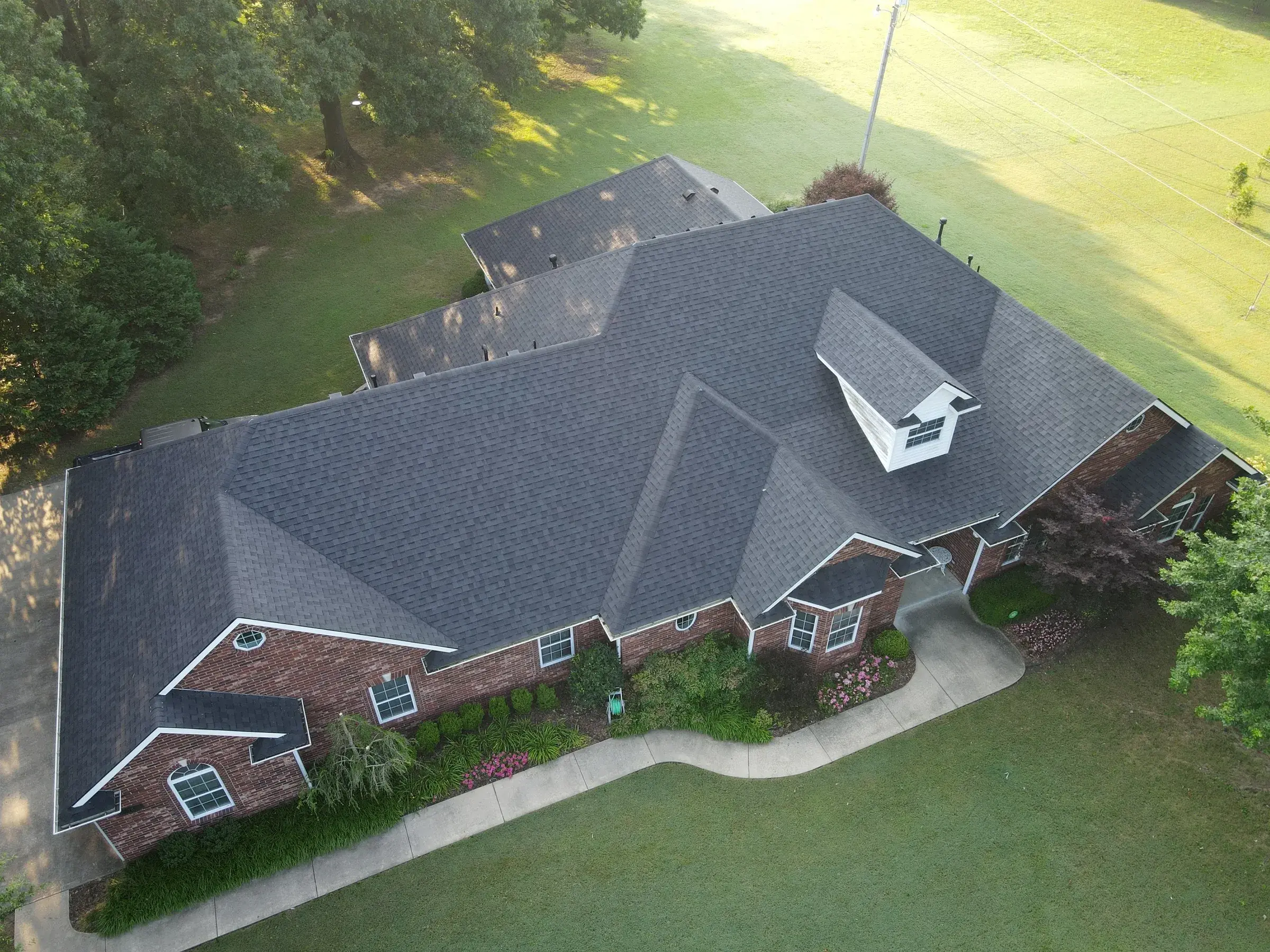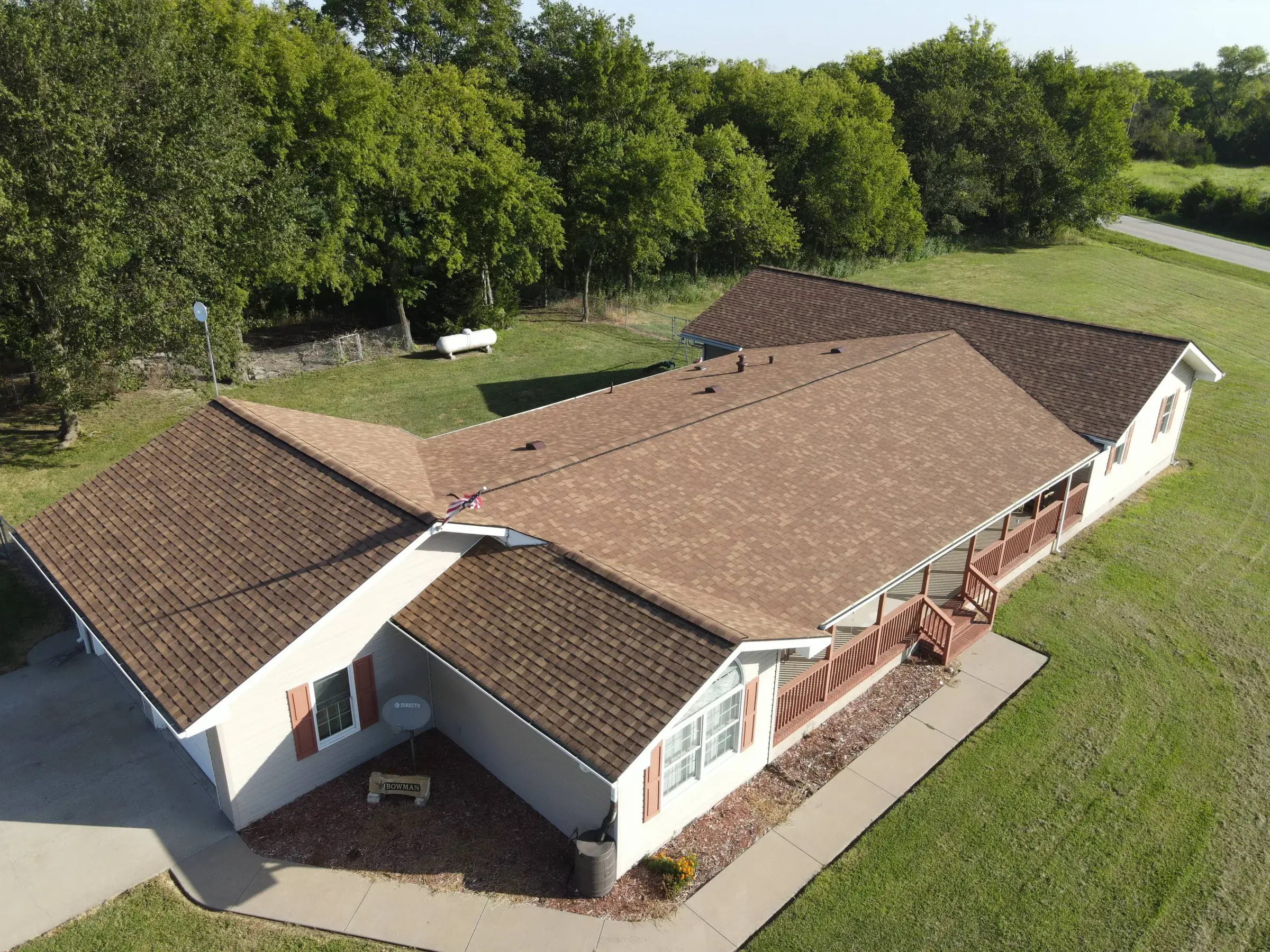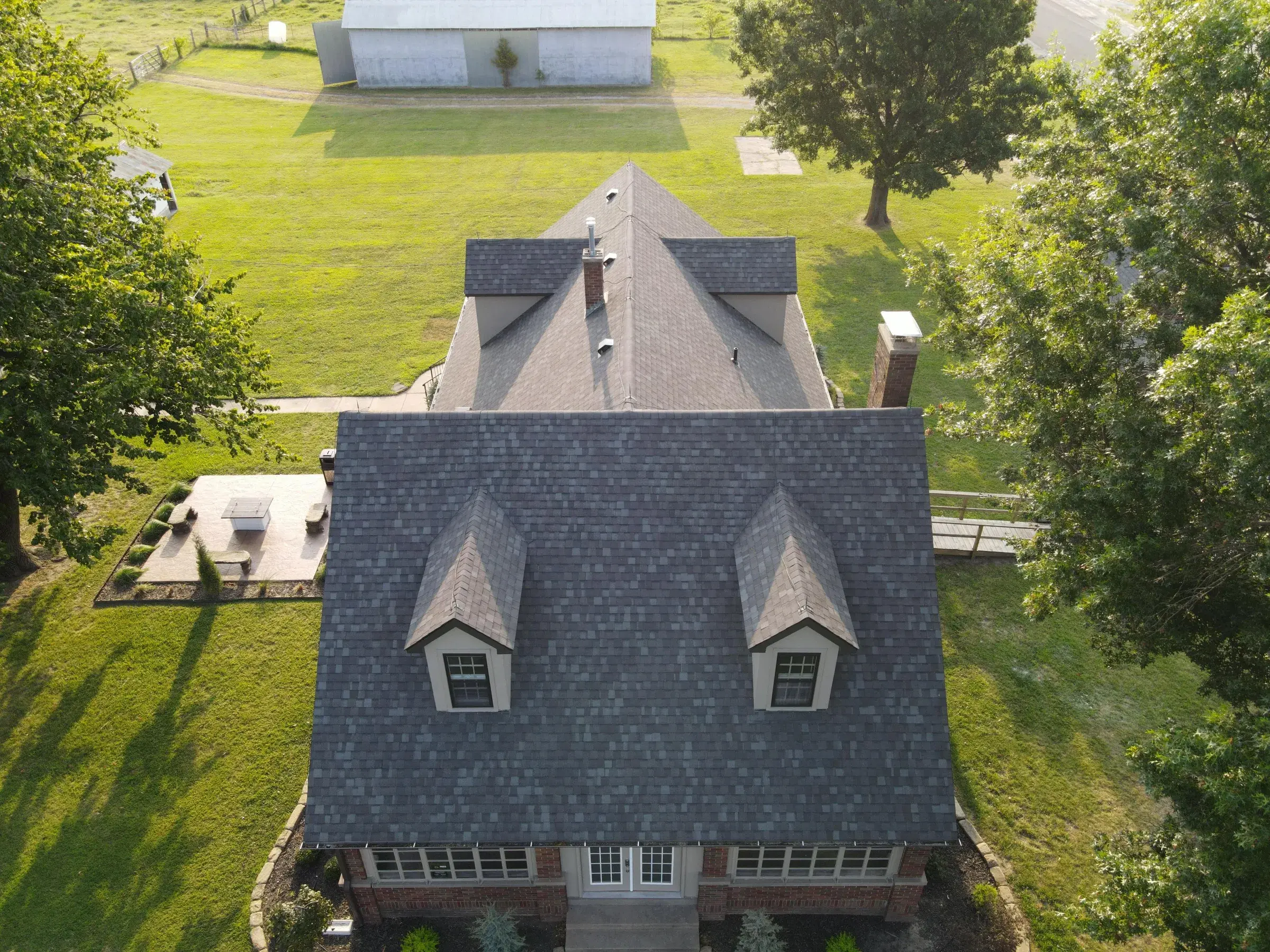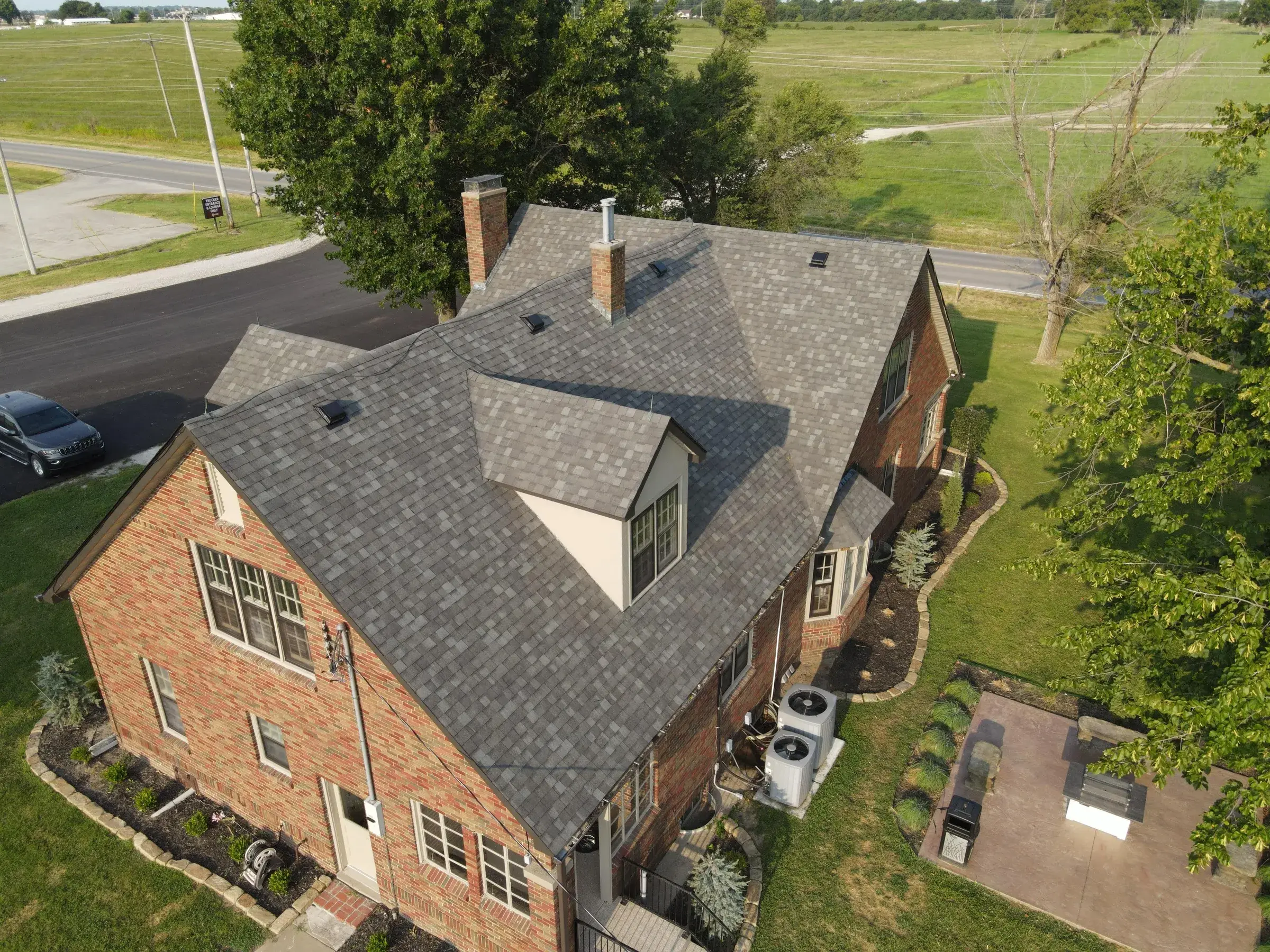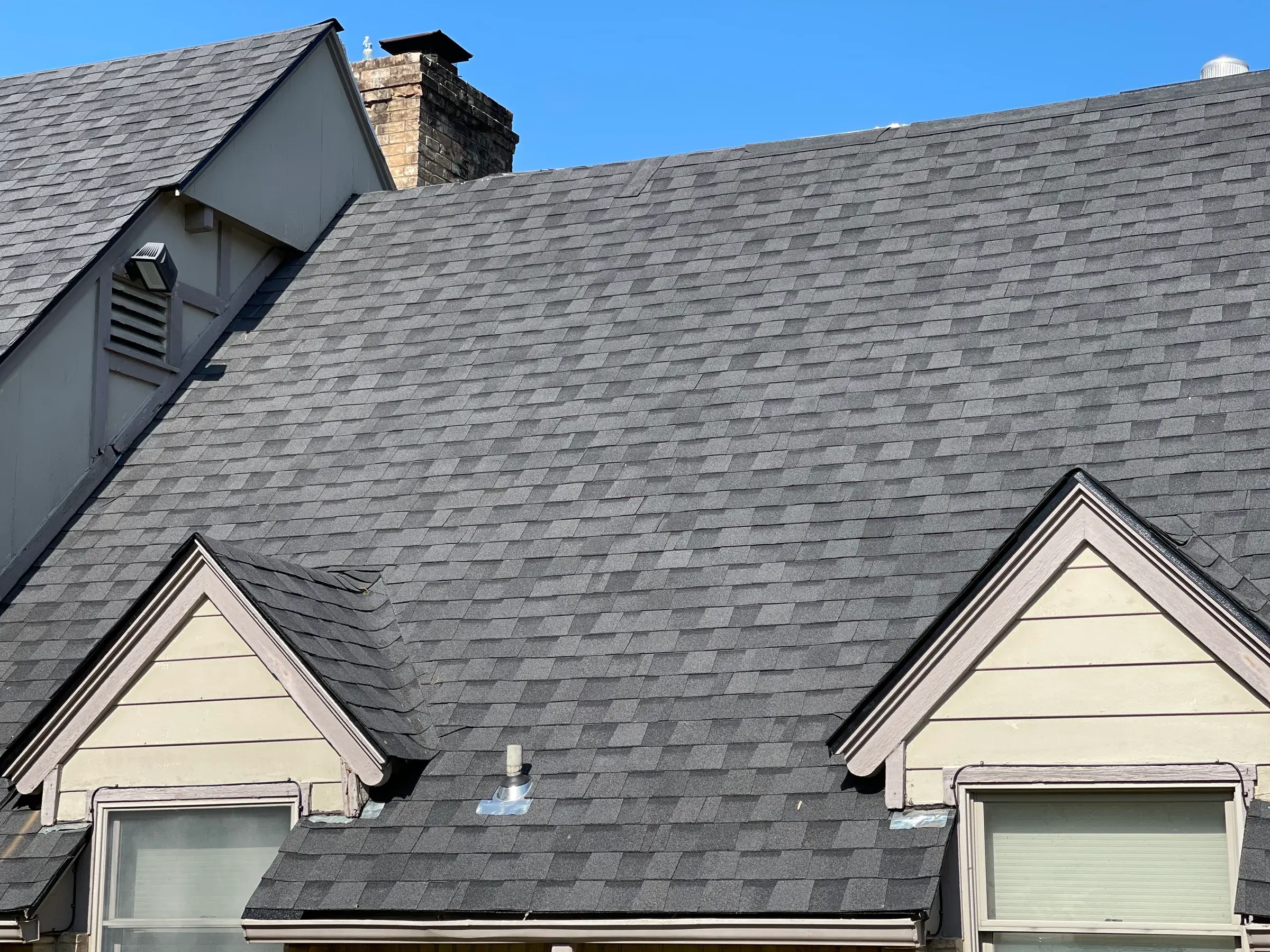
Drip edge is a metal flashing installed along a roof's eaves and rakes that directs runoff off the deck edge and into the gutter instead of behind it. Without it, water wicks back onto the fascia, soffit, and deck edge and causes rot. Modern residential code requires it on most new roofs, and it should appear as a line item on your quote.
What drip edge is and the specific failure it prevents
Drip edge is a strip of bent metal, usually about 10 feet long, that runs along the edges of a roof. One leg lies flat on the roof deck under the shingles. The other turns down over the edge of the deck and covers the top of the fascia — the flat board that faces out at the bottom of the roof, the one your gutter hangs on. Most profiles have a third small kick at the bottom that flares away from the wall. That kick is the entire point of the part.
Here is the failure it prevents. Water running off the end of a shingle does not fall straight down. It clings to the underside of whatever it is leaving and curls back — the same reason a poured glass of water dribbles down the outside of the glass instead of dropping cleanly. On a roof edge with no metal, that curl carries runoff back onto the raw edge of the sheathing and down the face of the fascia. Every rain. A small amount each time.
The metal breaks that curl. Water reaches the kick, loses the surface it was clinging to, and falls — into the gutter, or clear of the house. That is the whole mechanism. It is not sophisticated, and it costs less than almost anything else on the roof. Measured against a full replacement, edge metal is a rounding error. The rot it prevents is not.
Where water goes without it: fascia rot, soffit staining, and deck edge decay
The damage arrives in a predictable order, and it rarely looks like a roof problem at first.
The fascia goes first
Paint blisters along the top of the board, then peels in strips. The wood underneath goes gray, then soft. This matters more than it sounds, because your gutter hangers screw into the fascia. Soft fascia loses its grip on the hangers, the gutter tilts, water dumps over the low spot, and the dumping accelerates the rot that caused it. By the time someone calls about a sagging gutter, the actual repair is often carpentry.
Then the soffit
Tan or brown streaks appear on the underside panel at the eave. Behind that panel are your soffit vents, which are the intake side of attic ventilation. Wet insulation at the eave loses most of its R-value and stays wet, because that is the darkest, least-ventilated corner of the attic.
Then the deck edge
The outer inch or two of sheathing takes on water and stays damp. OSB swells and delaminates; plywood softens. On a tear-off you can see it immediately — a spongy band running the length of the eave. That band is a problem beyond the wood itself, because the starter course of shingles nails into it. Fasteners in soft decking hold poorly, and the eave is the single worst place on a roof to have weak fasteners, since that is where wind uplift is highest.
Oklahoma adds a specific accelerant. The Oklahoma Climatological Survey's 1991–2020 normals put this area at 89 nights a year below 32°F. Wood that is wet and then freezes breaks down faster than wood that is merely wet — the water expands inside the grain and inside the joints, and does it again the next night. A fascia that would take a decade to fail somewhere mild fails faster here. If you are already seeing soft fascia or streaked soffit, that is usually a [roof repair](/services/roof-repair) conversation before it is a replacement conversation.
Code requirements: the drip edge provision and what it actually specifies
The drip edge rule lives in Section R905.2.8.5 of the International Residential Code, in the asphalt shingle chapter. That section number has stayed the same across the recent editions Oklahoma has been moving between, which is unusual and convenient — but the text has not stayed the same, because Oklahoma amends it.
That amendment is the part worth your attention. The Oklahoma Uniform Building Code Commission adopts the residential code and publishes its own amendments to it, and its version of the drip edge section is not the version you will find quoted on national roofing blogs. Oklahoma's amended section requires:
- A drip edge at eaves and rake edges of shingle roofs — both, not one or the other.
- Adjacent segments overlapped not less than 2 inches.
- The metal extending not less than 1/4 inch below the roof sheathing.
- The metal extending not less than 2 inches back up onto the roof deck.
- Mechanical fastening to the roof deck at roughly 12-inch spacing — fastened to the deck, not merely tacked to the fascia.
- Drip edge installed over the underlayment along rake edges.
Miami requires a permit for a new roof and for a re-shingle, and it gets inspected against whatever edition is in force on that date. We pull the permit on the work we do. If you are planning a [new roof installation](/services/new-roof-installation), ask early which edition your job will be inspected under, because a job quoted in one code cycle can easily get installed in the next.
Profiles decoded: Type C, Type D, and rake versus eave
Edge metal comes in a small number of shapes, and roofers name them by letter. The names sound technical and mean almost nothing until you see the cross-section.
| Part | Shape in cross-section | Where it's normally used | What it solves | What to watch |
|---|---|---|---|---|
| Type C (L-style) | A simple L — deck leg, face leg, and a short kick at the bottom | Rakes and eaves; the common baseline | Basic edge protection; keeps runoff off the raw deck edge | The short kick releases water close to the fascia. On a wide overhang with no gutter, the throw is minimal |
| Type D (T-style, "D-metal") | Deck leg, face leg, then the bottom flares out and back, so the profile reads like a T | Eaves especially; rakes on better specs | Pushes the drip line farther off the fascia, and holds the face leg slightly off the wood so it can dry | Costs a little more and needs the gutter set to match its longer throw |
| Gutter apron (sometimes called Type F) | A long lower leg that reaches out and then down, into the gutter trough | Eaves only, where gutters exist | Water running behind the gutter instead of into it | Not a substitute for rake drip edge, and it will not rescue a clogged gutter |
Rakes and eaves are different jobs. The eave is the horizontal bottom edge, where the gutter lives and where the volume is. The rake is the sloped gable edge running from eave to ridge, where there is no gutter and the enemy is wind pushing rain sideways across the edge. That difference is why the two edges get layered in opposite orders.
The layering rule that matters most: over the underlayment at rakes, under it at eaves
This is the detail that separates a correct install from one that looks identical from the driveway and fails anyway. Read the table from the bottom up — that is the order the crew builds it.
| Order (deck upward) | At the eave | At the rake |
|---|---|---|
| 1 | Roof deck | Roof deck |
| 2 | Drip edge, fastened down to the deck | Underlayment, run out to the deck edge |
| 3 | Underlayment, lapped over the drip edge's deck leg | Drip edge, fastened over the underlayment |
| 4 | Starter course, then field shingles | Starter/rake course, then field shingles |
The reasoning is simple once you know where the water is. At the eave, the underlayment is the last defense, and any water that reaches it needs to run out on top of the metal and off the kick. Put the underlayment down first and the metal on top, and that water runs under the metal instead — straight onto the deck edge you were trying to protect.
At the rake, the water is not on the underlayment. It is being driven across the gable edge by wind. Metal on top means there is no gap for wind-driven rain to blow up under. This is the half Oklahoma's amended section states outright, and it is the half that matters most on the western side of Ottawa County, where the Neosho Lowlands are flat, open prairie and the wind has a long, unbroken run at your gable.
Oklahoma's amendment is silent on the eave sequence, having dropped the model IRC's sentence about it. That does not make the eave a free-for-all. It hands the question to two other authorities that both answer it the same way: your shingle manufacturer's published installation instructions, and the NRCA Roofing Manual: Steep-Slope Roof Systems, which details edge metal at the eave with the metal down first and the underlayment lapping over it. If a roofer tells you the sequence is identical at both edges, that is a signal to keep asking.
Materials and gauge: aluminum, galvanized steel, copper — and why coastal advice doesn't apply here
R905.2.8.5 specifies dimensions and fastening. It does not set a metal thickness for drip edge. Thickness is answered by the product spec sheet and the ASTM material standard the manufacturer builds to, so it is a fair thing to ask a bidder to put in writing.
| Material | Typical thickness sold | Relative cost | Where it makes sense here | Notes |
|---|---|---|---|---|
| Aluminum (ASTM B209 sheet) | About 0.019 in. at the light end, 0.024–0.027 in. heavier | Lowest | The default on most reroofs in this area; comes pre-finished in colors that can match fascia or gutter | Dents most easily from hail; moves the most with temperature, which is why the 2-inch laps matter |
| Galvanized steel (ASTM A653 coated sheet) | 26 gauge (~0.018 in.) to 24 gauge (~0.024 in.) | Low to moderate | Stiffer and shrugs off hail dings better; usually pre-painted | Cut ends and deep scratches expose bare steel — they want touch-up paint, not indifference |
| Copper (ASTM B370 sheet) | 16 oz. (~0.022 in.) and up | Highest | Copper gutters and historic or architectural details | Never let it touch aluminum — dissimilar metals corrode at the contact. Runoff also stains masonry below |
Search "best drip edge material" and most of what comes back was written for the coast. The advice is aluminum or copper, never galvanized, because salt-laden air corrodes coated steel at every cut edge and fastener. That reasoning is real — and it has nothing to do with this market. Miami sits in Ottawa County on the Neosho River, roughly 90 miles northeast of Tulsa, at 778 feet. There is no salt air. The single factor that drives coastal edge metal specs simply is not present, which means galvanized steel is a perfectly sound choice here for reasons the coastal guides never get to.
What does drive the choice here is hail and heat. The Oklahoma Climatological Survey puts this area at 4 to 5 days a year with hail larger than 0.75 inch. Thin aluminum records those days as dimples in the fascia line. Steel takes them better. Then there is the temperature swing — 57 days a year above 90°F, 89 nights below freezing, and a state record high of 116°F set right here in Miami in 1954. Metal that long expands and contracts with every one of those cycles. Aluminum moves more than steel does. That is exactly why the 2-inch lap exists and why laps should not be nailed tight through both pieces: the metal has to be able to move, or it buckles and opens the joint.
One thing worth saying plainly: dented edge metal is cosmetic. Dimpled drip edge still sheds water. What actually matters after hail is whether fasteners pulled, laps opened, or the face leg got creased away from the fascia. Hail big enough to dimple edge metal usually landed on other things too — a [roof inspection](/services/roof-inspections) tells you what else took a hit. We document what we find with a photo report and give you a written estimate for the work we would perform. Your insurer decides coverage under your policy.
Gutter apron vs. drip edge: not the same part, and both may be needed
These get used interchangeably in conversation and they are not the same thing. The difference is the length of the lower leg. A standard drip edge's face leg is short — it covers the fascia and kicks water out an inch or so. A gutter apron's leg is long enough to reach out over the back lip of the gutter and down into the trough, so the water is physically delivered inside the gutter with nowhere else to go.
The failure mode shows up when a gutter hangs a hair low, or a hair out, or the fascia has settled. Water leaves the short kick, crosses the gap, and hits the back wall of the gutter or the fascia behind it. You see it as a dark stripe on the fascia behind the gutter and paint failure in a line — with a gutter that never seems to be the problem, because from the ground the gutter is catching most of the water just fine.
Eastern Ottawa County has a second version of this. That side is Ozark Plains — rockier, wooded, rolling — and wooded means leaves in gutters every fall. A clogged gutter overflows, and on an eave with only a short-kick drip edge, a good share of that overflow runs backward down the fascia instead of out over the front. An apron does not prevent the clog; regular [gutter cleaning](/services/gutter-cleaning) does. But an apron decides where the overflow goes when it happens. Rakes, having no gutter, take ordinary drip edge and always will.
How to tell from the ground whether your roof has it
Stay off the roof. A phone camera at full zoom or a pair of binoculars from the driveway answers this in about five minutes.
- At the eave, sight along under the shingle edge just above the gutter. You should see a thin band of metal turning down in front of the fascia, or reaching into the gutter. Shingles hanging out over open air with nothing under them means no edge metal.
- At the rake, look along the gable edge. You are looking for a metal line running up the slope, sitting under the shingle edge and over the fascia board.
- Look for a wood molding strip nailed to the face of the fascia, roughly an inch by two, with the shingles extending just past it. That is the shingle mold detail Oklahoma's exception allows — not necessarily an omission.
- Check the fascia itself. Blistered paint in a line, gray or soft-looking wood, a stripe of discoloration behind the gutter — that is water going where it shouldn't, whatever the metal is doing.
- Look at the soffit from directly underneath. Tan streaks or a sagging panel at the eave mean water has been getting in behind the fascia for a while.
If what you see is ambiguous, that is a normal outcome — edge metal is small and mostly hidden by the shingle it sits under. Our inspections are free, and this is a five-minute answer on site.
How to make sure it's in the quote as a line item, not an assumption
Edge metal is commonly folded into a vague "flashing as needed" line, or left out of the written scope on the assumption that everybody does it. Sometimes the assumption is correct. Sometimes the crew that shows up in eight weeks does not share it. A line item is not a trust exercise — it is how you and the roofer agree on what is being installed before anyone is on a ladder.
Five ways to verify drip edge is included and installed correctly
- Find it as its own line on the estimate, naming the profile (Type C or Type D), the material and thickness, the color, and which edges it covers — eaves, rakes, or both. "Flashing as needed" is not a line item.
- Ask outright whether any existing edge metal is being reused, and if so on which edges and why. Get the answer in writing.
- Ask what sequence they use at the eave and at the rake. The right answer is metal first at the eave, underlayment first at the rake. If both edges get the same answer, keep asking.
- Ask whether a gutter apron is included at eaves where gutters exist, or whether the eave metal is expected to reach the trough on its own — and confirm the gutter position is being checked against it.
- Ask for the contractor's Oklahoma CIB registration number and check it yourself at verifyroofing.cib.ok.gov before you sign. Registration requires liability insurance of at least $500,000 for residential work. Confirm in the same conversation who is pulling the City of Miami permit.
There is an Oklahoma wrinkle that makes this question land harder than it would elsewhere. Oklahoma amended the reroofing section, R908.3.1.1, to add a condition the model code does not have: where the existing roof has one or more application of asphalt shingles, additional applications of asphalt shingles are not permitted. In plain terms, layering new shingles over old asphalt is off the table here. That pushes most Oklahoma reroofs into a full tear-off — which means the deck edge is exposed, the metal is fully accessible, and there is no practical reason to put twenty-year-old aluminum back on a new [roof replacement](/services/roof-replacement).
If a bidder leaves edge metal out, the useful move is not accusation. It is a question: which detail are you using at the eave, and is that the shingle mold exception or an omission? A roofer who knows the answer will give it in one sentence.
If you want a second read on what is actually at your roof edges — or a quote that spells the edge metal out instead of assuming it — we inspect for free across Oklahoma, Kansas, Missouri, and Arkansas from our office at 111 S Main St in Miami. Call (209) 758-8550.
Questions people ask about this
Is drip edge required by code in Oklahoma?
Yes, at both eaves and rakes, under Section R905.2.8.5 of the residential code Oklahoma adopts — with one Oklahoma-specific exception the national code text does not contain. If a nominal 1-inch by 2-inch shingle mold is attached to the fascia and the starter course of shingles is extended a minimum of 1/4 inch and not more than 1 inch, a metal drip edge is not required. Confirm which code edition is currently in force with the Oklahoma Uniform Building Code Commission, and confirm local amendments and your permit with the City of Miami building department.
Can drip edge be added to an existing roof without replacing it?
At the rake, often yes — the metal belongs over the underlayment there, so it can frequently be worked under the shingle edge and fastened without disturbing much. At the eave, not properly. The metal belongs under the underlayment, and getting it there means lifting the starter course and the first courses of shingles, which is close to a partial reroof of that edge. A gutter apron is the usual eave retrofit instead, because its long leg tucks under the first course and reaches the trough. Have someone look before you decide which situation you are in.
What is the difference between drip edge and a gutter apron?
They are different parts with different lower legs. A standard drip edge's face leg is short and kicks water out an inch or so past the fascia. A gutter apron's leg is long enough to reach over the gutter's back lip and down into the trough, so water is delivered inside the gutter rather than released near it. Where a gutter hangs slightly low or slightly out, a plain drip edge can let water cross the gap and run down the fascia. Many eaves want an apron; rakes have no gutters, so they take ordinary drip edge.
Does hail-dented drip edge need to be replaced?
Usually not on the dents alone — dimpled edge metal still sheds water, and the damage is cosmetic. What matters is whether fasteners pulled loose, laps opened up, or the face leg got creased away from the fascia, because those let water behind the metal. The Oklahoma Climatological Survey puts this area at 4 to 5 days a year with hail larger than 0.75 inch, and hail that dents edge metal generally hit shingles, vents, and gutters too. An inspection with a photo report tells you what else was affected; your insurer decides coverage under your policy.
Why doesn't my roofing quote mention drip edge at all?
There are four common reasons and only one of them is a problem. It may be bundled into a generic flashing line, it may be assumed because the crew always installs it, it may rely on Oklahoma's shingle mold exception, or it may genuinely not be included. A quote that omits it is not automatically improper. Ask for it as its own line naming the profile, material, thickness, color, and which edges are covered, and the ambiguity disappears.