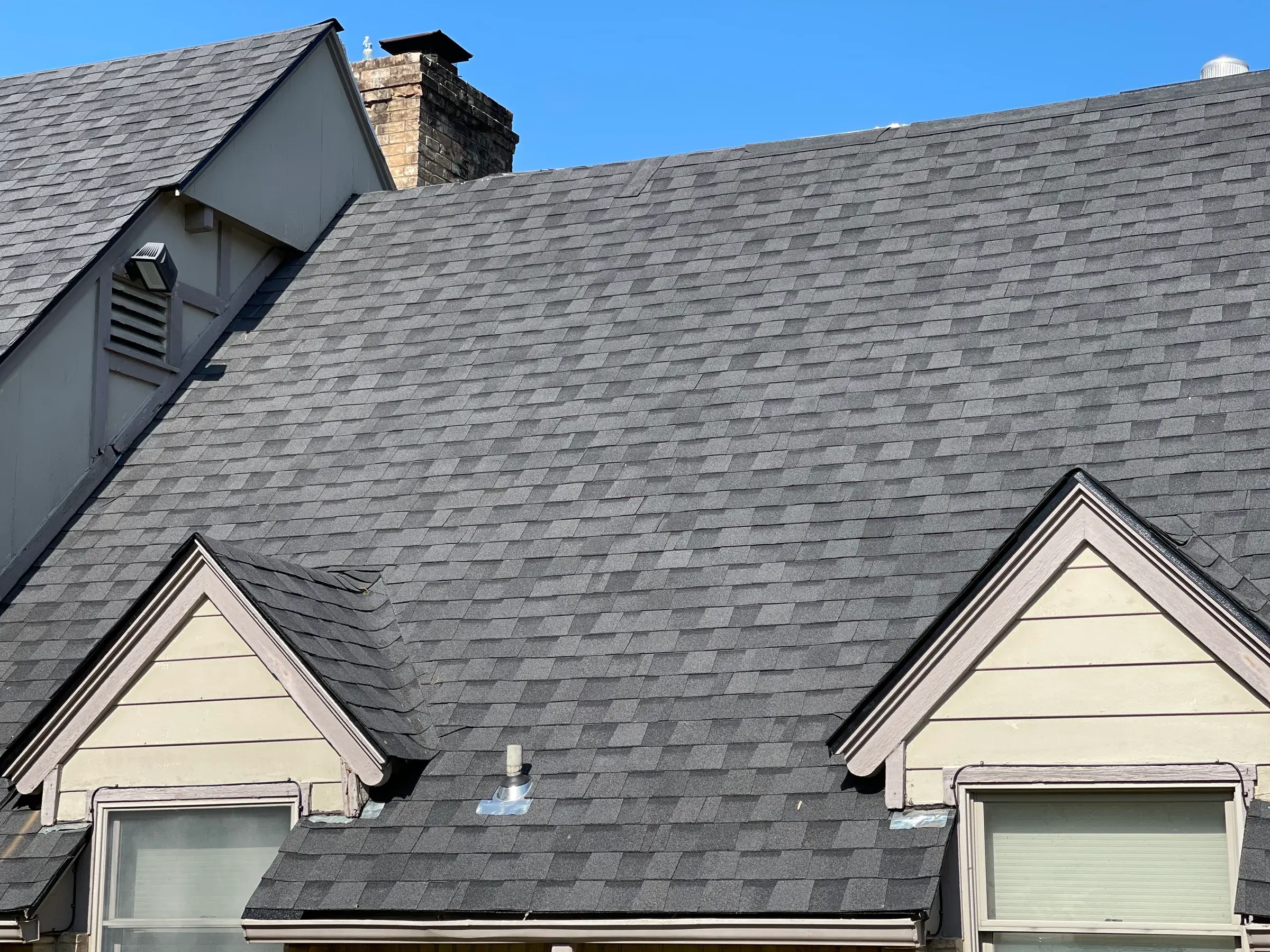
The most common early warning signs on a low-slope roof are ponding water that remains more than 48 hours after rain, blisters or ridges in the membrane, open or fishmouthed seams, cracked flashing at walls and curbs, punctures near rooftop equipment, and clogged drains or scuppers. Interior ceiling stains typically appear well after these surface symptoms.
Why low-slope roofs telegraph failure long before they leak
A shingle roof sheds water. A low-slope roof manages it. The National Roofing Contractors Association draws the line at slopes below 3:12 — below that, water no longer runs off on its own momentum. It moves where the deck's shape and the drains tell it to move, slowly, and it stays on the membrane for a while on the way.
That is not a defect. Single-ply membranes like TPO and EPDM, modified bitumen, and built-up roofs are all designed to be wet. The membrane field is rarely where a roof fails. Roofs fail where the membrane stops being continuous: at seams, at flashings, at penetrations, at terminations, and at drains. Every one of those details announces itself visually months — often years — before a ceiling tile stains.
Northeast Oklahoma is unusually hard on those details, and not because of any single storm. The Oklahoma Climatological Survey's 1991–2020 normals put Ottawa County at 89 nights a year below 32°F. That is 89 chances for water sitting in a seam or a blister to freeze and expand. The same normals show 57 days above 90°F, five above 100°F, and an August daily maximum normal of 91.5°F. A dark membrane in that sun runs considerably hotter than the air around it. Roughly 62% annual sunshine means a steady ultraviolet load on top of it. Add the 4–5 days a year the Survey records with hail larger than 0.75 inch, and what you have is a fatigue problem, not an event problem.
Fatigue is readable. That's the point of this page.
Ponding water: the 48-hour rule of thumb and what standing water actually does
The number you'll hear everywhere is 48 hours. It comes from NRCA guidance, which treats water still standing more than 48 hours after rainfall ends — under conditions that should allow drying — as ponding rather than normal drainage. Treat it as an industry benchmark for judging a roof, not a legal threshold. It's the line a roofing professional uses to separate "draining slowly" from "not draining."
Here is what standing water does that moving water doesn't. It concentrates dirt and biological growth, which holds more water. It keeps the membrane wet through every one of those 89 freeze cycles. It sits in the exact spot where a seam is most likely to be tested. And it is heavy, which causes deck deflection, which deepens the pond, which adds weight. That feedback loop is why a small ponded area rarely stays a small ponded area.
You can spot yesterday's pond even on a dry roof. Look for a chalky ring or a dirt line — the tide mark where the water evaporated. Ponds also grow silt: fine grit, sometimes a thin mat of vegetation. If you see a ring, you have a pond, whether or not there is water in it today.
Blisters, ridges, and wrinkles: trapped air, trapped moisture, and substrate movement
These three get confused constantly, and they mean different things.
Blisters
A blister is a pocket of air or moisture trapped between plies, or between the membrane and the substrate. Heat expands the pocket; cooling contracts it. The pocket grows a little with each cycle, and 57 days above 90°F is a lot of cycling. An intact blister is not leaking. It is a thin spot waiting for something to step on it or for hail to find it.
Do not cut a blister open to see what's inside. Once it's open, it's a hole, and you now need a repair today instead of on a schedule. Photograph it, mark its outline with chalk, measure it, and watch whether the outline moves.
Ridging and picture framing
Ridges that run in straight lines, often in a rectangular grid, are the insulation board joints telegraphing through the membrane. That pattern — roofers call it picture framing — usually means the boards are moving, the boards are wet and swelling, or the fasteners are backing out. It is one of the few surface symptoms that tells you something about the layer you can't see.
Wrinkles
Wrinkles concentrated near a seam are usually the seam telling you it's under stress it wasn't designed for. Wrinkles across an open field often mean the membrane has slipped relative to whatever is holding it down. Either way, a wrinkle at a seam is the step before the next section.
Open or fishmouthed seams: the single most common membrane leak source
If a membrane roof is leaking and nobody has put a hole in it, look at the seams first. A seam is where two sheets are welded, adhered, or torched together. It is the only part of the field that was assembled on site, in whatever weather that day happened to be.
A fishmouth is exactly what it sounds like: the edge of the top sheet lifts away in a small open mouth, usually an inch or two long. It admits water directly. Fishmouths cluster where sheets cross, where a seam runs into a flashing, and anywhere the installer had to work a sheet around a curve.
The field test IIBEC describes for roof condition assessment is simple and non-destructive: draw a blunt seam probe — a dull, rounded tool, never a screwdriver or a knife — along the seam edge with light pressure. A sound seam stops it. An unbonded seam lets it slide in. The reason the probe is dull matters: a sharp tool creates the defect it's supposedly finding.
Seam edges also collect a dark grime line when they've been holding water. Follow that line. It usually runs to the low spot.
Flashing and termination bar failure at walls, curbs, and parapets
Flashing is the transition detail — the material that carries the membrane up a vertical surface and ties it off. Base flashing runs up the wall from the roof. Counterflashing caps it from above so water can't get behind. A termination bar is the metal strip that mechanically fastens the top of the membrane to the wall, usually with a bead of sealant along its top edge.
That sealant bead is the most misunderstood component on a commercial roof. It is a maintenance item with a finite life. It was never meant to be the permanent waterproofing — it's there to keep water out of the joint the bar creates. When it cracks, shrinks, or pulls away, water gets behind the bar and travels down inside the wall, where you won't see it until it exits somewhere unrelated.
Parapets deserve their own paragraph in this town. A lot of Miami's commercial building stock sits along Main Street — the historic Route 66 alignment through town — and much of it is older masonry with parapet walls. Masonry and 89 freeze cycles a year do not get along. Mortar joints open, coping joints separate, and the wall starts feeding water down behind counterflashing that looks perfectly intact from the roof deck. If your building has a masonry parapet, the wall is part of the roof system whether the budget line says so or not.
Punctures and traffic damage around rooftop HVAC equipment
The membrane doesn't know the difference between a hailstone and a dropped wrench. What it knows is concentrated point load. The highest-traffic square footage on any commercial roof is the path from the roof hatch to the HVAC units, and that path is almost never protected by walkway pads.
Look for footprint scuffing, tool marks, dropped screws, cut sheet-metal shavings, and — the classic — a neat row of small punctures where somebody set a service panel down on its edge. Also look at what leaves the equipment: condensate that discharges onto the membrane instead of into a drain will keep one small area permanently wet and permanently freezing.
| Equipment | How it damages the roof | What to look for | When to check it |
|---|---|---|---|
| HVAC / RTU units | Service traffic, dropped tools, panels set on edge, condensate discharge onto membrane | Scuffed path from hatch, punctures near access panels, permanently damp area downhill of the unit, rusted curb fasteners | After every service visit |
| Kitchen grease exhaust | Grease degrades some membranes and softens asphalt; residue traps dirt and holds water | Dark staining spreading downhill from the fan, soft or swollen membrane, greasy film in the nearest drain | Twice a year, and any time filters are changed |
| Satellite dishes and antenna mounts | Ballast blocks abrade the membrane; through-fastened mounts create unflashed penetrations | Blocks sitting directly on membrane, sealant-only penetrations, wind-driven mount movement leaving arcs on the surface | Spring and fall |
| Solar racking | Concentrated point loads, thermal movement, added penetrations, and it blocks access to what's underneath | Deflection under ballast feet, penetration flashings hidden by panels, debris and ponding trapped between rows | Spring and fall, plus after hail |
| Gas lines, conduit, and pipe supports | Sleepers and blocks abrade the membrane as the pipe expands and contracts with temperature | Wear marks under supports, blocks that have walked out of position, pipe sitting directly on the membrane | Spring and fall |
| Roof hatch and ladder | The entry point concentrates all foot traffic; the hatch curb flashing takes the most abuse | Worn membrane at the landing, torn hatch gasket, loose curb flashing, no walkway pad | Spring and fall |
Drains, scuppers, and overflow: clogs, sumps, and the weight of trapped water
Drainage is the whole job. Everything else on a low-slope roof is there to support it.
Ottawa County splits neatly in two, and it changes what clogs your drains. East of Miami you're in the Ozark Plains — rockier, rolling, and wooded. That means leaf litter, twigs, and shade. West of town you're in the Neosho Lowlands, flat prairie and farmland with open wind fetch and nothing to slow airborne grit. Wooded-side buildings clog from the top down. Prairie-side buildings silt up from the bottom and lose surfacing to wind scour.
On the roof, check three things at every drain. Is the strainer dome present and unbroken? A missing dome lets a plastic bag do more damage than a year of leaves. Is the clamping ring tight and complete, with all its bolts? Is the sump — the shallow depression the drain sits in — actually lower than the surrounding membrane, or has it deflected upward while the field around it sank?
Scuppers are the through-wall openings that let water out at the parapet. They fail differently: the sleeve corrodes, the flashing at the sleeve cracks, and debris bridges the opening while water keeps rising behind it.
Both the International Building Code (Chapter 15) and the International Plumbing Code (Chapter 11) address primary and secondary — overflow — roof drainage. Oklahoma adopts code editions on its own schedule, and the City of Miami issues permits locally, so confirm the edition currently in force and any local amendments rather than assuming. What doesn't change is the principle: the overflow is the alarm, not a second drain. If water is running out of your overflow scupper, the primary drain has already failed and you're finding out at the last possible moment.
Interior symptoms and why the leak is rarely above the stain
By the time a ceiling tile is stained, water has been in the assembly for a while. And the stain is almost never under the hole.
Water entering a low-slope roof lands on the deck or on a vapour retarder, then travels laterally — along a deck flute, along a purlin, along a conduit run — until it finds the first opening downward. That can be many feet from the entry point, and it can be uphill of it in your mental map of the building, because the deck's slope and the roof's slope are not necessarily the same thing.
| Stage | What is happening | Why it misleads you |
|---|---|---|
| 1. Entry | Water passes a seam, a flashing joint, or a puncture | The entry point may be a fishmouth the size of a fingernail — invisible from the ground and easy to walk past on the roof |
| 2. Insulation layer | Water spreads sideways through insulation board joints and saturates the boards | The wet area is now many times larger than the hole; the insulation stops insulating long before anything drips |
| 3. Deck travel | Water runs along steel deck flutes, wood decking seams, or the top of a beam | This is the leg that moves water tens of feet horizontally, often in a straight line the roof surface gives no hint of |
| 4. First downward opening | Water exits at a fastener hole, a deck seam, a conduit penetration, or a light fixture | This is the stain's location. It is determined by the deck, not by the roof |
| 5. Ceiling plane | Water spreads across the tile or drywall and shows as a ring | The ring grows outward from where it dripped — the visible centre is the exit, not the entry |
Two practical consequences. First, mark the stain, photograph it, and note the date, but do not assume the repair goes above it. Second, if you have a suspended ceiling, lift the tile and look up. Following a rust track on a steel deck flute back to its high end is often the fastest way to find the real entry point — faster than anything you can do on the roof surface.
Alligatoring, chalking, granule loss, and surface aging
Surface aging is the slow category. It rarely causes this month's leak, and it reliably causes next year's.
Alligatoring is the network of shallow cracks that forms in the asphalt surface of a built-up roof as ultraviolet light drives off the volatiles and the asphalt gets brittle. Shallow alligatoring is cosmetic. Cracks that reach the felts are not. At roughly 62% annual sunshine, Miami roofs get a fairly steady dose of the thing that causes it.
Chalking is the powdery residue on a coated roof — the binder in the coating breaking down and releasing pigment. Wipe the surface with a dark cloth. Heavy chalk means the coating is nearing the end of its service life. ASTM D6083, the standard specification for acrylic roof coatings, is what a coating's published performance is measured against; ASTM D7053 covers evaluating sprayed polyurethane foam roof systems. Ask for the standard when someone quotes you a coating, because "it's a good coating" is not a specification.
Granule loss on a modified bitumen cap sheet works like it does on a shingle: the granules are the sunscreen. Bare black patches, or granules collecting in the drain sump, mean the asphalt underneath is now taking the UV directly. Granule loss concentrated in small round dents is a different conversation — that's hail, and on the 4–5 days a year the Oklahoma Climatological Survey records hail over 0.75 inch here, low-slope roofs take it as squarely as shingle roofs do.
Triage: what needs attention this week vs. this quarter vs. this budget cycle
Not every symptom is urgent, and treating them all as urgent is how maintenance budgets get spent on the wrong roof. Here is how the common ones sort.
| Symptom | Likely cause | Urgency | Who should look at it |
|---|---|---|---|
| Active drip inside the building | Open seam, puncture, or failed flashing upstream of the stain | Now | Roofing contractor; protect contents first, and interim tarping or patching can hold a wet-season opening until a proper repair |
| Water standing more than 48 hours after rain | Inadequate slope, deck deflection, or a blocked or high drain | Now if deep or growing; this quarter if shallow and stable | Roofing contractor; a structural engineer if deflection is visible |
| Overflow scupper or overflow drain discharging | Primary drainage has already failed | Now | Clear the primary drain immediately, then a roofing contractor |
| Open or fishmouthed seam | Weld or adhesion failure, thermal stress, poor original detailing | Now — this is the most common leak source | Roofing contractor |
| Cracked sealant at a termination bar | Normal sealant aging; it is a maintenance item, not permanent waterproofing | This quarter | Roofing contractor |
| Loose, torn, or lifted base flashing at a wall or curb | Building movement, fastener failure, or a masonry parapet feeding water in behind it | This quarter | Roofing contractor; a mason if the parapet mortar is the source |
| Blister in the membrane | Air or moisture trapped between plies or under the membrane, expanding with heat | This quarter — mark, measure, monitor; do not cut it open | Roofing contractor |
| Ridging or picture framing over insulation joints | Wet, moving, or loosening insulation boards; backed-out fasteners | This quarter — it reports on the layer you cannot see | Roofing contractor; consider a moisture survey |
| Punctures or scuffing near HVAC units | Service traffic with no walkway pads | This quarter, and after every service call | Roofing contractor; then talk to your mechanical vendor |
| Debris or missing strainer dome at a drain | Tree litter east of town; wind-driven grit and silt west of town | This quarter, and after every storm | Building maintenance staff can clear it; a contractor if the sump is damaged |
| Granule loss in round dents; bruising | Hail | This quarter — document it with dated photos before anything is disturbed | Roofing contractor |
| Chalking on a coated roof | Coating binder breaking down under UV | This budget cycle | Roofing contractor; ask for the ASTM D6083 data on any replacement coating |
| Shallow alligatoring on a built-up roof | Asphalt aging under UV | This budget cycle | Roofing contractor |
| General granule loss on a mod bit cap sheet | End-of-life surface wear | This budget cycle | Roofing contractor; start planning, not patching |
One clarification on the hail row. Documenting damage and deciding coverage are two different jobs. What a roofer can properly do is put dated, located photographs and a written estimate of the work in your hands, and meet your adjuster on the roof if you ask. Your insurer decides what your policy covers. Anyone offering to run your claim for you in Oklahoma is describing work the state regulates as public adjusting, which is a separate licence — worth knowing before you sign anything.
Building a simple documented inspection routine
NRCA's long-standing maintenance guidance is twice a year plus after any severe weather event. In this climate the two dates pick themselves: spring, after hail season has done whatever it was going to do, and fall, before those 89 freezing nights start working on anything that's holding water.
The routine below takes one person about an hour on a typical small commercial roof. It is not a substitute for a professional condition assessment of the kind IIBEC describes — but it is what makes a professional assessment worth paying for, because it gives the assessor a history instead of a snapshot.
Semi-annual commercial flat roof inspection (spring and fall)
- Photograph the whole roof from a fixed spot each time, so images are comparable across visits
- Walk the perimeter: check coping joints, counterflashing, and the top edge of every termination bar for cracked or missing sealant
- Check every parapet for open mortar joints, spalling brick, and separated coping
- Probe accessible seams with a blunt seam probe — light pressure only, never a sharp tool
- Look for fishmouths where seams cross and where seams meet flashings
- Mark, measure, date, and photograph every blister; compare against last visit's chalk outline; do not cut any open
- Note any ridging or picture framing over insulation joints, and whether the pattern has spread
- Walk the hatch-to-equipment path and count punctures, scuffs, dropped fasteners, and metal shavings
- Check each rooftop unit's curb flashing, fasteners, and condensate discharge point
- Check that pipe supports and ballast blocks are still in position and are not abrading the membrane
- Remove debris from every drain and scupper; confirm each strainer dome is present and intact
- Confirm each drain clamping ring is tight, with all bolts present
- Note the depth and extent of any ponding, plus any dry-weather tide rings or silt
- Check for granule loss, alligatoring, chalking, and bare patches; note whether losses are general or in round dents
- Inspect the roof hatch gasket, the landing area, and any walkway pads
- From inside, lift ceiling tiles at any known problem area and look for rust tracks and staining on the deck
- Log everything, including the items that were fine — an unchanged observation is data too
- Repeat within a few days of any hail or high-wind event, in addition to the scheduled visits
The roof file
Every roof should have a file, and it should outlive the person who started it. Keep it simple enough that it actually gets filled in. A spreadsheet with these columns is sufficient, with photos in a dated folder named to match the reference column.
| Date | Location on roof | Observation | Photo reference | Action taken | Follow-up date |
|---|---|---|---|---|---|
| YYYY-MM-DD | NE quadrant, 6 ft W of drain 2 | Ponding approx. 1 in., 8 ft x 10 ft, present 3 days after rain | 2026-04-12_NE_pond_01 | Cleared drain strainer; ponding unchanged; contractor notified | 30 days |
| YYYY-MM-DD | S parapet, behind RTU 3 | Termination bar sealant cracked, approx. 4 ft run | 2026-04-12_S_termbar_02 | Photographed; added to repair scope | This quarter |
| YYYY-MM-DD | Centre field, grid line C | Blister 14 in. x 9 in., outlined in chalk | 2026-04-12_field_blister_03 | Marked and measured; not cut; monitor | Next scheduled inspection |
| YYYY-MM-DD | Hatch landing | No walkway pad; membrane scuffed to scrim in 2 sq ft | 2026-04-12_hatch_04 | Walkway pad quoted | This quarter |
Why bother? Three reasons. A dated photo series is the difference between "this looks like storm damage" and a documented before-and-after. A log turns a replace-or-repair argument into an arithmetic problem. And when the person who knows the building leaves, the roof's history doesn't leave with them.
If you'd rather have someone else walk it, that's what we're here for. We work on commercial and low-slope roofs across northeast Oklahoma and into Kansas, Missouri, and Arkansas from our office at 111 S Main St in Miami, we pull the City of Miami permit when a job needs one, and an inspection with a photo report costs you nothing. Call (209) 758-8550 and we'll take a look.
Questions people ask about this
How long can water stand on a flat roof before it's a real problem?
NRCA guidance treats water still standing more than 48 hours after rain stops — under conditions that should allow it to dry — as ponding rather than normal drainage. That's an industry benchmark for evaluating a roof, not a legal deadline. What makes it matter locally is that the Oklahoma Climatological Survey records 89 nights a year below freezing in this area, so anything still sitting up there in winter is freezing and thawing repeatedly.
Is a blister an emergency?
Usually not. An intact blister is a pocket of trapped air or moisture, and while it's intact it isn't leaking — it's a thin spot. The mistake is cutting one open to investigate, which turns a monitoring item into a hole that needs fixing today. Outline it in chalk, measure it, photograph it with a date, and see whether it grows between inspections.
Why is the ceiling stain never under the hole in the roof?
Because water travels sideways before it travels down. After it gets past the membrane it spreads through the insulation, then runs along steel deck flutes, wood deck seams, or the top of a beam until it finds the first opening downward — a fastener hole, a deck seam, a light fixture. The stain marks that exit, not the entry. The entry can be many feet away, in a direction the roof surface gives no hint about.
How do I check that a commercial roofer is legitimate in Oklahoma?
Use the Construction Industries Board's free public lookup at verifyroofing.cib.ok.gov. It shows whether a contractor is registered with the state and what the registration covers. Note that Oklahoma issues registrations rather than licences, and no state in this four-state area requires a roofing surety bond — so "licensed and bonded" in an ad isn't a meaningful credential here. The lookup is.
How often should a commercial flat roof be inspected?
NRCA's maintenance guidance is twice a year plus after any severe weather. In northeast Oklahoma, spring and fall are the natural dates — spring after hail season, fall before the freeze cycles begin. Add an extra walk within a few days of any hail or high-wind event. The Oklahoma Climatological Survey records 4–5 days a year here with hail over 0.75 inch, and low-slope roofs take it as squarely as shingle roofs do.