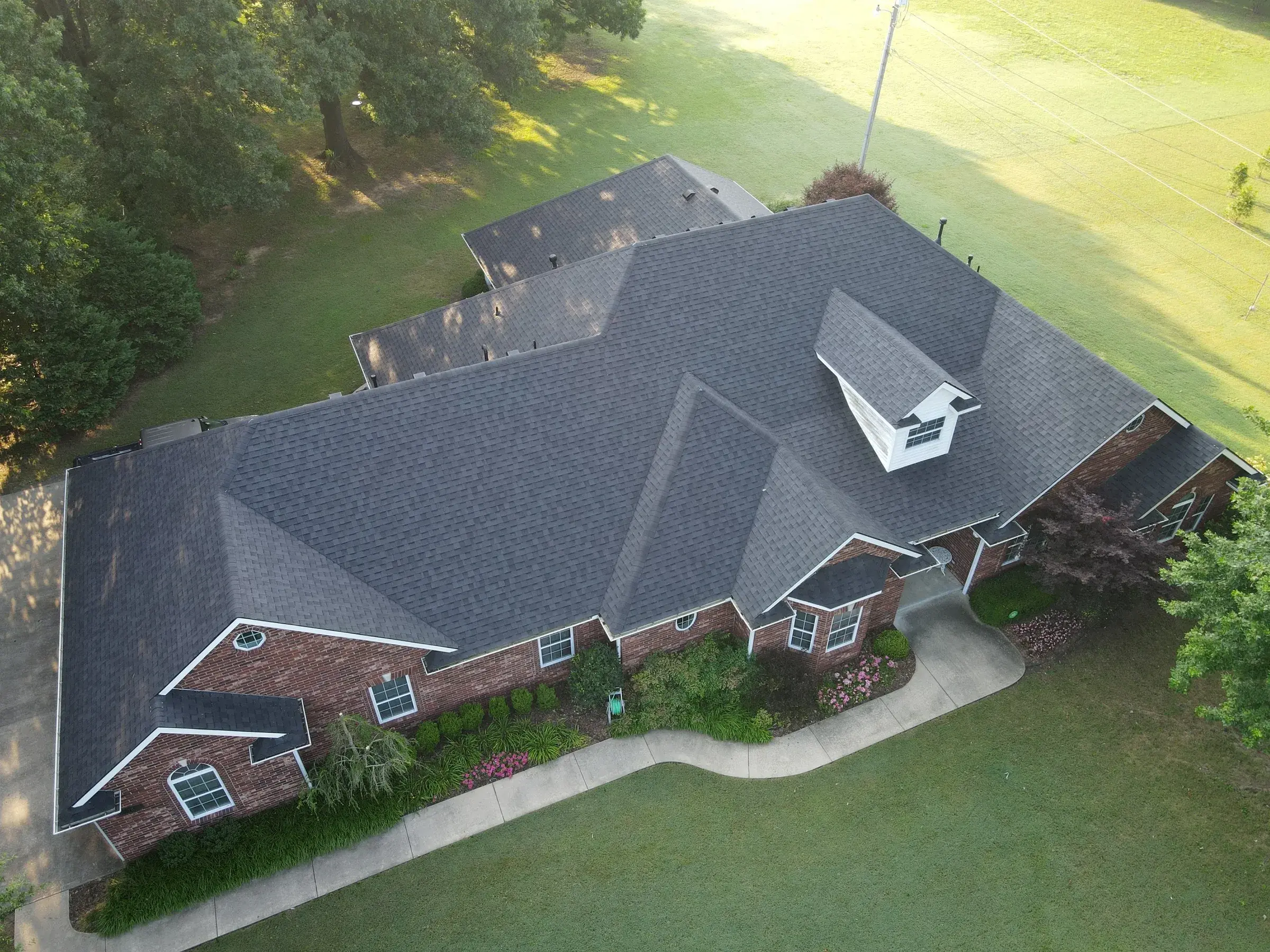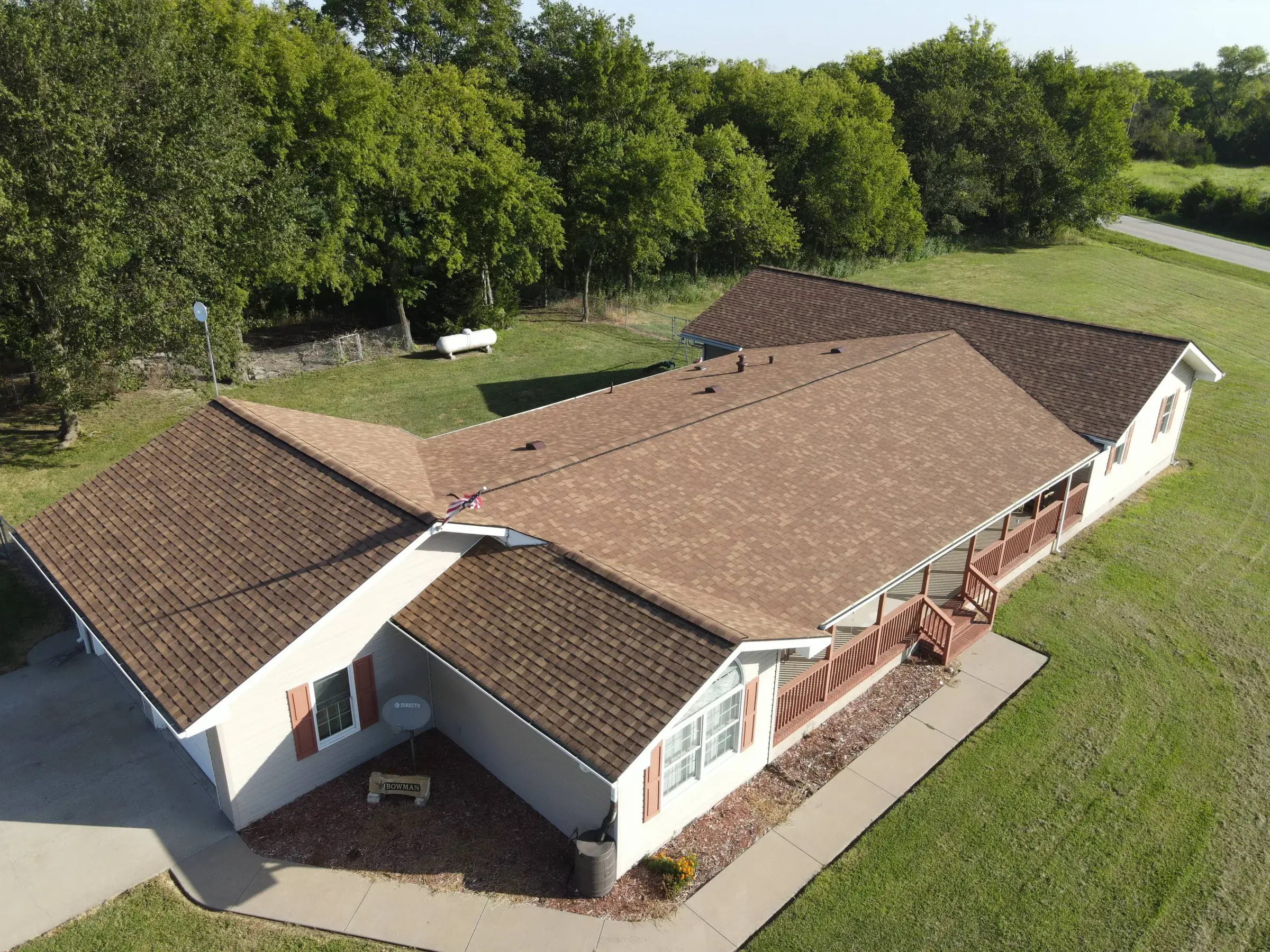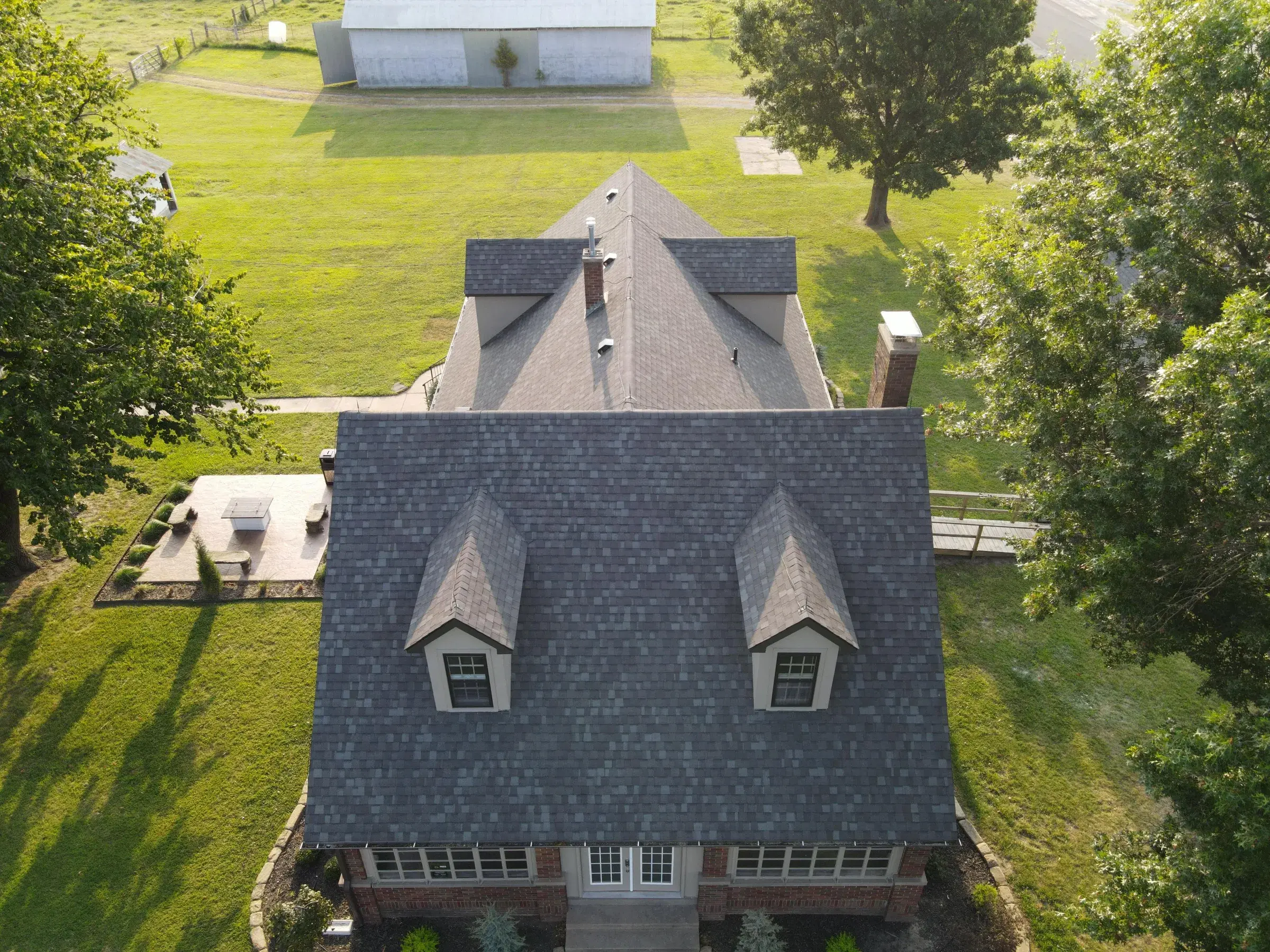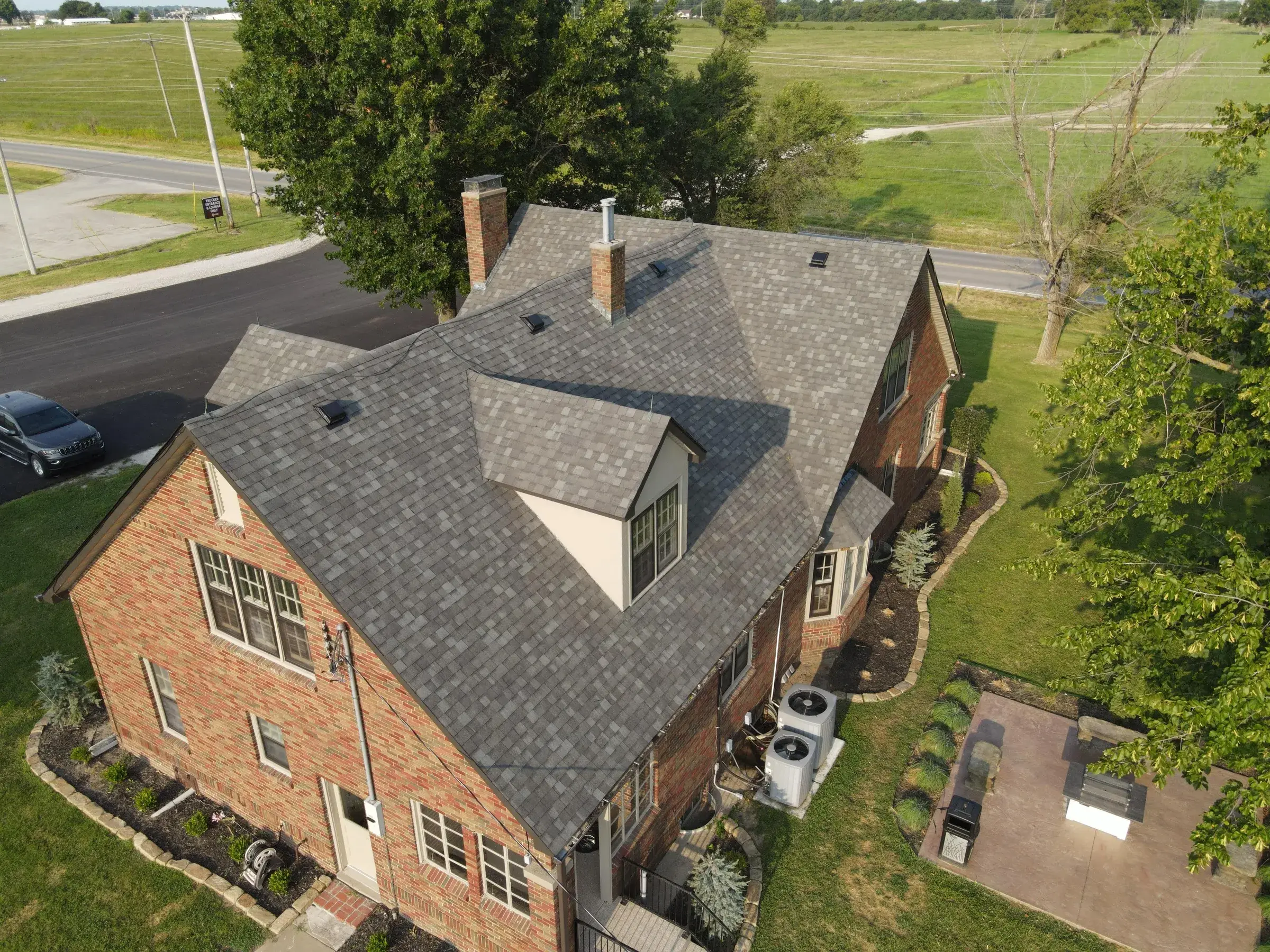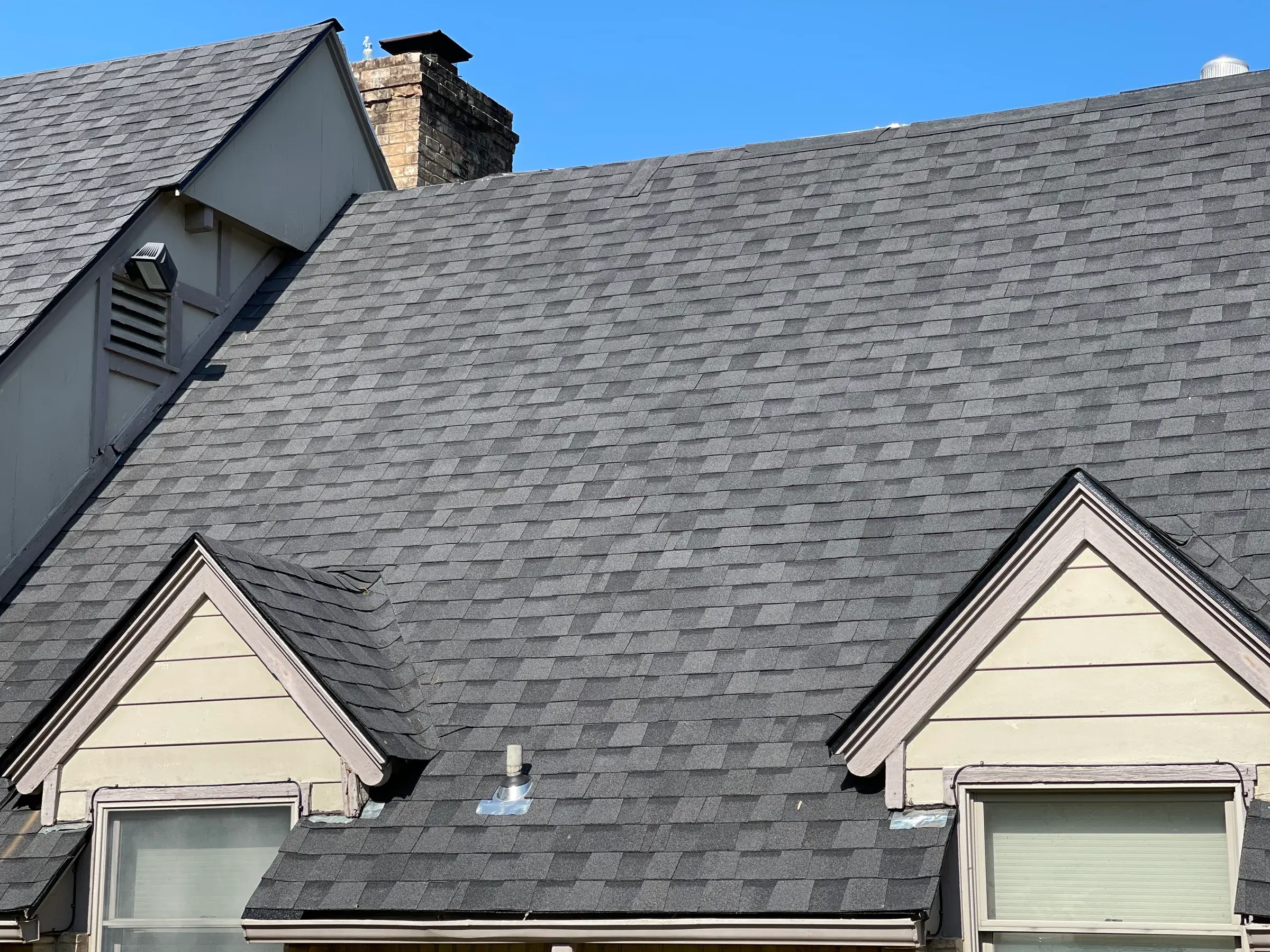
Work in order: make the home safe, control water intrusion, document everything with dated photos before cleanup, then report the loss to your insurer. Keep all receipts for emergency measures. Do not authorize permanent repairs or sign a contract before you understand the scope — emergency mitigation and permanent work are treated differently.
Hour 0–2: Safety First
The roof is not the emergency. The roof is already damaged and it will still be damaged in two hours. What can change in two hours is whether someone gets hurt. So the first pass through the house has nothing to do with shingles.
Start outside, from a distance, in daylight if you have it. Look for downed wires — in the wooded eastern half of Ottawa County, where the Ozark Plains bring trees right up against the service drop, a limb on a line is the single most common post-storm hazard. The National Fire Protection Association's guidance is blunt about this: treat every downed line as energized, stay back, and never touch anything the line is touching, including a fence, a puddle, a car, or a tree limb. Call 911 and the utility. Do not move the limb to get a better look at your roof.
If you smell gas, leave. Don't flip a light switch on the way out, don't use the garage door opener, don't start a car in the garage. Call from outside, from a neighbor's, or from the street.
Back inside, three things matter. A ceiling that is sagging or bulging is holding water, and water is heavy — do not stand under it. Standing water on a floor near an outlet, a submerged appliance, or a panel is an electrical hazard first and a water problem second; FEMA's post-disaster guidance for homeowners is to stay out of water that may be in contact with wiring and to shut power off at the main only if you can reach it without standing in water. If you can't, that's an electrician's call, not yours. And if any part of the structure looks like it moved — a wall out of plumb, a door that suddenly won't latch, a visible dip in a roof plane — get everyone out and call the fire department.
Hour 2–12: Stop the Water Without Making the Damage Worse
Now you have a job: keep water out of the parts of the house that aren't wet yet. Most policies place a duty on the homeowner to protect the property from further damage after a loss — read your own policy language, because it's your policy that governs. But the practical version is simple. Water that keeps running turns a roof claim into a roof, drywall, insulation, and flooring claim, and mold doesn't wait for an adjuster.
Inside the house first
Move furniture and electronics out from under any active drip. Pull up rugs — a wet rug on a wood floor cups the floor in a day. Put a bucket down and a towel in the bucket, which kills the noise and the splashing.
If a ceiling is bulging, there is a counterintuitive move that saves the ceiling: from off to the side, never underneath, use a long screwdriver to poke one small hole at the lowest point of the bulge and let it drain into a bucket. A controlled hole you can patch beats an uncontrolled collapse that takes the whole sheet of drywall, the insulation above it, and whatever was on the bed. Photograph the bulge before you do it. And do not do this if you have any reason to think there's wiring or a junction box in that bay.
Then the roof itself
Tarping is the right answer and it is also the thing you should not do yourself on a wet roof. It's not just the footing. A tarp only works if it runs over the ridge and is anchored above the damage, so water can't get under the top edge — a tarp stapled around a hole is a funnel. It has to be fastened without punching a new grid of holes through the good shingles beside the damaged ones, which is why the fastening is done with boards rolled into the tarp edge rather than nails driven through the field. And it has to be tight, because a loose tarp in Oklahoma wind is gone by morning and takes shingles with it.
We do emergency tarping and we don't charge for the inspection or the estimate. If you want to know what a tarp is supposed to look like when it's done right — and what it's supposed to cost you in documentation — that's covered on our emergency roof tarping page. Call us and we'll tell you honestly where you sit in the queue; after a hail event that hits the whole town, everyone in this trade is working a list.
What to Photograph Before Anything Gets Moved or Cleaned Up
This is the step homeowners skip and regret. Once the tarp is on, nobody can see what was under it. Once the yard is raked, the evidence is in a bag at the curb. Your phone timestamps everything automatically — that metadata is worth more than any note you write later.
Shoot in threes: a wide shot that shows the whole elevation and proves it's your house, a medium shot that shows the area, and a close-up that shows the actual damage. A close-up with no context is a photo of a shingle that could have come from anywhere.
- All four elevations of the house from the ground, plus the detached garage or shop if you have one
- Any hail on the ground, with a coin, a ruler, or a tape measure in the frame for scale — do it fast, it melts
- Granules: in the gutters, on the splash blocks, in a line at the bottom of the downspout, washed into the driveway
- Soft metals, which bruise before shingles do — gutters, downspouts, fascia, the mailbox, the A/C condenser fins, the grill lid, the shed door
- Debris on the roof and in the yard, exactly where it landed
- Inside: every stain, every drip, every wet spot, with a bucket in frame for scale
- The attic: daylight through the deck, damp or dark decking, wet insulation — shoot from the hatch with the flash on, don't walk the joists in the dark
- A short video walking the perimeter narrating what you're seeing and the date
The soft-metal shots matter more than people realize. An adjuster who can't get a read on the shingles can often read a downspout, because aluminum records a hit that a weathered shingle hides. The Oklahoma Climatological Survey puts this area at four to five days a year with hail larger than three quarters of an inch, which means the roof you're standing under has probably taken hits before — and telling this storm's damage from the last one is exactly what dated photos and fresh, unweathered dents do for you. Our guide to documenting roof storm damage with photos goes deeper on framing and what a bruise actually looks like.
Hour 12–48: Reporting the Loss to Your Carrier and What to Say
Call the number on your policy or use your carrier's app. The Oklahoma Insurance Department's consumer guidance on filing property claims is the plain-English reference here, and it's worth ten minutes of your time before you dial — it is written by the regulator, not by anyone with a stake in the outcome.
Here is the part that matters and that almost nobody tells you: report what you observed, not what you concluded. You know the date and roughly the time of the storm. You know you heard hail, or you didn't. You know there's a stain on the bedroom ceiling and shingles in the yard. You do not know that the roof is 'totaled', you do not know that the damage is hail rather than wind or age, and you should not say either. Guessing at cause and severity on a recorded line, to a person whose job is to write down what you said, helps nobody — least of all you, if the guess turns out wrong. Describe. Don't diagnose.
Before you hang up, get answers to these:
- Your claim number, and the name and direct contact for the adjuster assigned
- Your deductible for this loss — some Oklahoma policies carry a separate wind and hail deductible calculated as a percentage of the dwelling amount rather than a flat dollar figure, so confirm which one applies
- Whether the policy pays replacement cost or actual cash value on the roof, and whether there's a roof surfacing schedule or a cosmetic damage exclusion
- The deadline for submitting a sworn proof of loss, if one applies
- Whether your policy covers reasonable emergency measures, and what documentation the carrier wants for them
- How you should submit photos, and whether they'd like the ones you already took
If you want the longer version of what happens between the first call and the final check, we've written it out step by step in our walkthrough of the Oklahoma roof insurance claim process.
Emergency vs. Permanent Repairs: Why the Distinction Affects Reimbursement
These are two different categories of work, treated differently, paid on different schedules, and documented differently. Mixing them up is the most expensive administrative mistake a homeowner makes in the first week.
| Emergency mitigation | Permanent repair | |
|---|---|---|
| What it is | Temporary measures that stop further damage: tarping an exposed slope, boarding a broken window, extracting water, setting fans | Making the roof system whole again: tear-off, deck repair, underlayment, flashing, shingles, ventilation |
| Why your policy cares | Most policies place a duty on you to protect the property from further damage after a loss. Check your own wording — that's the wording that counts. | Paid under your dwelling coverage once scope and price are settled, subject to your deductible and policy terms |
| Who authorizes it | You do, immediately. You do not have to wait for an adjuster to stop water coming into your bedroom. | You do — but only after you have a written scope in hand and know what you're agreeing to |
| When money typically moves | Often handled early in the claim as part of the loss. Your insurer decides whether and how it's covered. | Usually after the inspection and scope are settled. Many replacement-cost policies pay actual cash value first and release the held-back depreciation after the work is completed and invoiced. |
| Documentation needed | Dated photos taken before the tarp went on, an itemized invoice describing exactly what was done and where, and receipts for anything you bought yourself | A written, itemized estimate; a photo report; the City of Miami permit; and a final invoice that matches the work actually performed |
| The classic mistake | Tarping first and photographing never. The tarp hides the evidence it was installed to protect. | Letting permanent work start before the adjuster has seen the roof — you've now removed the thing they came to look at |
One more reason the distinction is worth understanding: a tarp is not a repair, and no honest contractor should let you believe it is. It buys you time to make a decision carefully. That's its whole job.
Keeping Receipts and a Written Damage Log
Memory is bad at this. Three weeks from now you will not remember whether the ceiling stain appeared the night of the storm or two days later, and that detail can matter. A log takes four minutes a day and it is the cheapest thing you will do in this entire process.
Keep it in a notes app or on a legal pad on the kitchen counter. Four columns, nothing fancy. The photo reference column is the part that makes it work — it ties every claim you make to an image somebody else can look at.
| Date & time | Room / location | Observation | Photo reference |
|---|---|---|---|
| Day 1, 7:10 a.m. | Exterior — north slope | Shingle tabs missing near ridge; granule pile on splash block below downspout | IMG_0412–0418 |
| Day 1, 7:25 a.m. | Detached garage | Dents in metal roll-up door and mailbox; tape measure in frame for scale | IMG_0419–0424 |
| Day 1, 9:00 a.m. | Master bedroom | Brown ring on ceiling ~14 in. across, damp to the touch; bucket placed, no active drip yet | IMG_0431, VID_0002 |
| Day 1, 4:30 p.m. | Attic above master bedroom | Daylight visible at one penetration; decking dark and damp in a 2-ft area | IMG_0440–0443 |
| Day 2, 11:15 a.m. | North slope | Emergency tarp installed over ridge; invoice # ______ received | IMG_0455–0460 |
| Day 3, 2:00 p.m. | Whole roof | Independent assessment; written estimate and photo report received | PDF — estimate_0703 |
Alongside the log, start an envelope. Into it goes: every receipt for tarps, plastic, buckets, fans, dehumidifier rental, and box fans; the tarping invoice; a hotel receipt if the house was unlivable; and mileage if you had to make trips. Photograph each receipt the day you get it — thermal paper fades to blank in a few months, and the faded ones are the ones you'll need.
Hour 48–72: Getting an Independent Roof Assessment
By now the water is controlled, the photos exist, and the claim is open. This is the right moment — not sooner — to have someone who actually knows roofs walk yours and tell you what's there. Not to sell you anything. To tell you what's there.
Before you let anyone on your roof, spend ninety seconds on this. Oklahoma's Construction Industries Board runs a public lookup at verifyroofing.cib.ok.gov. Type in a company name and see whether they're registered. Registration is not a rubber stamp: it requires the contractor to carry commercial general liability insurance of at least $500,000 for residential work. That's the number standing between you and a claim on your own homeowners policy if somebody falls off your roof. Oklahoma, Kansas, and Arkansas issue registrations rather than licenses, and Missouri has no state roofing license at all — so if a contractor tells you they're 'licensed and bonded,' they're using words that don't describe anything in this market. Ask for the registration number and check it yourself. It takes less time than reading their brochure.
Two Oklahoma specifics worth knowing before you compare estimates. Oklahoma amended IRC section R908.3.1.1 to require a full tear-off rather than a shingle-over in defined conditions — so an estimate that quietly proposes a layover where the code requires tear-off is not a cheaper bid, it's a non-compliant one. And the City of Miami requires a permit for new roofs and re-shingles. We pull it. Ask any other bidder whether they do, and watch how quickly they answer.
A useful assessment leaves you holding two documents: a photo report showing what was found and where, and a written, itemized estimate for the work we would perform. Not a number on the back of a card. If you ask us to be there when your adjuster comes out, we'll be there and we'll show them what we found. We won't tell you your damage 'qualifies' — that isn't ours to say, and anyone who says it is guessing. Free inspections, free estimates, across Ottawa County and out into Kansas, Missouri, and Arkansas; the details of what storm damage roof repair actually involves are on our services page, and if you want to know how we work locally, our Miami, OK page lays it out.
Who You Should Not Sign With in the First 72 Hours, and Why
After a hail event that covers a whole town, the trucks show up. Some of them are legitimate out-of-area contractors doing honest work. Some of them will be in Missouri by the time your shingles start curling. You cannot tell them apart by the truck, and the CIB lookup exists precisely because you shouldn't have to try.
The clearest red flag in Oklahoma is any conversation about your deductible. Under 59 O.S. § 1151.30 — amended effective November 1, 2025 by HB 1257 — it is unlawful to advertise or promise to pay, directly or indirectly, any part of an insurance deductible, or to give an insured anything of value for a service. That last clause covers the yard-sign discount, the referral bonus, and the gift card for a review on an insurance job. So when someone at your door says they'll 'take care of' your deductible or get you a 'free roof,' they are describing conduct Oklahoma law prohibits. That tells you everything about how they'll handle the rest of your money. We've written more on how to spot storm chasers in Oklahoma if you want the full pattern.
The other trap is paper. A 'contingency agreement' that binds you to whatever the insurance company approves is a contract with a blank price, signed before anyone knows the scope. You are agreeing to a number that doesn't exist yet, with a company you met four minutes ago, on the worst morning of your year.
So, the short list of things not to do in the first three days:
- Do not climb onto a wet or hail-slicked roof to look, tarp, or photograph
- Do not tarp it yourself — a tarp anchored below the damage funnels water in, and a loose one leaves with the next gust
- Do not throw away damaged shingles, gutter sections, or debris before photographing and bagging them
- Do not clean up, rake, or pressure-wash before the photos are taken
- Do not tell your carrier anything you don't know to be true, including your own guess at the cause
- Do not sign a contract with no price, no scope, or a blank space anywhere on it
- Do not sign with anyone whose registration you haven't checked at verifyroofing.cib.ok.gov
- Do not accept any offer involving your deductible, a rebate, a gift card, or a sign in your yard on an insurance job
- Do not let permanent work begin before your adjuster has seen the roof
- Do not hire based on who knocked first
What Happens Next: Adjuster Scheduling and Realistic Timelines
Expect the inspection to take longer than you want. When one storm damages a whole town, carriers bring in catastrophe adjusters from out of state and work a queue. That's not a carrier being difficult — it's arithmetic. Ask your adjuster directly for an expected timeframe and write the answer in your log with the date you were told it. If a promised date passes, you now have a record, and the Oklahoma Insurance Department's consumer division exists to answer questions about how your carrier is handling the claim.
When the adjuster does come, be there. Have your photos on your phone, your log in your hand, and your bagged debris by the garage. If you've asked us to attend, we'll walk the roof with them and point at what we found. Then wait for the written scope — the itemized document that says what the carrier will pay for. Read it against the estimate you're holding. Where they differ, the difference is usually a line item somebody didn't see, and that's a factual conversation about a roof, not an argument about a claim.
On money: many replacement-cost policies pay actual cash value first — the depreciated value — and release the recoverable depreciation after the work is done and invoiced. That means the first check is often smaller than the total. It is not the total. Understanding that one sentence prevents most of the panic that happens on day ten. Your policy language and your insurer's decision govern all of it.
Your 72-hour checklist, in order
Print this and work top to bottom
- Hour 0–2 — Clear the house of anyone in danger; stay 30+ feet from any downed line and call 911 and the utility (NFPA)
- Hour 0–2 — If you smell gas, leave first and call from outside
- Hour 0–2 — Stay out of standing water near wiring; cut the main only if you can reach it dry (FEMA)
- Hour 0–2 — Do not go onto the roof, then or later (NOAA National Weather Service)
- Hour 2–12 — Move furniture, pull rugs, set buckets under drips
- Hour 2–12 — Drain a bulging ceiling with one small hole from the side, after photographing it
- Hour 2–12 — Call for emergency tarping rather than doing it yourself
- Hour 2–12 — Bag damaged shingles and debris; do not haul anything off
- Before cleanup — Photograph all four elevations wide, then medium, then close
- Before cleanup — Photograph hail with a coin or tape for scale before it melts
- Before cleanup — Photograph soft metals: gutters, downspouts, mailbox, A/C fins, grill lid
- Before cleanup — Photograph every interior stain and the attic from the hatch
- Hour 12–48 — Report the loss; describe what you observed, not what you concluded
- Hour 12–48 — Get the claim number, adjuster contact, deductible type and amount, ACV vs. RCV, proof-of-loss deadline
- Hour 12–48 — Start the damage log and the receipt envelope; photograph every receipt the day you get it
- Hour 48–72 — Check any contractor at verifyroofing.cib.ok.gov before they touch your roof
- Hour 48–72 — Get a photo report and a written, itemized estimate — not a number on a card
- Hour 48–72 — Confirm the estimate reflects a code-compliant tear-off and that the bidder pulls the City of Miami permit
- Hour 48–72 — Sign nothing with a blank price or a blank scope
- Ongoing — Ask your adjuster for a timeframe and log the answer with the date
If your roof is open to the weather in Miami or anywhere across Ottawa County and into Kansas, Missouri, or Arkansas, we can tarp the slope, walk the roof, and give you a photo report and a written estimate at no charge — and be there when your adjuster comes, if you want us there. We're at 111 S Main St in Miami, on the old Route 66 alignment. Call (209) 758-8550.
We are roofing contractors, not public adjusters or insurance attorneys. Coverage decisions are made by your insurer under your policy.
Questions people ask about this
Should I tarp my own roof after a hailstorm?
No. Two reasons, and the footing is only the first one. Hail strips granules off the shingles and those granules act like ball bearings under a wet boot. The second reason is technical: a tarp only works if it runs over the ridge and is anchored above the damage, and if it's fastened without punching a new grid of holes through the sound shingles beside the damaged ones. A tarp stapled around a hole funnels water in, and a loose tarp in Oklahoma wind is gone by morning and takes shingles with it.
Can my roofer talk to my insurance company for me?
Not in the way people mean. Under 36 O.S. § 6202(4), representing an insured's interests in a claim for compensation is public adjusting, and doing it without a license is a misdemeanor — a signed authorization from you does not change that. Oklahoma also voids assignment of benefits under 36 O.S. § 1230, so no contractor here can legitimately 'bill your insurance directly.' What we can do is document the damage in a photo report, provide a written estimate for the work we'd perform, be on the roof with your adjuster if you ask, and explain what we're looking at. Your insurer decides coverage under your policy.
I already cleaned up the yard before I took photos. Did I ruin the claim?
No, but you gave up your easiest evidence, so lean harder on what's left. The roof itself is still there and still shows what happened. Soft metals — gutters, downspouts, the A/C condenser fins, the mailbox — hold dents that a weathered shingle can hide, and those are still in place. Granules collect in gutters and at the base of downspouts and don't rake up. Photograph all of it now, note in your damage log what you removed and when, and if the debris is still in a bag at the curb, take it back out and shoot it.
How do I check that a roofing contractor is legitimate in Oklahoma?
Use the Construction Industries Board's public lookup at verifyroofing.cib.ok.gov and search the company name. Registration requires the contractor to carry commercial general liability coverage of at least $500,000 for residential work, which is what protects you if someone is hurt on your property. Note that Oklahoma, Kansas, and Arkansas issue registrations rather than licenses, and Missouri has no state roofing license at all — so 'licensed and bonded' isn't describing anything real in this market. Ask for the registration number and verify it yourself.
Someone offered to cover my deductible. Is that a good deal?
It's an unlawful one to advertise. Under 59 O.S. § 1151.30, amended effective November 1, 2025 by HB 1257, it is unlawful to advertise or promise to pay any part of an insurance deductible directly or indirectly, or to give an insured anything of value for a service — which also covers yard-sign discounts, referral bonuses, and gift cards for reviews on insurance jobs. Someone who opens with an offer they aren't permitted to make has told you how they'll handle everything after that.