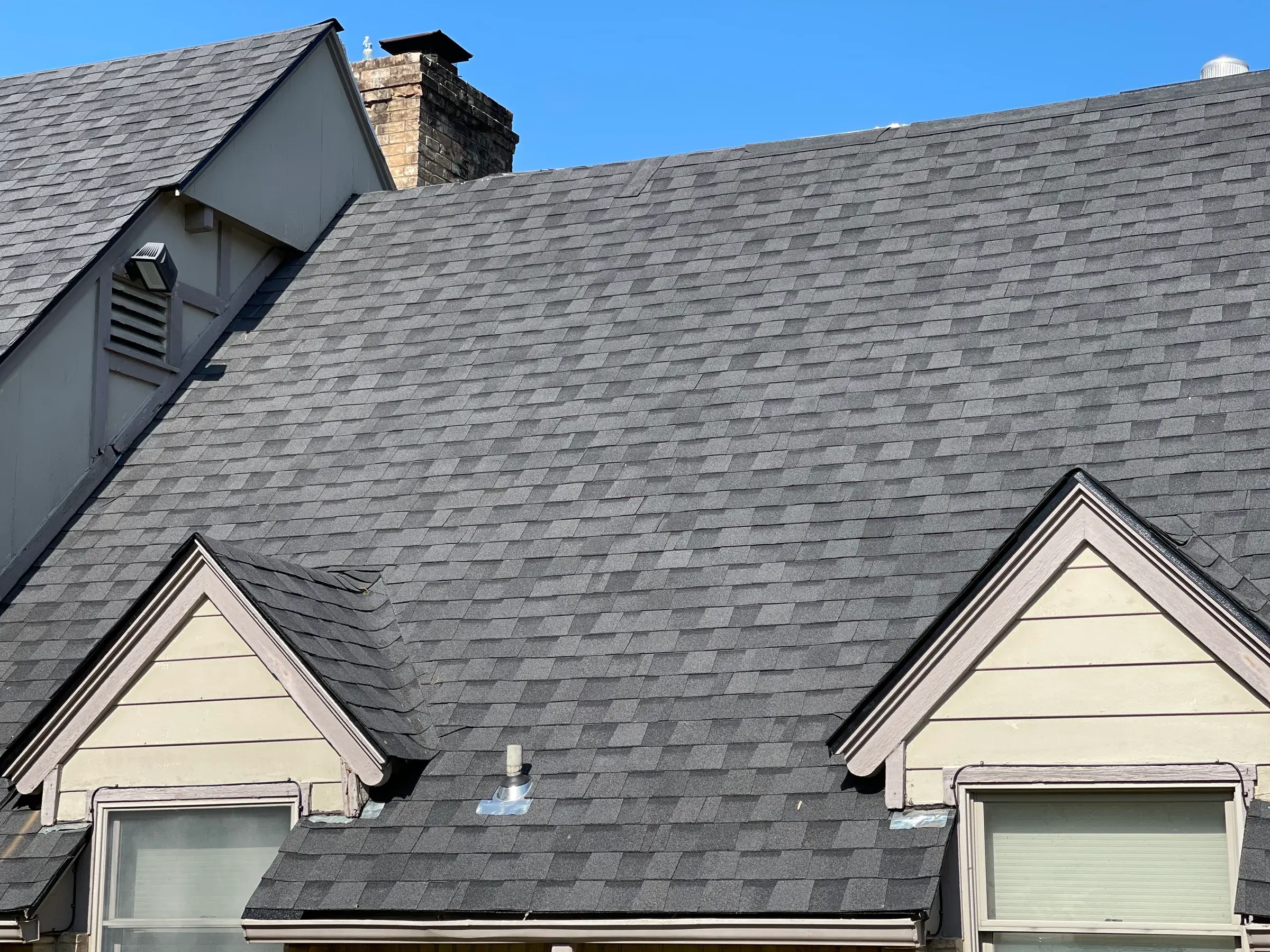
A tarp is temporary mitigation, not a repair. Its job is to stop water intrusion from enlarging the loss while your claim and permanent repair are scheduled. Most policies expect reasonable mitigation after a loss, and mitigation costs are typically documented separately from permanent repairs — so keep the invoice and photographs.
What a tarp is actually for: mitigation, not repair
A tarp does not fix anything. It buys time, and that is the whole point. Think of it as a clock, not a cure.
Water that gets past your shingles does not sit politely under the hole. It runs along the rafters, soaks the insulation, and shows up on a ceiling in a room nowhere near the damage. Wet insulation stops insulating. Drywall wicks. In an August week where the Oklahoma Climatological Survey puts Miami's normal daily high at 91.5°F, a wet attic is a warm, dark, humid box — and things grow in it fast.
So a tarp has two jobs. The first is to stop the loss from getting bigger while your claim and your permanent repair get scheduled. The second is quieter but just as valuable: it freezes the situation in place so the damage that gets inspected is the damage the storm caused, not damage that spread for three weeks because nobody did anything.
Your duty to mitigate: why insurers expect you to act
Almost every homeowners policy has a section titled something like "Your Duties After Loss." One of those duties is to protect the property from further damage. The Insurance Information Institute describes this as the duty to mitigate — you are expected to take reasonable steps to keep a small loss from becoming a large one, and reasonable emergency measures are treated differently from permanent repairs.
The Oklahoma Insurance Department's homeowner claim guidance says the same thing in plainer terms: photograph the damage, make temporary repairs to prevent further loss, keep your receipts, and do not make permanent repairs before the adjuster has looked at it. That last part is where people get tripped up. A tarp is a temporary repair. A new roof is a permanent one. Tarping first does not hurt your claim — replacing shingles before anyone has seen them can.
One more thing the guidance implies but rarely spells out: do not throw away the evidence. The shingle tabs in your flower bed, the split ridge cap, the dented gutter section you pulled down — bag them and set them aside. A blown-off shingle in a trash bag is a physical record of what happened. There is more on the first 48 hours in our walkthrough of [what to do after a storm damages your roof](/blog/what-to-do-after-storm-damages-roof).
How a professional tarp is anchored — and why the method matters on a claimed roof
The fabric almost never fails. The edges fail. Every tarp that ends up in a neighbor's yard came loose at a corner, and everything after that was just wind doing arithmetic.
The other thing most people get wrong is coverage area. IBHS research on sealed roof decks — where the seams in the deck are taped or covered with a self-adhered membrane — makes the point that once the shingles are gone, the deck itself is the last thing between the weather and your ceiling, and water pours through the seams between the deck panels, not just through the obvious hole. That is why a tarp has to extend well past the visible damage. You are not covering a hole. You are covering an exposed deck.
FEMA's Operation Blue Roof, run by the Army Corps of Engineers after declared disasters, is a useful reference here precisely because it is a temporary program built for scale: reinforced sheeting held down by wood strips fastened through the covering, not loose nails punched through the middle of it. The method below is the same idea.
Correct tarp anchoring over a ridge
- Start high and go over the top. The tarp begins at least four feet above the damaged area, runs up the slope, crosses the ridge — the peak where the two slopes meet — and continues down the far side. Water then has no way to run under the top edge.
- Roll the top edge around a batten. On the far slope, lay a 2x4 along the tarp's end and roll the tarp around it two or three full turns, until the wood is wrapped tight inside the fabric.
- Sandwich it and screw through. Set a second 2x4 on top of the rolled bundle, then drive screws through the top board, through the rolled tarp, and into the roof deck — the plywood or board layer under the shingles — catching a rafter where possible.
- Repeat down both sides and the bottom. Same batten roll on every edge. No free fabric anywhere.
- Leave no flap. A single lifted corner is a lever. Out on the west side of Ottawa County — the Neosho Lowlands, flat prairie with a long open run at the wind — one loose corner will work every fastener on that edge loose overnight.
- Account for every hole. Each screw is a penetration. They all sit in the battens, at known locations, photographed, and they all get addressed at the permanent repair.
Here is why the anchoring method matters on a roof you are about to claim. Fasteners driven through the field of the slope are new holes in shingles that may already be part of your loss. A batten roll keeps the penetrations at the edges, in wood, in places a roofer can point to and account for. Scattered nails in the middle of a slope are just damage with your name on it.
Why the DIY blue tarp usually fails: ponding, flapping, and fastener holes
Ponding is the first killer. A tarp nailed at four corners sags in the middle, and the sag collects water. Water weighs about 8.3 pounds per gallon. A shallow pond a few feet across is a couple hundred pounds hanging off a handful of nails in a grommet, and grommets tear out of poly sheeting without much argument.
Sun is the slower killer. The Oklahoma Climatological Survey's normals put Miami at about 62% annual sunshine, with 57 days a year above 90°F and five above 100°F. Light polyethylene sheeting handles that badly. It goes chalky, then brittle, then it splits along the fold lines you put in it when you unpacked it.
And then there are the holes. A homeowner tarping a leak typically ends up with dozens of nail holes spread across the slope. If the tarp blows off in the next system, you now have storm damage and a grid of self-inflicted punctures on the same roof, and no honest way to separate them. That is a genuinely bad position to be standing in when the adjuster arrives.
| What matters | Hardware-store tarp, installed DIY | Professional tarp installation |
|---|---|---|
| Anchoring | Nails or staples through the tarp into shingles; sometimes bricks, rope, or a couple of concrete blocks | Edges rolled around wood battens and screwed through into the deck; edges captured rather than punctured mid-slope |
| Coverage area | Sized to the hole you can see | Extends well past the damage and over the ridge, covering the exposed deck seams too |
| Fastener holes | Dozens, scattered through the field of the slope, indistinguishable from storm damage | Limited, in known locations, photographed, and addressed at the permanent repair |
| Wind behavior | Grommets tear, corners lift, the tarp becomes the wind's lever | Battens spread the load across wood instead of concentrating it at a grommet |
| Ponding | Sags between fasteners and holds water; the weight pulls the fasteners out | Tensioned across the slope so water runs off instead of pooling |
| Material and UV | Light poly sheeting; chalks and splits under 57 days a year above 90°F and roughly 62% sunshine | Heavier reinforced sheeting — still temporary; no tarp is a roof covering |
| Realistic service life | Often one storm | Weeks, not seasons. A tarp is temporary by design and nobody warrants one |
| Who is on the roof | You, on wet or hail-bruised shingles | A roofer with fall protection and a ladder set for the pitch |
| Effect on a pending claim | Adds damage you caused to a roof you were about to claim | Produces dated photos and a separate itemized invoice for the file |
When tarping is the wrong call and interior containment is better
Sometimes the right answer is a bucket, not a tarp. If the leak traces to one lifted shingle or a cracked pipe boot — the rubber collar that seals around a plumbing vent — a full tarp puts more new penetrations in the roof than the leak justifies. A targeted repair, or simply catching the water until a roofer can get there, is the better trade.
Weather can also make tarping the wrong call outright. A frosted slope, standing ice, active lightning, or a pitch too steep to work safely in the dark all mean the roof waits until morning. A tarp installed badly on ice is worse than no tarp, and it is genuinely dangerous to install.
Interior containment done properly is more than a bucket. If a ceiling is bulging, it is holding pounds of water and it will let go all at once. The controlled move is to stand to the side — never underneath — and put a small hole in the low point of the bulge with a screwdriver so it drains into a container you chose. A small hole you made beats a ceiling on your floor. If water is running anywhere near a light fixture, a ceiling fan, or a panel, kill that circuit at the breaker first. And photograph the room before you start hauling furniture out of it.
Containment has one hard limit: it needs a person. That matters here more than in most markets. About 13% of Ottawa County's 13,701 housing units sit vacant, and a good share of those are seasonal places out toward Grand Lake o' the Cherokees. A bucket in an empty lake house is not mitigation — it is a bucket that overflows on Tuesday. If nobody is going to be in the building, that is exactly when a properly anchored tarp earns its cost.
How long a tarp realistically lasts before it becomes a liability
Weeks. Not a season, and certainly not a year. Anyone who tells you otherwise is selling a tarp as a roof.
Three things eat it. Sun does the slow damage described above. Wind does the mechanical damage: every gust cycles the fabric, and every cycle works the fasteners a little looser than they were. Then freeze-thaw finishes it. With 89 nights a year below 32°F, water that sits under or on a tarp freezes, expands, and lifts edges that were tight in October. The tarp that went on in January is not the same tarp in March, even if it looks the same from the driveway.
There is a location wrinkle too. The eastern half of Ottawa County is Ozark Plains — rockier, rolling, and wooded. The same trees that dropped a limb on your roof will drop the next one on your tarp, and poly sheeting loses that argument every time.
The liability part is simple. Past a certain point the tarp stops being protection and starts being a hazard: a large sheet of plastic, loosely held, in a wind market. It can also cut the other way on your claim, because damage that happens after a tarp quietly failed and nobody checked is harder to explain than damage from the storm itself. Look at it after every wind event. And treat the permanent repair as the actual deadline — the tarp is not the plan, it is the pause.
Emergency mitigation costs and the claim: documentation that supports reimbursement
Mitigation is normally handled as its own line in a claim file, separate from the permanent repair. That separation is the entire reason documentation matters. Nobody here can tell you your tarp will be reimbursed — your insurer decides coverage under your policy, and that is not a decision a roofer gets to make or predict. What you can control is whether the paperwork makes the decision easy.
Practically: get an itemized invoice for the emergency work that stands on its own and is not folded into a roof-replacement number. Keep the dated photos. Keep the receipts for materials if you bought any. If you can reach your adjuster before the work, ask how they want emergency mitigation submitted — carriers differ, and asking costs nothing.
What to photograph before and after tarping
- A wide shot from the ground showing the whole elevation with the damage area in frame — this is the shot that orients everything else
- The damaged area close up, before anything covers it. Once the tarp goes on, this photograph no longer exists
- Physical evidence on the ground: shingle pieces, hail on the driveway with a coin or tape measure beside it for scale, downed limbs
- Collateral hits that corroborate the storm — dented gutters, bent vent caps, damaged AC condenser fins, a pocked mailbox
- Interior damage: the ceiling stain, wet insulation, water on the floor, the bucket in place
- Damaged contents in position, before you move them out of the room
- The tarp during installation, with the batten anchoring visible, so it is clear which holes are mitigation and which are storm
- The finished tarp from two angles plus one from the ground
- Every receipt and invoice: materials, the mitigation invoice itself, and lodging if the home is not livable
- Leave your phone's timestamp and location data on, and send originals rather than screenshots — a screenshot strips the metadata that makes the photo useful
| In the claim file | Emergency mitigation | Permanent repair |
|---|---|---|
| What it is | Temporary work that stops the loss growing: tarping, board-up, drying out, a patch on a failed pipe boot | Work that restores the roof: tear-off, deck repair, new covering, flashing |
| Timing | Often before the adjuster inspects, because water does not wait | After the scope is settled and the City of Miami roofing permit is pulled |
| Paperwork it should generate | Its own itemized invoice, dated before-and-after photos, and — for emergency work — your written acknowledgement that the work is necessary to prevent damage to the premises | A written estimate for the scope of work, a signed contract, and the permit |
| Common mistake | Rolling the tarp cost into the roof-replacement invoice, where it disappears as a line item | Starting the tear-off before the scope is agreed |
| Who decides whether it is covered | Your insurer, under your policy | Your insurer, under your policy |
| Oklahoma detail | 59 O.S. §1151.21(C) makes emergency services an exception to the roofing act's tender-back rule only where the insured acknowledges in writing that the work is necessary to prevent damage to the premises | Oklahoma amended IRC R908.3.1.1 to require tear-off rather than a shingle-over in defined conditions, so "lay new over the old" is not always on the table |
There are limits on what any roofer in Oklahoma may do inside your claim, and they are worth knowing before someone offers to take it off your hands. Under 36 O.S. §6202 and §6220, a contractor who represents the insured's interests in a claim for compensation is acting as a public adjuster. Doing that without a license is a misdemeanor, and a signed authorization from you does not cure it. So we document the damage with a photo report, we give you a written estimate for the work we would perform, we can meet your adjuster on site if you ask, and we will help you understand how the process works. We do not file, negotiate, or interpret your policy. If you want the sequence laid out, we cover it in the [Oklahoma roof insurance claim process](/blog/oklahoma-roof-insurance-claim-process).
Two more Oklahoma rules that come up after every hail day. First, 59 O.S. §1151.30 makes it unlawful to advertise or promise to pay any part of a deductible, directly or indirectly, or to give an insured anything of value for a service — which also covers yard-sign money, referral cash, and paid reviews on insurance jobs. It was amended effective November 1, 2025 by HB 1257. If a tarp crew offers to "take care of your deductible," that is not generosity, and you should not want that contractor's name on your file. Second, 36 O.S. §1230 voids assignment of benefits in Oklahoma, so nobody here can "bill your insurance directly" on your behalf. Ottawa County borders both Kansas and Missouri, and the rules genuinely are not the same across that line — Kansas permits contractor assignment subject to conditions. Where your property sits decides which rules apply to it.
Tarping low-slope and metal roofs: different problems
On a low-slope roof, gravity is not helping you. A tarp on a nearly flat surface does not shed water, it collects it, and every fastener you drove becomes a place for the pond to drain — into the building. Low-slope mitigation usually means non-penetrating weight, or a self-adhered patch membrane over the actual breach, rather than a sheet stretched across the whole roof.
This is not a niche problem in Ottawa County. Manufactured and mobile homes are 12.2% of the housing stock here. Those roofs are typically shallow or flat, often metal or membrane, and the structure underneath is thinner than a stick-built deck. Screwing a tarp down to one can create leaks that outlast the storm by years. If that is your home, the tarp is frequently the wrong tool and a patch is the right one.
Metal has its own rules. You do not solve a metal roof problem by driving screws through the panel — every penetration is a permanent hole that has to be sealed correctly, and penetrating a coated panel can affect what the panel manufacturer's spec sheet says about its finish coverage. On standing seam, clamps that grip the seams hold a cover without a single new hole. On exposed-fastener panels, weight and a peel-and-stick patch over the actual puncture usually beat a tarp.
And one thing worth saying plainly, because it saves people money: hail on metal usually dents and scars the coating without punching through it. A dented metal roof that is not leaking does not need a tarp at all. It needs somebody to look at it. The Oklahoma Climatological Survey records 4 to 5 days a year here with hail larger than 0.75 inch, which is more than enough to bruise metal and to bruise asphalt shingles — a bruise being a soft spot where the hailstone fractured the mat under the granules. Bruises leak later, not tonight.
What happens between the tarp and the permanent repair
The order that works: document, tarp if it is warranted, get the roof inspected and scoped, get a written estimate, pull the permit, do the repair. A tarp that goes up before anybody photographs what is under it has destroyed the one piece of evidence that mattered most, which is why our [free roof inspection](/services/roof-inspections) produces a photo report — you keep it whether or not you ever hire us.
On the permanent side, the City of Miami requires a permit for new roofs and re-shingles, and we pull it. Current Oklahoma residential code also matters to your options: Oklahoma amended IRC R908.3.1.1 so that tear-off is required rather than a shingle-over in defined conditions. That is worth knowing before someone quotes you a cheap layover. The rest of that work — deck repair, flashing, replacement — is [storm damage roof repair](/services/storm-damage-roof-repair), and it is a different job with a different contract than the tarp.
After a hail day, out-of-area crews show up here quickly. A crew that will tarp tonight and be four states away when the adjuster arrives is a bad trade at any price, and their nail holes stay behind when they leave.
If you have water coming in right now: photograph it, contain it, and call. We are at 111 S Main St in Miami — the historic Route 66 alignment through town — and we work the surrounding communities, including [Commerce](/locations/commerce-ok) five miles north. Inspections and quotes are free, and [emergency roof tarping](/services/emergency-roof-tarping) is written up on its own invoice so your file stays clean. (209) 758-8550.
Questions people ask about this
Will my insurance company pay for the tarp?
Your insurer decides that under your policy, and no roofer can promise you an answer. What is generally true is that policies expect reasonable steps to prevent further damage — the Insurance Information Institute calls this the duty to mitigate — and that mitigation is normally documented as a separate item from the permanent repair. Keep the itemized emergency invoice on its own, keep dated before-and-after photos, and ask your adjuster how they want emergency mitigation submitted.
How long can a tarp stay on my roof?
Think weeks, not seasons. Sun, wind cycling, and freeze-thaw all work against it — Miami averages 89 nights a year below 32°F and roughly 62% annual sunshine, and both take a toll on poly sheeting and on the fasteners holding it. Past a certain point a loose tarp becomes a hazard rather than protection. Inspect it after every wind event and treat the permanent repair as the real deadline.
Can I just tarp the roof myself?
You can, but weigh what it costs you. Storm-hit shingles shed granules that act like ball bearings, and a wet or frosted slope is genuinely dangerous — no photograph or tarp is worth a fall. The other cost is on your claim: a DIY tarp usually means dozens of nail holes scattered through the slope, and if it blows off you are left with storm damage and self-inflicted punctures that nobody can tell apart. If you do tarp, run it over the ridge and anchor the edges with wood battens rather than nailing through the middle.
My metal roof is dented from hail but it isn't leaking. Should I tarp it?
Usually not. Hail typically dents and scars a metal panel's coating without penetrating it, so there is nothing for a tarp to cover — and driving screws through the panel to hold one creates permanent holes you did not have before. Get it inspected instead. The same applies to asphalt shingles with hail bruises, which are soft spots where the stone fractured the mat under the granules; they leak later, not tonight.
Does a tarp need a permit in Miami, Oklahoma?
The permit requirement we can speak to directly is for the permanent work: the City of Miami requires a permit for new roofs and re-shingles, and we pull it as part of the job. A tarp is temporary mitigation rather than a roof covering. If you have any doubt about your specific situation, the city building office will tell you in one phone call.