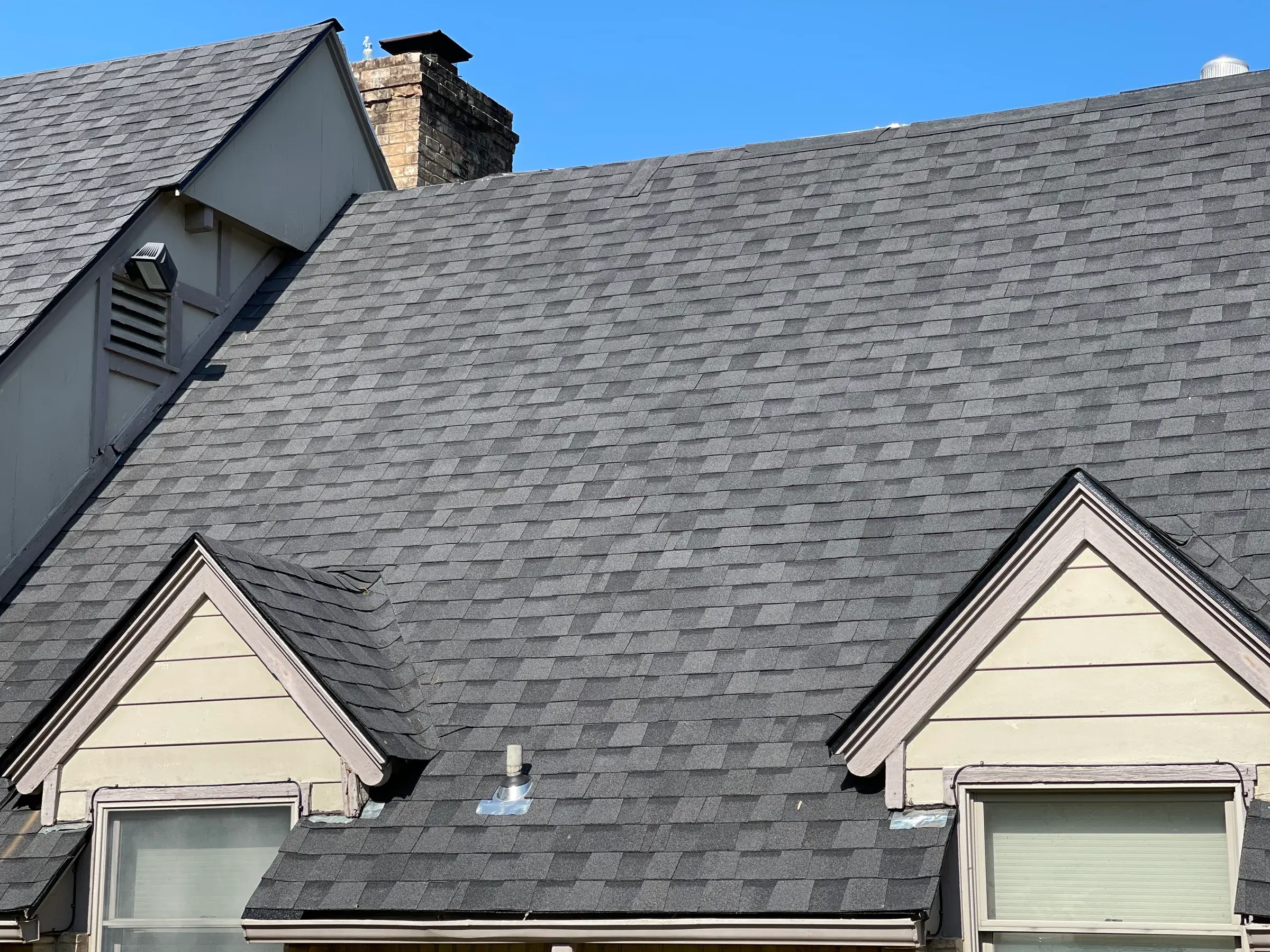
A storm chaser is a crew that follows hail into a market, signs volume, subcontracts the work, and leaves. The tell is not the license plate — it is verification. Check the contractor's Oklahoma registration with the Construction Industries Board, require a written contract, and never sign a blank or open scope on the porch.
Why northeast Oklahoma draws out-of-market crews after hail
The Oklahoma Climatological Survey puts Ottawa County at four to five days a year with hail larger than three quarters of an inch. That is not a freak event. It is a schedule, and companies that make their money on storm volume know it as well as your insurance agent does.
Geography does the rest. Ottawa County borders both Kansas and Missouri, so a single line of storms can generate claims in three states before dinner. Crews working a loss on one side of a state line are already on the road system that feeds Miami. Add the terrain split — the east side sits in the Ozark Plains, rocky and wooded, while the west is Neosho Lowlands prairie with open wind fetch — and you get two damage patterns close enough together to work in one trip.
The housing stock matters too. Ottawa County has 13,701 housing units and 76.7% of them are detached single-family homes, with another 12.2% mobile or manufactured. That is a dense, uniform target: drive one street, pitch one product. Median home value is $123,300 and median household income is $49,947, which means a wind-and-hail deductible is a real bite out of a real month. Anyone offering to make that bite disappear will get a hearing at the door. That is exactly why the offer gets made.
And roughly 13% of those units sit vacant — a lot of them second homes around Grand Lake o' the Cherokees. An owner who is not there is an owner who cannot watch the work, cannot count the crew, and will not see the roof again until spring.
What a storm chaser actually is — and why "out of town" alone isn't the tell
A storm chaser is a business model, not a license plate. The model is: follow the loss, canvass hard, sign as many contingency agreements as possible in a short window, hand the labor to whatever crew is available, get paid, move to the next weather event. Nothing in that sequence requires the company to still exist when your ridge cap starts backing out.
Here is the honest part. "From somewhere else" is a weak tell, and we would be the last people to pretend otherwise. We work across Oklahoma, Kansas, Missouri and Arkansas from one office on Main Street in Miami. To a homeowner in Baxter Springs, we are the out-of-town truck. Plenty of legitimate regional companies cross state lines after a storm because that is where the work is.
So stop grading the plate and start grading four things you can actually check: Is the company registered where it is standing? Is there a physical address you could drive to? Who is doing the work, and who carries the insurance on them? And what does the paper actually say — not what the person on the porch says it says? Every one of those is verifiable in an afternoon. Charm is not.
Verifying registration: how to look up an Oklahoma roofing contractor in five minutes
Oklahoma runs a public verification tool through the Construction Industries Board. It is at verifyroofing.cib.ok.gov, it is free, and almost nobody in this market tells homeowners it exists. It should be the first thing you do after someone hands you a card.
- Get the exact legal business name and the registration number off the card or the contract — not the name painted on the truck, which may be a brand rather than an entity.
- Open verifyroofing.cib.ok.gov and search the number, then search the name separately. They should return the same company.
- Check that the registration is active and current, not expired or lapsed.
- Confirm the address on the CIB record matches the address on the paperwork in your hand.
- If the number returns nothing, or returns a different company, stop. Do not sign anything and do not pay anything.
Registration is not a formality. To hold it for residential work, a contractor has to carry commercial general liability insurance of at least $500,000. That threshold is the whole point of the exercise: it is the difference between a company that has posted real coverage and a company that has posted a phone number.
What the law requires on their truck, their card, and their contract
This is the fastest screen available and it costs you nothing. Under 59 O.S. § 1151.17(C), an Oklahoma-registered roofing contractor's registration number has to appear on signage, business cards, correspondence, contracts and vehicles. All of it.
Which means the number should already be on the truck sitting in your driveway. If the truck is wearing a magnetic sign with a phone number and no registration number, you are not looking at a branding choice. You are looking at a company out of compliance with the statute that governs it — before it has even quoted you. A company that will not follow the easy rule in public has not earned your trust on the hard rules that happen in your attic.
Permits work the same way. The City of Miami requires a permit for new roofs and re-shingles. We pull it. If someone tells you a re-roof here does not need one, they are either wrong or hoping you are. The permit also does something quietly useful: it creates a public record tying a named contractor to your address, which is worth a great deal if the job goes sideways.
Verify before you sign — the five-minute version
- Registration number checked at verifyroofing.cib.ok.gov and returning an active record in the same legal name as the contract
- A physical street address in the record you could actually drive to — not a P.O. box, not a motel, not "we're staying in town for the season"
- The registration number visibly displayed on the vehicle, the card and the contract, as § 1151.17(C) requires
- Certificate of commercial general liability insurance — ask that the insurer or agent send it to you directly, not a PDF forwarded from the salesperson
- A written statement on workers' compensation coverage for the people who will physically be on your roof
- A written contract naming the material, the layers, the flashing, the decking allowance and the price — before any signature
- Confirmation in writing that the contractor pulls the City of Miami permit
- A straight answer to "who is doing the work — your employees, or a subcontractor?" and "whose insurance covers them?"
The contingency agreement and the "assignment of benefits" problem
Most porch paperwork after a storm is a contingency agreement: you agree to use this contractor if your insurer approves the claim. That is not automatically predatory. It is a normal way to sequence work around an unknown. The problem is what gets bolted onto it.
Read for three things. First, whether the document is actually a binding contract with a cancellation penalty rather than a conditional one. Second, whether it gives the contractor authority to speak or negotiate for you. Third, whether it assigns your insurance benefits to the contractor.
That last one matters enormously here, and it is where the state line bites. Under 36 O.S. § 1230, Oklahoma voids assignment of insurance benefits. No Oklahoma contractor can take over your benefits or "bill your insurance directly," and any paper that says so is not describing Oklahoma. Kansas, by contrast, permits contractor assignment subject to conditions. A crew working both sides of the border may well hand you the Kansas version of their form in an Oklahoma driveway. Check which state's law your contract is written under. It is usually one line near the bottom, and it tells you whether the company knows where it is standing.
So what is a contractor allowed to do? Quite a lot, actually. We document the damage with a dated photo report. We provide a written estimate for the work we would perform. We can meet your adjuster on site if you ask us to. We will help you understand the process — we walk through the whole sequence at /blog/oklahoma-roof-insurance-claim-process. What we will not do is stand between you and your insurer, because your insurer decides coverage under your policy, and Oklahoma is specific about who is allowed to argue that on your behalf.
Red flags: deductible offers, pressure to sign today, blank scopes, cash up front, no local address
| What you hear or see | Why it's a problem | What a legitimate contractor does instead |
|---|---|---|
| "We'll cover your deductible." "You'll pay nothing out of pocket." | 59 O.S. § 1151.30 makes it unlawful to advertise or promise to pay any part of a deductible. It also means the number on your estimate is not the real price of the work. | Quotes the actual price, tells you plainly that the deductible is yours, and puts both in writing. |
| "We'll handle the claim." "We'll fight the adjuster for you." | Under 36 O.S. § 6202(4) and § 6220(E) that is public adjusting. Unlicensed, it is a misdemeanour — and your signed authorization does not fix it. | Documents damage with a photo report, provides a written estimate for its own work, and meets the adjuster on site if you ask. |
| "This price is only good today." "The crew leaves tomorrow." | Manufactured urgency exists for one reason: to run out the clock on verification. | Leaves the estimate with you and expects you to look up the registration before you decide. |
| A blank scope, or "scope to be determined by insurance." | You have signed an open-ended obligation with no defined work and no price. | Names the material, the number of layers to remove, the flashing, the decking allowance and the price. |
| Cash, or a large deposit before materials are on site. | Money in hand is the leverage. Once it changes hands, so do your options. | Ties payment to milestones and expects to be paid for work actually performed. |
| Magnetic sign, no registration number on the vehicle. | § 1151.17(C) requires the registration number on vehicles, signage, cards, correspondence and contracts. Its absence is non-compliance, in public, on day one. | Displays the number and will read it out so you can check it yourself. |
| "A re-roof doesn't need a permit around here." | The City of Miami requires a permit for new roofs and re-shingles. | Pulls the permit, and says so in the contract. |
| A P.O. box, a motel, or no Oklahoma address at all. | In year three, there is nowhere to send a letter and nobody to receive it. | Gives you a street address you could drive to on a Tuesday. |
Your Oklahoma cancellation rights — including the 72-hour right if the claim is denied
This one gets described wrong constantly, including by people selling roofs, so be precise about it. Under 59 O.S. § 1151.21(A), if your insurer denies the claim in whole or in part, you may cancel the residential roofing contract within 72 hours of receiving that written notice of denial.
That is not a general cooling-off period. It does not mean you get three days to change your mind about any roofing contract for any reason. It is a specific escape hatch tied to a specific event: the denial. The trigger is the insurer's written notice, and the clock starts when you receive it. If you cancel under it, do it in writing, date it, and keep a copy of the denial letter with it.
The other half of § 1151.21 is the one nobody mentions on the porch: after that cancellation, the contractor has to tender back payments and deposits you have made. Keep every receipt from the first handshake forward. The paper trail is the right.
| Your right | Where it comes from | What to do with it |
|---|---|---|
| A written contract for residential roofing work | 59 O.S. § 1151.21 | Refuse verbal deals entirely. If the scope and price aren't on paper, there is nothing to enforce later. |
| The registration number on the contract, cards, signage and vehicles | 59 O.S. § 1151.17(C) | Read it off the paperwork and run it through verifyroofing.cib.ok.gov before you sign anything. |
| Proof of insurance before anyone climbs on your roof | CIB registration requires commercial general liability of at least $500,000 for residential work | Ask for the certificate and a written statement on workers' compensation. Ask that the insurer or agent send the certificate to you directly. |
| Cancel within 72 hours of written notice that your insurer denied the claim, in whole or in part | 59 O.S. § 1151.21(A) | Cancel in writing. Date it. Staple the denial letter to your copy. |
| Tender-back of payments and deposits after that cancellation | 59 O.S. § 1151.21 | Keep every receipt, including cash. Without them there is nothing to tender back against. |
| Assignment of insurance benefits is void in Oklahoma | 36 O.S. § 1230 | No Oklahoma contractor can take over your benefits or bill your insurer directly. If the contract says otherwise, put the pen down. |
Why the warranty on the paper is only as good as the company in five years
There are two warranties on a roof and they are not the same animal. The manufacturer's material warranty covers defects in the shingle itself, and it usually depends on the installation meeting the spec sheet. The workmanship warranty covers the installation — the part that actually fails — and it is a promise from a legal entity.
A promise from a legal entity is worth exactly as long as that entity exists and answers the phone. A twenty-five-year workmanship warranty from a company that dissolves in eighteen months is not a twenty-five-year warranty. It is a printed sentence. Storm-volume outfits are not usually built to last past the storm, and the paperwork does not disclose that anywhere.
So check the name. The legal entity on the contract should match the entity on the CIB record and the name on the truck. If those are three different things, ask why, and get the answer in writing. Then ask the question that actually matters: when a nail pop shows up in year five, who exactly do I call, and where do they physically work? A local roofer answers that in one sentence. Ours is on Main Street in Miami, and you can read how we got here at /about.
Questions that separate a real contractor from a sales crew
You do not need to be rude or clever. You need to be boring and specific. Salespeople are trained for objections, not for administrative questions with checkable answers.
At the door: what to say
- "What's your Oklahoma CIB registration number? I'll look it up while you're here." — A registered contractor reads it out. A chaser starts explaining.
- "What's your street address in Oklahoma?" — Not the corporate office three states away. The one here.
- "Are the people on my roof your employees or a subcontractor, and whose workers' comp covers them?" — Subs are not automatically a problem. Not knowing the answer is.
- "Will you pull the City of Miami permit in your name?" — The city requires one for new roofs and re-shingles.
- "Leave the estimate with me. I'm getting a second one and I'm not signing today." — This is the whole test. Watch what happens next.
- "Please don't touch the roof or lift any shingles until I've decided." — Nobody inspects what they haven't been hired to inspect.
- "Which state's law governs this contract?" — In an Oklahoma driveway, the answer is Oklahoma.
- If the pressure continues: "I'm not making a decision at the door. If you'd like to leave your card, I'll call you." Then close the door. You owe a stranger nothing beyond that sentence.
If you would rather not have that conversation at all, get ahead of it. Have a roof you already know the condition of. That is most of what a documented inspection buys you — our /services/roof-inspections page explains what we photograph and why, and /services/storm-damage-roof-repair covers what happens after hail actually lands. A homeowner holding a dated photo report from before the storm is a very difficult person to sell an imaginary problem to.
Where to file a complaint if it goes wrong
Oklahoma gives you real places to go, and using them takes less time than people assume. Where you file depends on what happened.
- Oklahoma Construction Industries Board — for the contractor's registration and conduct. 59 O.S. § 1151.14 sets out the grounds for a complaint against a registered roofing contractor. The CIB is also where an unregistered contractor gets reported.
- Oklahoma Attorney General, Consumer Protection Unit — the AG's office publishes guidance on post-disaster contractor fraud specifically, and takes consumer complaints on deceptive practices.
- Oklahoma Insurance Department — if the issue involves the claim itself, an adjuster, or someone adjusting without a license.
- Better Business Bureau — the BBB publishes post-storm contractor fraud guidance and keeps a complaint record that the next homeowner can read.
- Local law enforcement — if money was taken and no work was done, that is not a contract dispute.
File while you still have the paperwork, the photos and the dates. Complaints made a year later against a company that has already folded its tent are the hardest kind to act on, and the tent folds fast.
If someone knocked this week and you are not sure what you are looking at, we will come look at the roof and tell you what is actually up there — free, in writing, with photos, whether it is us doing the work or not. We are at 111 S Main St in Miami, we cover Ottawa County and out past Commerce, and you can reach us at (209) 758-8550. Ask us for our registration number when you call. We would rather you check it.
We are roofing contractors, not public adjusters or insurance attorneys. Coverage decisions are made by your insurer under your policy.
Questions people ask about this
Is it illegal for an out-of-state roofing company to work in Oklahoma?
No. Working across state lines is normal and legal — we do it ourselves from one office in Miami. What matters is whether the company holds a current Oklahoma roofing contractor registration with the Construction Industries Board, carries the required insurance, and follows Oklahoma law on the contract. You can check the registration yourself for free at verifyroofing.cib.ok.gov. The plate on the truck is not the test; the registration is.
Someone offered to waive or cover my deductible. Is that legal in Oklahoma?
No. Under 59 O.S. § 1151.30 it is unlawful to advertise or promise to pay any part of an insurance deductible, directly or indirectly. The statute was amended effective 1 November 2025 by HB 1257 to also prohibit offering an insured anything of value for a service, which covers yard-sign payments, referral fees and review incentives on insurance jobs. If the offer is made anyway, the money is coming out of the scope or the materials — and it tells you what else that company is willing to do.
What's the difference between a license and a registration in Oklahoma roofing?
Oklahoma does not license roofing contractors; it registers them through the Construction Industries Board. Registration for residential work requires commercial general liability insurance of at least $500,000. Kansas and Arkansas also use registration systems, and Missouri has no statewide roofing license at all. No state in this four-state area requires a surety bond for residential roofing, so any company advertising itself as "licensed and bonded in Oklahoma" is describing paperwork that does not exist.
I already signed something on my porch. Can I get out of it?
It depends on what happened next. Under 59 O.S. § 1151.21(A), if your insurer denies the claim in whole or in part, you may cancel within 72 hours of receiving that written notice of denial, and the contractor must tender back your payments and deposits. That right is tied to the denial — it is not a general three-day cooling-off period for any roofing contract. Outside of that, read the cancellation clause in the document itself, put any cancellation in writing, and contact the Construction Industries Board or the Attorney General's Consumer Protection Unit if the company will not release you.
Is it a bad sign if a contractor uses subcontractors?
Not by itself — plenty of established companies use subs, and we would rather be honest about that than pretend otherwise. What matters is that you get a straight answer to two questions: who will physically be on my roof, and whose workers' compensation covers them. A contractor who knows the answer and will put it in writing is in a different category from one who gets vague. Ask for the insurance certificate to come to you directly from the insurer or agent rather than as a forwarded PDF.